Operation Ring Stalingrad
Operation Ring was the final Soviet offensive designed to crush the encircled German forces at Stalingrad and bring the battle to a decisive end. It began on 10 January 1943 and concluded on 2 February 1943, resulting in the complete destruction of the German Sixth Army and marking one of the most catastrophic defeats in German military history. The operation was the culmination of the wider Soviet encirclement achieved earlier by Operation Uranus, which had trapped German forces inside the ruined city and its surrounding steppe.
The plan for Operation Ring was developed by the Soviet High Command, the Stavka, with major input from Georgy Zhukov and Aleksandr Vasilevsky, and was executed primarily by the Don Front under the command of Konstantin Rokossovsky. Unlike the earlier encirclement, which relied on maneuver warfare and armored breakthroughs, Operation Ring was conceived as a methodical annihilation of a trapped enemy through overwhelming firepower and incremental ground assaults. By January 1943, the Germans inside Stalingrad were exhausted, under-supplied, freezing, and increasingly demoralized, yet Adolf Hitler still forbade any attempt at breakout or surrender.
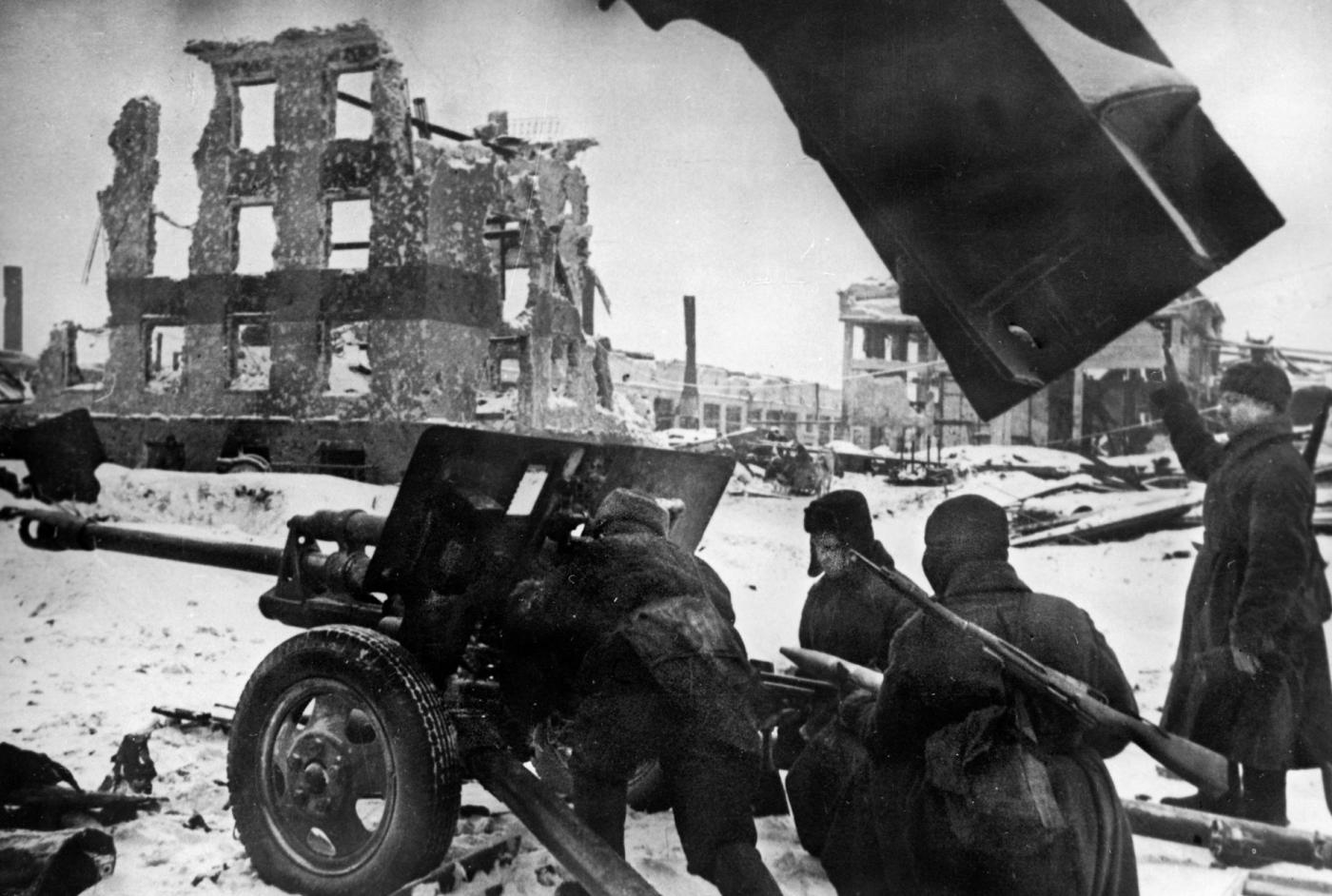
The operation opened with one of the most intense artillery barrages of the Second World War. Around 7,000 field guns, howitzers, mortars, and rocket launchers were concentrated along a relatively narrow front. On the morning of 10 January, this massive artillery force unleashed a devastating bombardment that lasted several hours, systematically smashing German defensive positions, command posts, supply dumps, and communication lines. The scale of the fire was unprecedented: entire sectors of the German line were obliterated, and survivors later described the ground shaking continuously as if struck by an earthquake. This artillery preparation reflected the Red Army’s growing mastery of fire coordination and its willingness to expend enormous resources to ensure success.
Following the barrage, Soviet infantry and armor advanced in tightly coordinated assaults, steadily compressing the German pocket. The German Sixth Army, commanded by Friedrich Paulus, attempted to form successive defensive lines, but each was shorter, weaker, and less cohesive than the last. German units were already suffering from extreme shortages of ammunition, food, fuel, and medical supplies. The Luftwaffe airlift, promised by Hermann Göring, had utterly failed to meet even a fraction of the army’s needs, and many soldiers were surviving on starvation rations while fighting in sub-zero temperatures.
As Operation Ring progressed, the Soviet forces split the encircled Germans into smaller and smaller pockets. By late January 1943, the Germans were divided into a southern group in the city center and a northern group around the tractor factory area. Soviet artillery continued to play a decisive role, pounding German positions at close range and preventing any meaningful regrouping. Tanks and assault guns were brought forward to fire directly into ruins that concealed German strongpoints, while infantry cleared buildings room by room.
German commanders reacted with a mixture of grim determination and growing despair. Paulus repeatedly informed Hitler that his army was on the verge of collapse and requested permission to surrender in order to save the remaining lives. Hitler not only refused but promoted Paulus to field marshal on 30 January 1943, a move widely interpreted as a signal that he was expected to commit suicide rather than surrender, since no German field marshal had ever been captured alive. Paulus ignored this unspoken expectation and chose surrender instead. On 31 January 1943, he capitulated with the southern group of the Sixth Army. The northern group, commanded by General Karl Strecker, held out for two more days before surrendering on 2 February 1943.
Operation Ring was completely successful in achieving its objectives. Approximately 90,000 German soldiers, including 22 generals, were taken prisoner, though only a small fraction would ever return to Germany. Well over 200,000 Axis troops had been killed, wounded, or captured during the entire Stalingrad campaign. The German Sixth Army ceased to exist as a fighting force, and its annihilation sent shockwaves through Germany and its allies. It was the first time an entire German field army had been destroyed and surrendered on such a scale.
Several striking facts underscore the significance of Operation Ring. The Soviet artillery concentration at Stalingrad became a model for later Red Army offensives, demonstrating the effectiveness of overwhelming firepower combined with methodical ground advances. Paulus, the first German field marshal ever captured, spent years in Soviet captivity and later testified against the Nazi leadership. For the Soviet Union, the victory became a powerful symbol of resilience and revenge, while for Germany it marked the definitive end of any realistic hope of victory on the Eastern Front. Operation Ring was not merely the final act at Stalingrad; it was a turning point that irrevocably shifted the balance of the war in favor of the Red Army.