Opel Blitz Truck
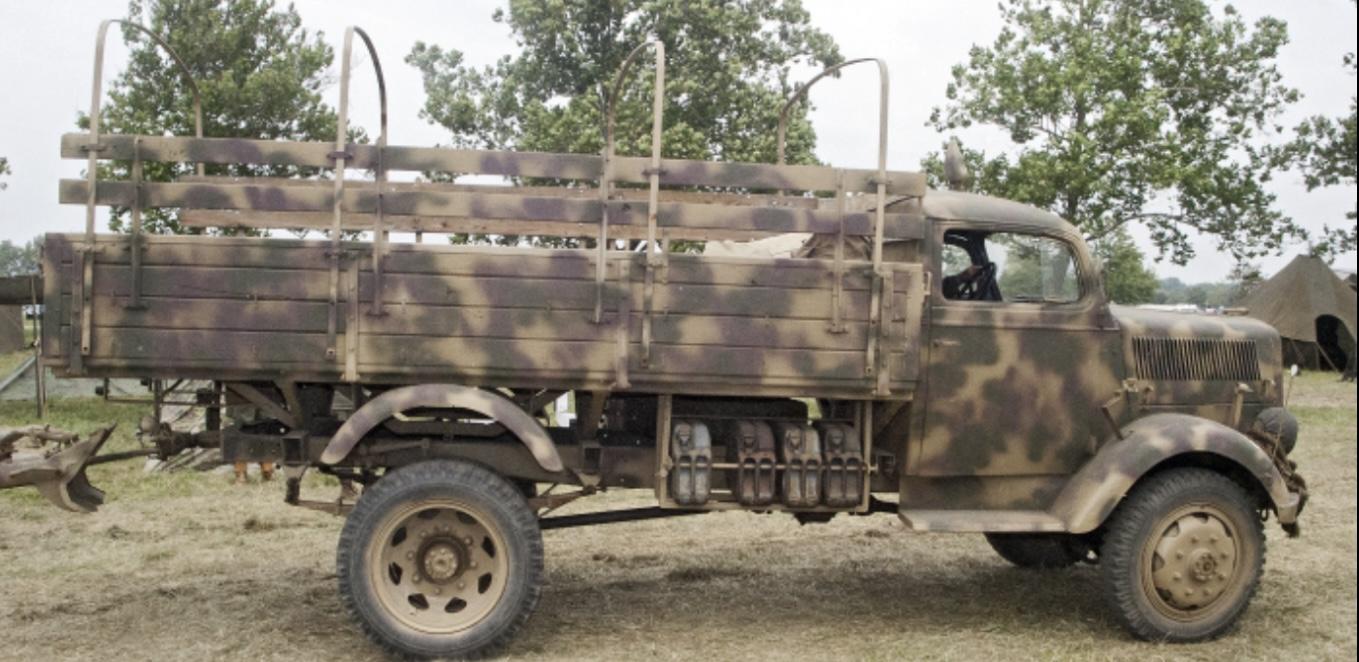
The Opel Blitz was one of the most important transport trucks of the Second World War, a machine that quietly kept the German war machine moving long after its early momentum had begun to fade. Introduced in the mid-1930s and mass-produced through multiple factories—most notably the Opel plant at Brandenburg and facilities in Rüsselsheim—it became the standard 3-ton truck of the Wehrmacht. Between 1937 and 1944 around 82,000 Opel Blitz trucks were built, not counting thousands more of related models and licensed variants assembled under different arrangements as the war situation worsened.
While the Blitz is most often remembered as the German military’s general-purpose workhorse, it also played a crucial role in refuelling operations. Tanks and armoured vehicles consumed immense quantities of fuel, and the Blitz became one of the primary vehicles used to deliver that fuel to the front. Many units used it loaded with stacks of 20-litre fuel containers—the famous Jerry cans that Germany invented and introduced in 1937. These cans were brilliantly designed: rugged, stackable, with three handles so a single soldier could pass them quickly hand-to-hand. Other Blitz trucks were factory-built or field-modified into fuel tankers, often referred to as Tankwagen, with cylindrical tanks mounted on the chassis. The Luftwaffe relied heavily on these tanker variants to refuel aircraft at forward airfields, where mobility mattered more than anything and infrastructure was often little more than a clearing in a forest.
The truck’s reliability was one reason it became so widespread. It had a 3.6-litre straight-six petrol engine that offered decent power, simple maintenance, and predictable performance in cold or dusty conditions. Its suspension was basic but strong enough for improvised roads, and the 4x2 layout—although not ideal for mud—was adequate for most logistical work behind the lines. Later in the war, Germany produced an all-wheel-drive variant, the Blitz A, but by then Allied bombing and industrial shortages had already begun to cripple production. The Brandenburg truck plant was destroyed in August 1944, forcing Germany to rely increasingly on less suitable replacements.
Despite its strengths, there were never enough Opel Blitz trucks to support Germany’s expanding fronts. The reasons were numerous and interconnected. Germany entered the war without the vast industrial base needed to support a long logistics war, and the Blitz, though excellent, could not make up for strategic miscalculations. The German high command focused heavily on tanks, aircraft, and weapons, while logistics vehicles—seen as mundane—were under-prioritised in funding and planning. As mechanised divisions raced ahead during early campaigns, the supply units struggled to keep up; a panzer division could burn through thousands of litres of fuel in a single day, yet the supply columns were often a thin line of overworked trucks vulnerable to breakdown, weather, and enemy action.
Fuel shortages were not just a matter of production but also distribution. Germany had limited access to oil and relied on synthetic fuel plants that were vulnerable to Allied bombing. Even when fuel existed, there were not enough dedicated tanker trucks to bring it forward. Jerry cans helped bridge the gap, allowing rapid distribution in small quantities, but this method was labour-intensive and inefficient when armoured units needed bulk refuelling. Some Blitz trucks could carry around 200 Jerry cans, but this still meant frequent resupply runs across increasingly dangerous routes.
Luftwaffe tanker units faced similar constraints. Blitz tankers were essential for keeping operational aircraft fuelled, especially in places like the Eastern Front where airfields were constantly shifting. But winter conditions, shortages of spare parts, and attrition reduced the number of serviceable vehicles. The Luftwaffe eventually resorted to using anything with wheels—captured trucks, horse carts, even improvised tractors—to keep aircraft running.
By 1944, Germany’s logistical chain had deteriorated so badly that even elite panzer divisions often had only a fraction of the transport trucks they needed. The Opel Blitz remained one of the few dependable vehicles left, but no amount of engineering could compensate for a collapsing supply apparatus. The Blitz’s story is ultimately a reminder that wars are not won by tanks alone. They are won by the ability to keep those tanks moving, and the German army—despite having one of the best medium trucks of the era—never built enough of them to sustain the vast, grinding campaigns it undertook.