Nebelwerfer
The german rocket mortar system of the second world war became infamous less for its size than for the unearthly, rising howl its projectiles made in flight. allied troops compared the sound to a dive-bomber or a screaming creature, and soon it gained nicknames like moaning minnie and screamin’ meemie. although the eerie wail suggested a purpose-built terror weapon, the noise was actually a side effect of the spin-stabilised rockets it used, whose angled exhaust ports created that unmistakable shriek.
the weapon was conceived by army engineers under the heer’s waffenamt and developed by rheinmetall-borsig, a company with long experience in artillery design. german interest in solid-fuel rockets grew during the 1930s, when treaty restrictions limited heavy gun development but did not address these new systems. the first major model, the 15 cm nbw 41, appeared in 1940 and soon formed the core of dedicated rocket regiments.
production was shared among several arms manufacturers, with rheinmetall-borsig as the chief designer. thousands of launchers of all calibres were built from 1940 to 1945, with rocket manufacture reaching into the millions. over 6,000 units of the initial 15 cm pattern were made, while the larger 21 cm and 30 cm types were produced in lower but still substantial numbers.
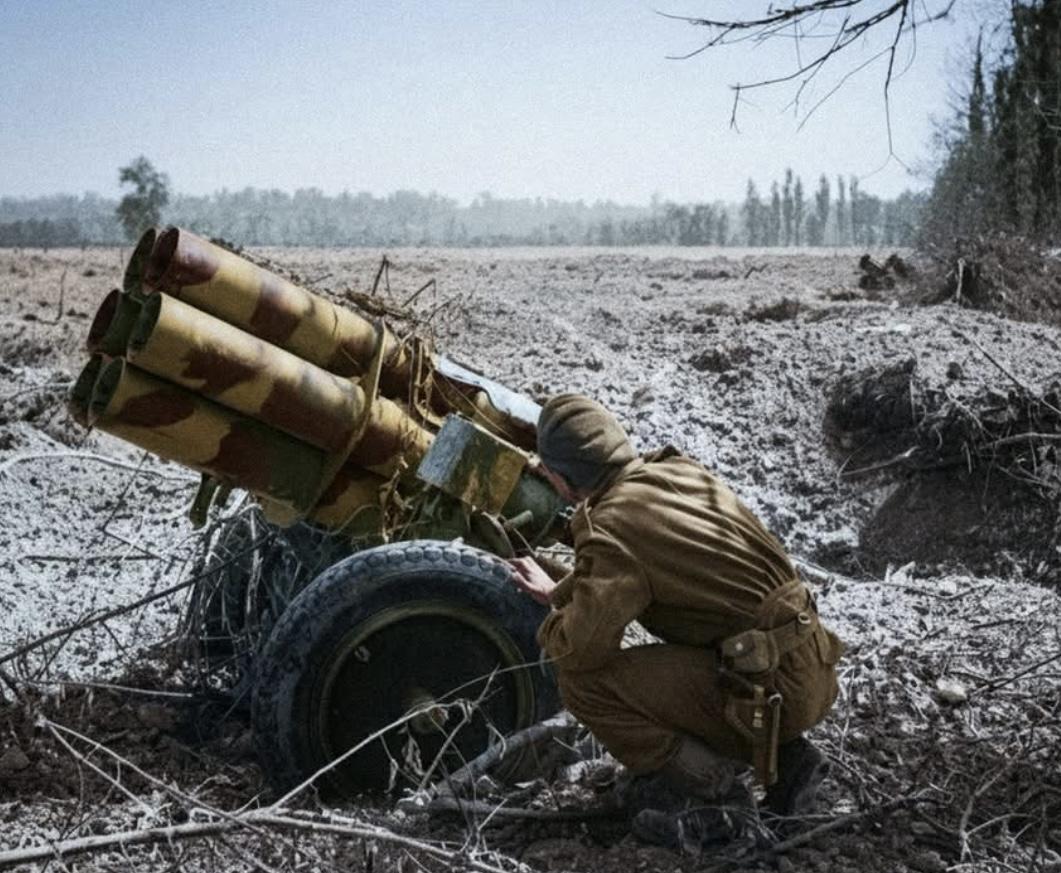
the rockets were unusual in that they used tubes rather than rails and relied on angled venturi nozzles for spin stabilisation instead of fins. this design created the piercing howl that made the system so feared. the standard 15 cm projectile, the wgr.41, weighed about 34 kilograms and carried roughly 2.5 kilograms of explosive. the heavier 21 cm wgr.42 packed around 28 kilograms of filler, while the massive 30 cm model delivered about 45 kilograms. smoke and incendiary rounds were also produced, reflecting the smoke-laying origins of the units that first operated the weapon.
in performance terms, the 15 cm launcher could reach nearly 7 kilometres, while the 21 cm variant stretched to around 8 kilometres. accuracy was far below that of conventional guns, but this mattered little for an area-saturation weapon designed to break up positions, shake troop morale and devastate strongpoints. crews typically fired all six rockets in quick succession and immediately shifted position, as the huge backblast cloud revealed their firing point to anyone watching.
the system’s mobility and simplicity were among its strengths. mounted on a light field-gun carriage, it could be towed by trucks or half-tracks, and many rockets were adapted for use on makeshift racks or on armoured half-tracks in the schwerer wurfrahmen arrangements. the soviets examined captured examples, though their own katyusha designs followed a different path based on fin-stabilised, rail-launched rockets.
although it represented only a fraction of germany’s overall artillery output, this rocket mortar left a deep psychological mark on the battlefield. veterans repeatedly described its wailing salvo as one of the most disturbing sounds of the war. despite its scatter and limited precision, its ability to unleash concentrated bursts of explosive power kept it in service to the final days of the conflict, ensuring its place as one of the era’s most memorable weapons.