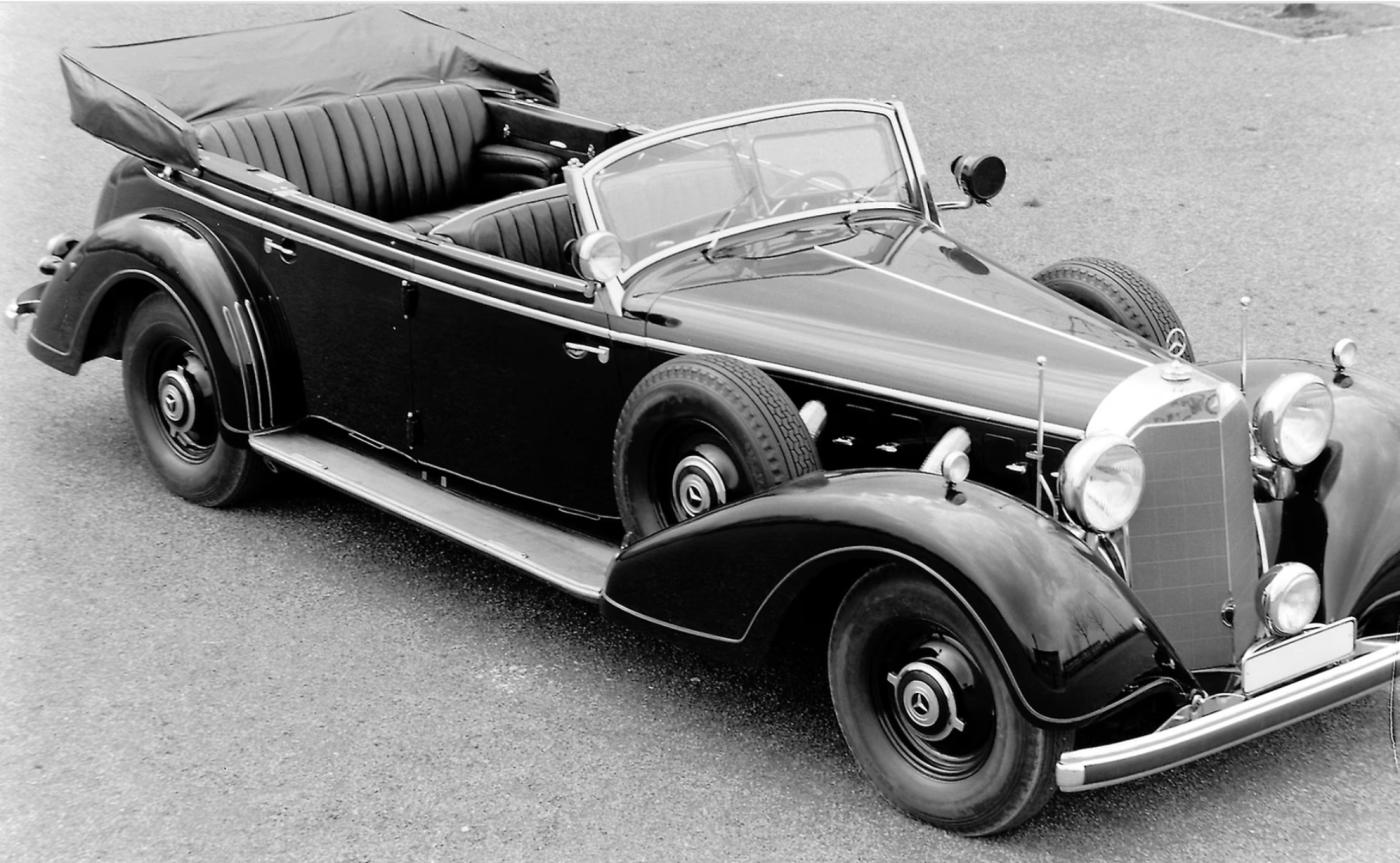
Mercedes w150
Mercedes-Benz supplied some of its most imposing and symbolically charged vehicles to the leadership of the Third Reich through the second-series Großer Mercedes 770, known internally as the W150. Developed from 1938 onward, the W150 was not simply a luxury automobile but a machine well suited to the political theater of the Nazi state. Its sheer size, height, and commanding stance made it ideal for ceremonial use, particularly in open or partially open forms that allowed senior figures to be seen by crowds during parades, state visits, and orchestrated public appearances.
The W150 was an evolution of the earlier W07 770, redesigned with a longer chassis and significantly greater weight capacity. It was powered by a large inline-eight engine with supercharging available, producing immense torque. This mattered because many of the cars were fitted with heavy coachwork, armor, and thick glass, yet still needed to move smoothly at low speeds through urban streets while projecting effortless authority. In open touring or convertible limousine form, the vehicle became a moving platform from which power was displayed rather than transported.
Open-top W150s became closely associated with Nazi leadership, most famously with Adolf Hitler, although they were also used by other senior figures and state offices. The “open” configuration could take several forms: full touring bodies with no permanent roof, cabriolets with folding tops, or large convertible limousines where only the rear passenger compartment could be opened. These configurations balanced visibility and control. The leader could be seen and could perform gestures to the crowd, while the car’s mass, its escorts, and its engineering reinforced distance and dominance.
Production numbers for the Großer Mercedes 770 are small by any standard. Across both major series built between 1930 and 1944, a total of about 205 cars were produced. Of these, 88 were W150 models. All of the open-top parade cars associated with the Third Reich came from this group of 88 chassis. Surviving records and secondary histories do not reliably break down how many of those 88 were built specifically as open tourers or convertible limousines, but it is clear that they represented a minority within an already tiny production run, making each example highly distinctive and politically charged.
The relationship between Mercedes-Benz, formally Daimler-Benz during the period, and the Nazi state went far beyond supplying a handful of prestige vehicles. As Germany rearmed and mobilized for total war, Daimler-Benz became deeply integrated into the wartime economy. The company produced aircraft engines, trucks, and other military equipment essential to the war effort. As labor shortages intensified due to conscription and casualties, Daimler-Benz factories increasingly relied on forced labor.
From the early 1940s onward, Daimler-Benz used large numbers of foreign civilian forced laborers, prisoners of war, and concentration camp inmates in its plants. These workers were deployed under coercive conditions, often housed in camps adjacent to factories, subjected to harsh discipline, inadequate food, and dangerous working environments. Historical studies estimate that by 1944 tens of thousands of forced laborers were working across Daimler-Benz operations. This labor directly supported the production of military vehicles and engines and indirectly sustained prestige projects such as the continued maintenance and modification of high-ranking officials’ cars.
The W150 therefore sits at an uncomfortable intersection of engineering excellence, political symbolism, and moral compromise. As an object, it represents the peak of prewar German automotive craftsmanship. As a historical artifact, it is inseparable from the regime that used it as a prop of authority and from the industrial system that, while capable of extraordinary technical achievements, was also complicit in exploitation and mass suffering. Understanding how Mercedes-Benz supplied and produced these open-top cars requires not only counting chassis and describing coachwork, but also acknowledging the broader context of collaboration, coercion, and human cost that underpinned their existence.