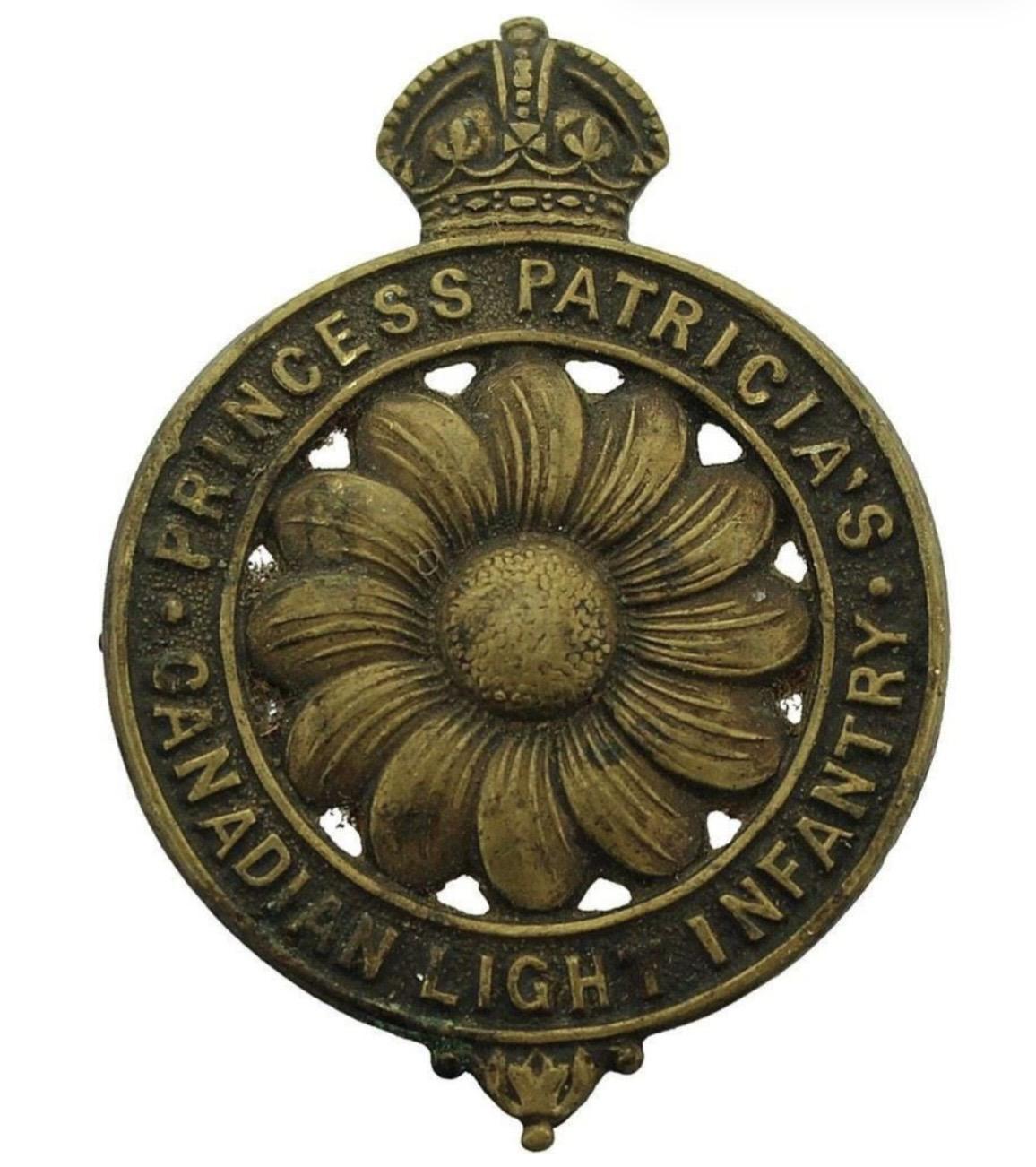
Princess Patricia’s Canadian Light Infantry
Princess Patricia's Canadian Light Infantry was formed at the very beginning of the First World War. The regiment officially came into existence on 10 August 1914, just days after Britain declared war on Germany. Its creation was made possible by Captain Andrew Hamilton Gault, a wealthy Montreal businessman and militia officer, who offered $100,000 of his own money to raise and equip a battalion for overseas service. Because of this private funding, it became the last privately raised regiment in Canadian military history.
The regiment was named in honour of Princess Patricia of Connaught, the daughter of the Governor General of Canada, the Duke of Connaught. Princess Patricia took a deep personal interest in the unit. She designed and hand-embroidered the original regimental colour known as the Ric-A-Dam-Doo, a unique crimson silk flag that accompanied the regiment overseas and into battle. The motto Ric-A-Dam-Doo roughly translates from Gaelic as “cloth of thy mother,” symbolizing the regiment’s bond with its royal patron.
The first commanding officer was Lieutenant-Colonel Francis Farquhar, a British Army officer serving on the Governor General’s staff in Ottawa. Approximately 1,098 men were accepted into the battalion, although more than 3,000 applied. These men became known as the “Originals.” They were recruited from across Canada and also from Britain. Many were veterans of previous service in the British Army or Canadian militia. The ranks included cowboys from the West, trappers and prospectors from the North, clerks, students, labourers, police officers, and adventurers. Because so many had prior military experience, the regiment quickly developed a reputation for professionalism and discipline.
Training began in Ottawa in August 1914. By late September the regiment sailed from Montreal to England, arriving in October. After additional training on Salisbury Plain, they were sent to France in December 1914. On 21 December 1914, they became the first Canadian infantry unit to arrive on the Western Front. In early January 1915 they entered the trenches near Ypres in Belgium.
One of their earliest and most devastating engagements came during the Second Battle of Ypres in May 1915, particularly at the Battle of Frezenberg. Facing intense German assaults, artillery bombardment, and poison gas attacks, the Patricias suffered catastrophic losses. Of roughly 700 men who went into the line, only about 150 remained fit for duty after several days of fighting. Nearly all senior officers were killed or wounded, and at one point the battalion was commanded by a lieutenant. Their stubborn defence helped delay the German advance and earned the regiment a lasting reputation for tenacity.
Throughout the First World War, the regiment fought in many of the major engagements involving Canadian forces, including Mount Sorrel in 1916, the Somme later that year, Vimy Ridge in April 1917, Passchendaele in 1917, and the Hundred Days Offensive in 1918, including Amiens and the advance to Mons. By the end of the war, the Originals had been almost entirely replaced by reinforcements due to the enormous casualties sustained.
After the war, the wartime battalion was disbanded in 1920, but the regiment itself was retained as part of Canada’s Permanent Active Militia, making it one of the country’s few regular force infantry regiments. It was again mobilized for service in the Second World War. In 1939 the regiment sailed for Britain and later participated in the Allied invasion of Sicily in July 1943 and the Italian campaign. In 1945 it moved into Northwest Europe as the war in Italy concluded.
During the Korean War, the regiment expanded to three battalions. The 2nd Battalion was among the first Canadian units deployed to Korea in 1950. In April 1951, the regiment fought at the Battle of Kapyong, where it helped halt a major Chinese offensive. For its actions there, the regiment received the United States Presidential Unit Citation, a rare honour for a Canadian unit.
In the decades that followed, Princess Patricia’s Canadian Light Infantry served in numerous peacekeeping missions and later in Afghanistan in the early 21st century. Over its long history, more than 1,800 members of the regiment have lost their lives in service. Today, the regiment remains an active and vital part of the Canadian Army, with battalions based primarily in Western Canada, continuing a tradition that began in August 1914 with a privately funded battalion of determined volunteers who quickly proved themselves in the harshest conditions of modern warfare.