Mein Kampf
Mein Kampf, meaning “My Struggle,” is the book Adolf Hitler wrote that became the central ideological work of Nazism. It was part autobiography and part political manifesto, describing how he viewed the world, his hatred of Jews and political enemies, and the goals he believed Germany should pursue. The book later became one of the most widely distributed political texts of the twentieth century because it was promoted heavily once Hitler came to power.
Hitler began writing the book in 1924 while imprisoned in Landsberg Prison in Bavaria. He had been arrested after the failed Beer Hall Putsch, an attempted coup in Munich in November 1923 where he and his supporters tried to overthrow the German government. He was sentenced to five years for treason but served only about nine months. During this time he dictated much of the book to his associate Rudolf Hess, who typed and organized the text while Hitler developed the arguments and narrative.
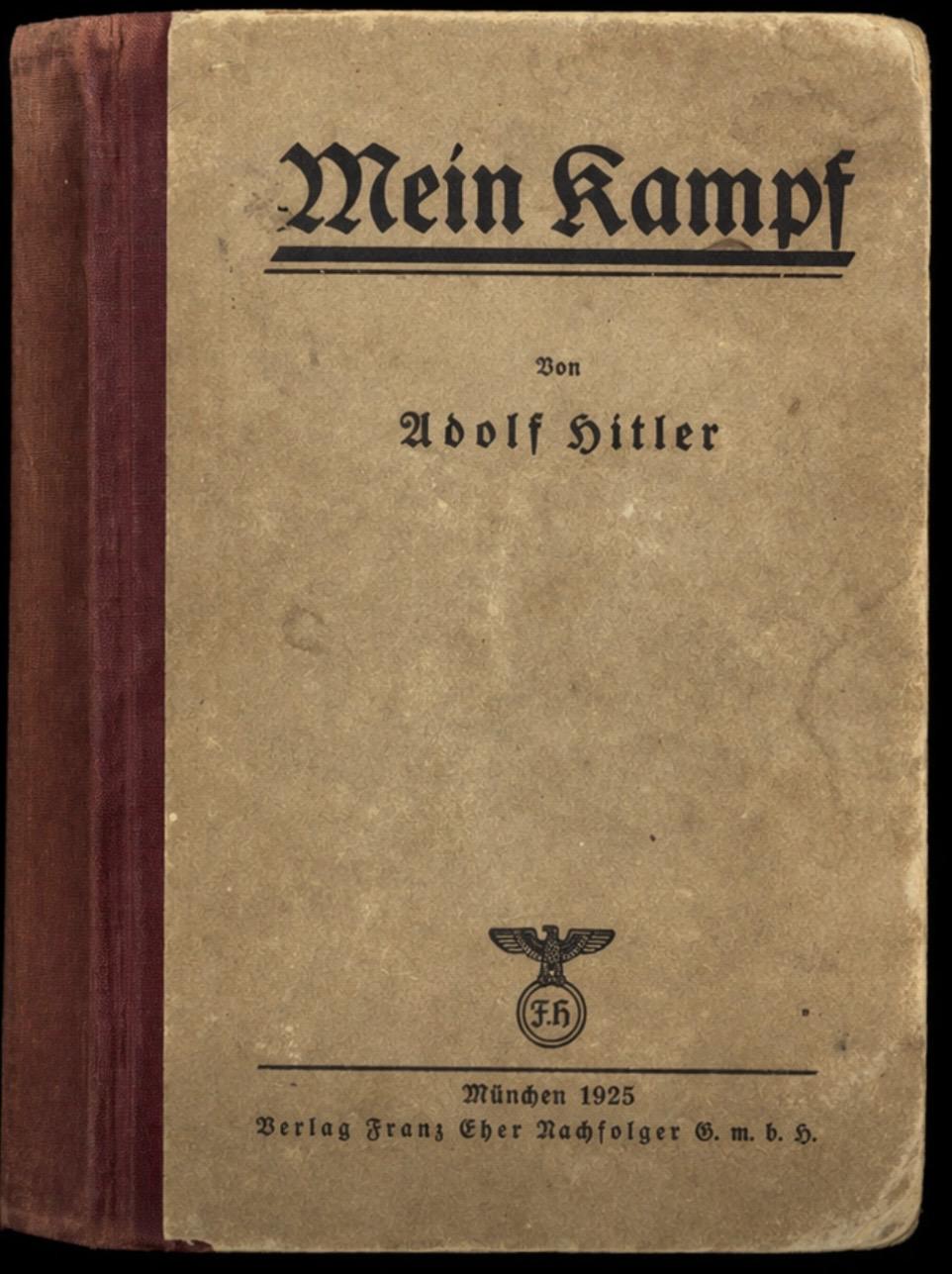
The work was published in two volumes. The first appeared in July 1925 and the second in 1926. Originally Hitler intended the title to be extremely long and descriptive, something closer to “Four and a Half Years of Struggle Against Lies, Stupidity and Cowardice,” but the publisher shortened it to the simple title Mein Kampf.
The early sales were modest. During the late 1920s the book sold only a few hundred thousand copies and was far from a bestseller. At that stage Hitler was still a fringe political figure and the Nazi Party had limited influence. However, once he became Chancellor of Germany in 1933 the book’s circulation increased dramatically. The Nazi state actively promoted it as the ideological foundation of the regime. Copies were frequently given as official gifts by the government. Newly married couples often received one from local authorities and civil servants or soldiers were sometimes presented with copies. By the late 1930s millions had been printed and distributed across Germany and other countries.
By the time the Second World War began more than five million copies had been sold, and by the end of the war over twelve million copies were in circulation in numerous languages. It was translated widely across Europe and even in countries outside Germany. In Nazi Germany it became almost symbolic of loyalty to the regime.
The book itself mixes Hitler’s personal history with his political theories. In the early chapters he describes his youth in Austria, his years living in Vienna, his experience as a soldier during the First World War, and the political upheaval in Germany after the war. He portrayed Germany’s defeat in 1918 as a betrayal rather than a military failure and blamed various political groups for what he called the country’s humiliation.
Central to the book are several ideological beliefs that later shaped Nazi policies. One of the most prominent is his idea of racial hierarchy. Hitler argued that humanity was divided into competing races and that the so-called Aryan race was superior and responsible for civilization and progress. According to his worldview, other groups were inferior and threatened the survival of Germany.
His antisemitism runs throughout the book. Hitler claimed that Jews were responsible for many of the political, economic, and cultural problems he believed Germany faced. These claims were built on conspiracy theories and long-standing antisemitic ideas that had circulated in Europe for decades. In the book he portrayed Jews as manipulating finance, politics, and culture in ways he claimed weakened nations. These ideas later became the ideological justification for the persecution of Jews under the Nazi regime.
Another major belief expressed in the book is extreme nationalism. Hitler argued that all Germans should be united into one powerful state and that Germany needed to recover from what he saw as the humiliation of the Treaty of Versailles, which had imposed territorial losses and heavy reparations after the First World War.
He also wrote about the concept of Lebensraum, meaning “living space.” Hitler believed Germany needed to expand eastward into Eastern Europe to gain land and resources for its population. This idea later influenced the expansionist policies and invasions that occurred during the Second World War.
The book also reveals his belief in authoritarian leadership. Hitler rejected parliamentary democracy, arguing that a nation should be led by a single powerful leader whose authority was absolute. This concept later became known as the Führer principle and defined the structure of Nazi rule.
Another theme in the book is propaganda. Hitler wrote extensively about how propaganda should influence large populations. He believed political messaging needed to be simple, emotional, and repeated constantly so that it would shape public opinion. These ideas later shaped the propaganda system developed by the Nazi government.
Although the book is not considered well written by literary standards, it became extremely influential because it outlined many of the ideas that later defined Nazi Germany. Historians often point out that much of what Hitler eventually did as dictator had already been described or hinted at in the book years earlier.
Financially the book helped Hitler significantly. Even before he took power the royalties provided him with a steady income. After becoming leader of Germany the massive sales generated enormous profits, making him personally wealthy.
After Hitler’s death in 1945 the copyright for the book passed to the German state of Bavaria. For many decades the state refused to allow it to be republished in Germany in order to prevent its use as Nazi propaganda. When the copyright expired in 2016, a heavily annotated academic edition was released with extensive historical commentary explaining and criticizing the text.
The book is still available today in many countries and is studied mainly by historians, researchers, and students examining the origins of Nazi ideology. Some retailers have restricted sales, but copies remain accessible through libraries, academic publications, and online archives.
Original copies from the 1920s and 1930s have become collectible historical artifacts. Early editions printed before the Nazi takeover of Germany are especially sought after by collectors. Typical early copies can sell for several hundred to several thousand pounds depending on their condition.
Signed copies are far rarer and significantly more valuable. Authentic examples bearing Hitler’s autograph have appeared at auctions and private sales for tens of thousands of pounds. Prices often range between about twenty thousand and sixty thousand pounds, though exceptional examples with strong historical provenance can sell for even more.
Despite its continued availability, the book today is primarily regarded as a historical document illustrating the ideology that contributed to the rise of Nazi Germany and the events that followed during the Second World War.