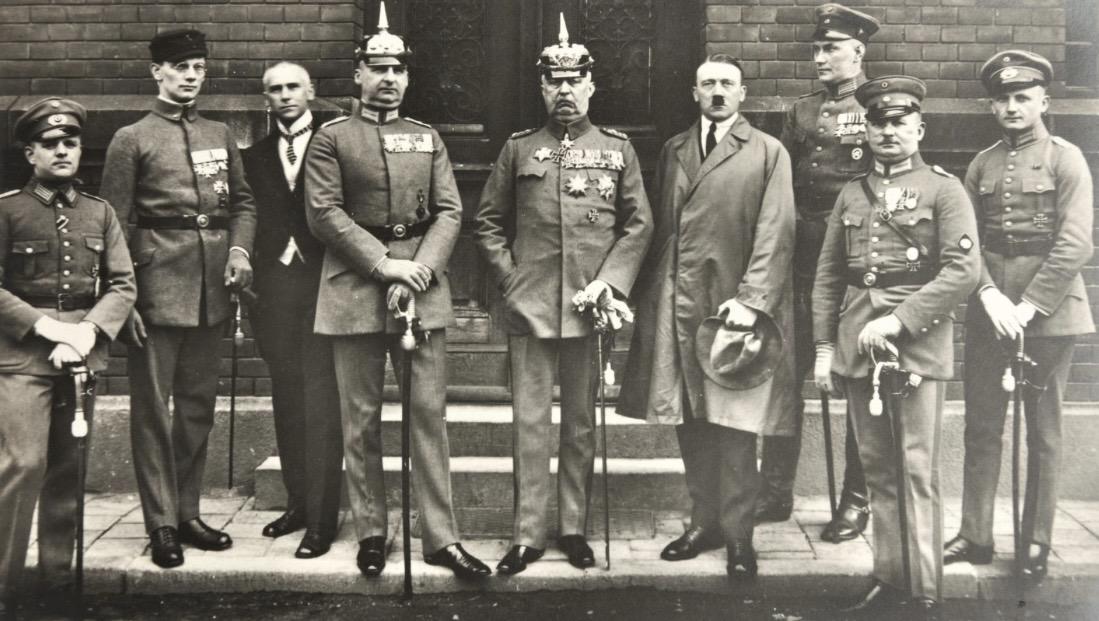
Hitlers 1924 Trial
On 1 April 1924 Adolf Hitler was convicted of high treason by the Bavarian People’s Court in Munich following his role in the failed Beer Hall Putsch of November 1923. The trial had begun on 26 February 1924 and quickly became one of the most widely reported court cases in Germany at the time. The presiding judge was Georg Neithardt, a Bavarian judge known for holding strong nationalist views. Hitler and several of his associates were charged with attempting to overthrow the government of the Weimar Republic by force.
The charges stemmed from the events of 8–9 November 1923 when Hitler and members of the Nazi Party attempted to seize power in Munich. The uprising began at the Bürgerbräukeller beer hall where Bavarian government leaders were attending a meeting. Hitler burst into the hall with armed supporters and declared that a national revolution had begun. He hoped that the Bavarian authorities and the army would support his plan to march on Berlin and overthrow the national government.
The following day Hitler and his supporters marched through Munich in what they hoped would become a mass uprising. Instead they were confronted by armed police near the Feldherrnhalle monument in the city centre. Shots were fired and the confrontation lasted only a short time, but it left fourteen Nazi supporters and four policemen dead. The coup collapsed almost immediately and Hitler fled the scene. He was arrested two days later and charged with high treason.
The trial that followed turned into a huge public spectacle. Hitler used the courtroom as a platform to deliver long political speeches defending his actions. Instead of denying his role he openly admitted responsibility and claimed that he had acted out of patriotism to save Germany. He blamed the Weimar government for the country’s problems and attacked the Treaty of Versailles. His speeches were widely reported in newspapers across Germany and the trial gave him far more publicity than he had ever received before.
When the verdict was delivered on 1 April 1924 Hitler was found guilty of high treason. The court sentenced him to five years imprisonment. However the sentence was not the harsh punishment that might have been expected. The judges imposed what was known as “fortress confinement”, a special category of imprisonment used in Germany for political offenders. Prisoners under this system did not have to perform hard labour and were usually held in much more comfortable conditions than ordinary criminals.
Hitler was sent to Landsberg Prison, located in the Bavarian town of Landsberg am Lech. The prison itself was a large fortress-like building overlooking the town. Although it was technically a prison the conditions for Hitler and his fellow conspirators were unusually relaxed. He was given a large cell with a desk and good lighting where he could read and write. Guards treated him with a surprising degree of respect and many of them sympathised with his nationalist political views.
He was allowed to receive many visitors and correspond freely with supporters outside the prison. Friends and followers regularly came to see him and sometimes even brought gifts or food. Other imprisoned participants of the failed coup were housed in the same prison and they often gathered together for discussions about politics. Some prisoners even acted as helpers for Hitler and brought meals to his room.
During his time in prison Hitler spent much of his day reading, discussing politics and dictating his ideas for the future. The most important work he carried out during this period was writing the book Mein Kampf. He did not actually type it himself but dictated large sections of it to his close associate Rudolf Hess, who was imprisoned with him. The book combined Hitler’s personal story with his political ideology and his ideas about Germany’s future.
While in Landsberg he also began thinking about how the Nazi movement should change its strategy. The failure of the Beer Hall Putsch convinced him that trying to seize power through a violent uprising would not succeed. Instead he decided that the movement would attempt to gain power legally through elections and political influence. This decision would later become an important part of the Nazi Party’s strategy in the years that followed.
Although Hitler had been sentenced to five years imprisonment he did not serve anywhere near that length of time. Under German law prisoners who behaved well could apply for early release after only a short period. Hitler’s behaviour in prison was considered orderly and cooperative. In addition many officials in Bavaria viewed him as a nationalist rather than a dangerous criminal and were sympathetic to his political ideas.
Because of this combination of legal rules and political sympathy Hitler was granted early release. After serving only about nine months of his sentence he was freed from Landsberg Prison on 20 December 1924. By the time he walked out of the prison gates he was far better known across Germany than he had been before his arrest.
Instead of ending his political career the trial and imprisonment had the opposite effect. The publicity from the courtroom speeches had made him a national figure and his time in prison allowed him to organise his ideas and plan the future of the Nazi movement. What had begun as a failed coup and a criminal trial ultimately helped shape the next phase of his political rise.