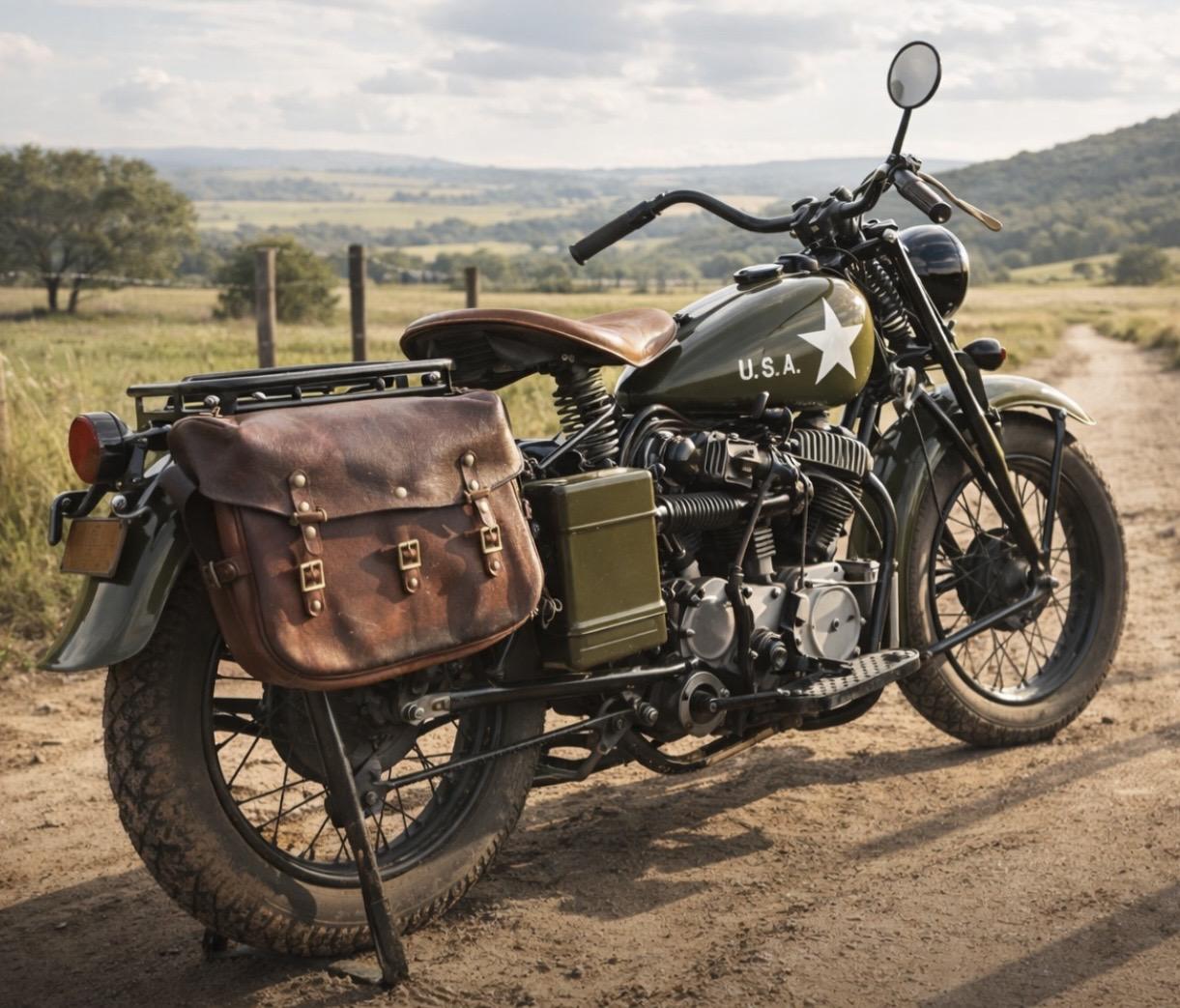
Indian 741 Motorbike
The Indian 741 military motorcycle was one of the principal machines produced by the American Indian Motorcycle Company during the Second World War. Built at the company’s long-established factory in Springfield, Massachusetts, it became the most numerous Indian motorcycle used in wartime service and was widely supplied to Allied forces. Although the larger Harley-Davidson WLA is usually remembered as the classic American military motorcycle, the Indian 741 served in great numbers with British, Commonwealth and other Allied armies throughout the conflict.
The design of the motorcycle was derived from the famous Scout line that had been created for Indian earlier in the twentieth century by engineer Charles B. Franklin. Franklin’s Scout design was compact, reliable and relatively light compared with many other motorcycles of its era. By the late 1930s the Indian company adapted one of the smaller civilian Scout models, known as the Thirty-Fifty, into a military machine suitable for dispatch riding and general army transport duties. The resulting motorcycle was designated the Model 741.
Development began shortly before the outbreak of war in Europe, at a time when foreign purchasing commissions were seeking military equipment from American manufacturers. The British Purchasing Commission in particular required a dependable motorcycle that could be used for communication duties. Indian engineers therefore modified the civilian Scout to meet military requirements, strengthening certain components, simplifying equipment and adapting it for rugged service conditions.
The motorcycle used a 30.5 cubic inch, or roughly 500 cubic centimetre, air-cooled side-valve V-twin engine. This engine was deliberately tuned for reliability rather than speed and produced around fifteen horsepower. While modest in output, the motor was durable and easy to maintain in the field, which was a critical requirement for wartime equipment. Fuel was supplied through a Linkert carburettor and ignition was by battery and coil.
Power was transmitted through a three-speed gearbox operated by a hand shift mounted on the side of the fuel tank. The clutch was foot operated, which was typical of American motorcycles of the period. Riders controlled the throttle with a twist grip on the handlebar. These controls required some familiarity but once mastered they allowed reliable operation in a wide variety of conditions.
The motorcycle had a rigid frame and a girder-type front fork. Suspension at the rear was provided only by the sprung saddle rather than by a full rear suspension system. This was standard for motorcycles of the era and helped keep the machine mechanically simple and durable. The Indian 741 weighed roughly 450 pounds and was capable of reaching speeds of about sixty to sixty-five miles per hour on good roads. It also had relatively good ground clearance so it could travel over rough tracks and uneven terrain.
Production of the Indian 741 began in 1939 and continued until about 1944. During this period more than thirty thousand examples were manufactured. Unlike many American military motorcycles, most of these machines were not used by the United States Army itself. Instead they were supplied to Allied nations under wartime aid programmes. Britain and the nations of the Commonwealth received large numbers of them, and they were also sent to countries such as Canada, Australia and New Zealand. Thousands were shipped to the Soviet Union as part of Allied support during the war.
The motorcycle’s main role was as a dispatch or courier machine. Before reliable portable radios became common, armies depended heavily on dispatch riders to carry written messages between headquarters, units and command posts. Riders could move quickly along roads or tracks and often reached locations that were difficult for larger vehicles. The Indian 741 was also used for reconnaissance patrols, escort duties, traffic control and liaison work between formations. Military police units frequently used these motorcycles to escort convoys or regulate road traffic during large troop movements.
Compared with the larger 750 cc American military motorcycles used by U.S. forces, the Indian 741 had both advantages and limitations. Its smaller engine made it lighter and more economical on fuel, which was valuable in long campaigns where fuel supplies were limited. On the other hand it had less power, which meant it was not well suited for carrying heavy loads or pulling sidecars. As a result it was primarily used for solo riding in communication roles rather than as a multipurpose military vehicle.
At the end of the war thousands of these motorcycles were declared surplus and sold off to civilians at very low prices. Many former dispatch bikes were bought by returning servicemen or by civilian riders who needed inexpensive transport in the difficult post-war years. Some were converted for normal road use, while others were dismantled for parts or modified for racing and custom motorcycles. Because the engines were strong and simple, they were often adapted for amateur competition machines and speedway racing.
Today the Indian 741 is regarded as one of the classic military motorcycles of the Second World War. Surviving examples are increasingly valued by collectors and restorers, especially those that retain their original military equipment such as blackout lights, luggage racks and olive drab paint. Machines that have been carefully restored to their wartime appearance often appear in military vehicle shows and historical displays.
Collector values vary depending on condition, originality and completeness. A motorcycle that has been heavily modified or only partially restored may sell for roughly fifteen thousand pounds or dollars equivalent. Well restored military examples with correct equipment can command significantly higher prices, sometimes reaching twenty-five thousand or more at specialist auctions or vintage motorcycle sales. Original machines with documented wartime history are particularly desirable among collectors.