On this day in military history…
Operation Iceberg was the codename for the Allied invasion of the Japanese island of Okinawa during the Second World War. The operation began on 1 April 1945 and took place on Okinawa in the Ryukyu Islands, about 350 miles south of the Japanese home island of Kyushu. It became the largest amphibious assault in the Pacific War and one of the bloodiest battles fought by the United States against Japan. The goal of the operation was to capture Okinawa and use its airfields and harbours as a base for bombing Japan and preparing for a possible invasion of the Japanese mainland.
Overall command of the American forces in the Pacific belonged to Admiral Chester W. Nimitz, the Commander in Chief of the United States Pacific Fleet. The naval forces involved in Operation Iceberg were part of the U.S. Fifth Fleet commanded by Admiral Raymond A. Spruance. The powerful carrier task forces that protected the fleet were commanded by Vice Admiral Marc A. Mitscher. The land invasion itself was carried out by the United States Tenth Army under Lieutenant General Simon Bolivar Buckner Jr.
The Japanese defence of Okinawa was organised by General Mitsuru Ushijima, commander of the Japanese 32nd Army. His chief of staff was General Isamu Cho, while Colonel Hiromichi Yahara served as the army’s main strategist. Instead of trying to stop the Americans at the beaches, Ushijima decided to let them land and then fight a long defensive battle from heavily fortified positions in the south of the island. Japanese troops dug deep caves, tunnels, and bunkers into the hills and limestone ridges, turning the terrain into a natural fortress.
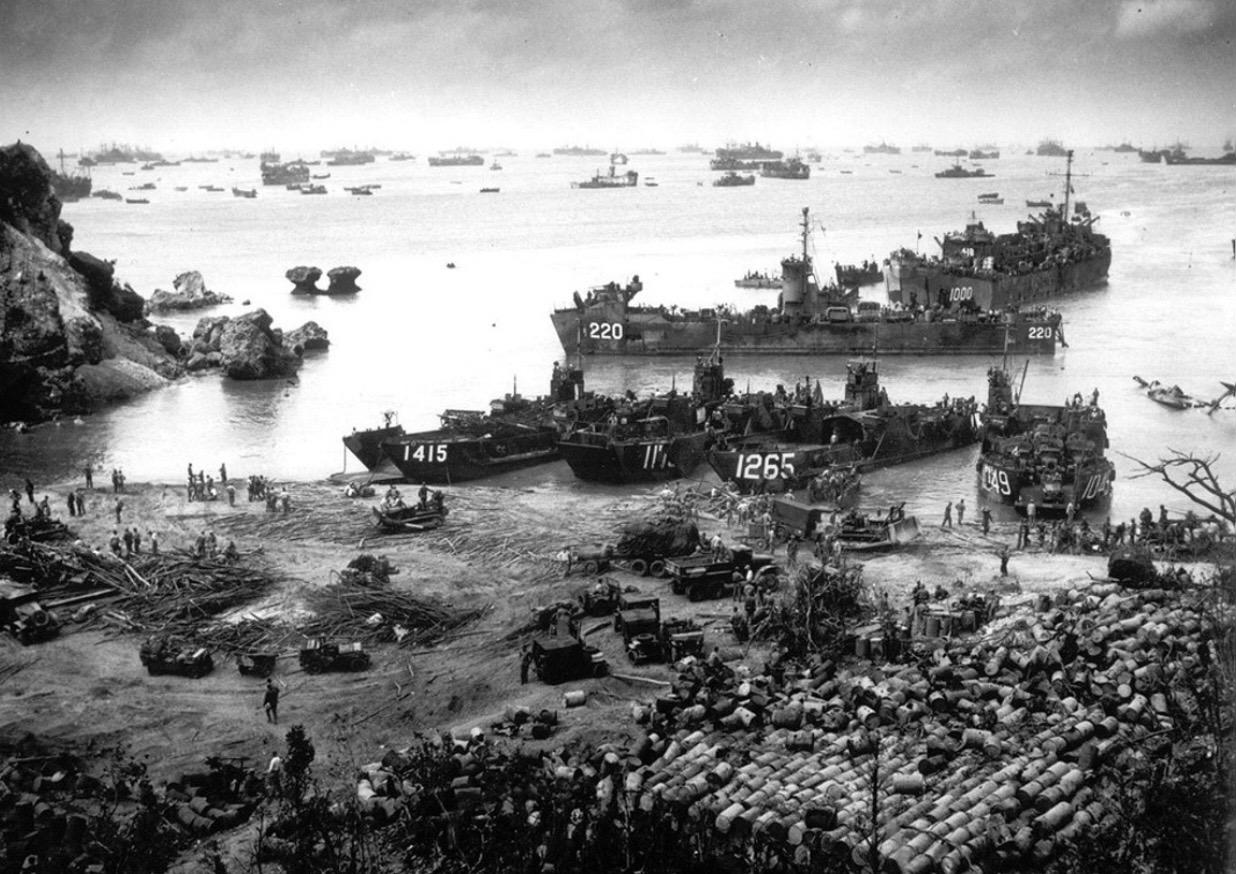
For the invasion the United States assembled one of the largest fleets ever gathered in the Pacific. Hundreds of warships took part including battleships, cruisers, destroyers, transport ships, and aircraft carriers. On Easter Sunday, 1 April 1945, more than 60,000 American soldiers and Marines landed on the beaches of Okinawa. To the surprise of many commanders the first landings met little resistance. The beaches were secured quickly and the Americans advanced inland to capture the island’s airfields.
While the troops were landing ashore the fleet offshore came under constant attack from Japanese aircraft. The Japanese had begun using suicide aircraft known as kamikazes. These pilots deliberately crashed their planes into Allied ships carrying bombs or fuel in order to cause maximum damage. On the first day of the invasion intense air battles took place around the fleet and American forces lost 116 aircraft during the fighting. Heavy anti-aircraft fire from ships and fighter patrols destroyed many Japanese aircraft but large numbers still managed to reach the fleet.
During these attacks three American aircraft carriers were damaged by Japanese air strikes. The carriers were heavily protected by fighter aircraft and escort ships but kamikaze pilots often broke through the defences. Explosions and fires caused serious damage on several ships, although skilled damage-control crews prevented the carriers from being sunk. These attacks showed how dangerous the kamikaze threat had become to Allied naval forces.
As the battle continued the Japanese launched a series of massive air offensives known as Operation Kikusui, meaning “Floating Chrysanthemum.” Wave after wave of aircraft attacked the fleet around Okinawa. Hundreds of Japanese planes took part in these strikes and many of them were kamikaze aircraft. Radar picket destroyers positioned around the fleet were particularly exposed and many were hit while warning the fleet of incoming raids.
Some of the most dramatic carrier attacks occurred later in the campaign. Major carriers such as USS Bunker Hill and USS Enterprise were struck by kamikaze aircraft. The attacks caused huge explosions, fires across the flight decks, and hundreds of casualties among the crews. In the case of Bunker Hill more than 350 sailors were killed and hundreds more wounded. The carrier survived but was forced to leave the battle for repairs.
The naval battle around Okinawa was one of the most intense ever fought by the United States Navy. Dozens of American ships were sunk and many more damaged during the campaign. Thousands of sailors were killed in the constant kamikaze attacks that struck the fleet over the weeks of fighting. Despite these losses the fleet continued to provide air support, bombardment, and supplies for the troops fighting ashore.
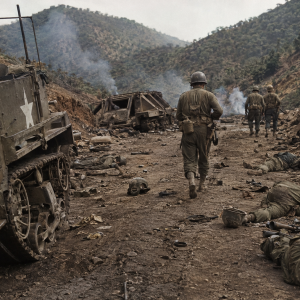
On land the battle became extremely difficult as American forces advanced south into the main Japanese defensive lines. The fighting took place in mud, rain, and rugged hills where Japanese troops fought from hidden caves and bunkers. Artillery, flamethrowers, and tanks were often needed to destroy the fortified positions. Casualties on both sides were very high as the battle dragged on through April, May, and June.
Lieutenant General Simon Bolivar Buckner Jr., the commander of the U.S. Tenth Army, was killed by Japanese artillery fire in June 1945 while observing the front lines. He became the highest ranking American officer killed by enemy fire during the Second World War.
By late June the Japanese defence collapsed. With defeat certain, General Mitsuru Ushijima and many of his senior officers committed suicide rather than surrender. Most of the Japanese defenders were killed during the battle and large numbers of Okinawan civilians also died as the fighting swept across the island.
Operation Iceberg lasted around 82 days and ended with the capture of Okinawa by American forces. The island then became a major base for American bombers and naval forces operating against Japan. The ferocity of the battle and the huge casualties on both sides also showed how costly an invasion of the Japanese mainland might be, a factor that influenced the final stages of the war later in 1945.