Medal Of Honour
The Medal of Honor stands above all other American military decorations. It is awarded only for acts of extraordinary heroism, carried out at the risk of life and far beyond what duty requires, usually in combat against an enemy of the United States. More than a military award, it is a national symbol of sacrifice and courage, presented by the President of the United States in the name of Congress to recognize actions so exceptional they set the recipient apart even among the bravest.
Although it is often called the Congressional Medal of Honor, this is not its official title. The wording reflects the fact that Congress authorizes the award, while the President presents it on behalf of the nation, usually during a formal ceremony at the White House.
The origins of the Medal of Honor lie in the American Civil War. Before that conflict, the United States had little interest in military decorations, viewing them as a European custom inconsistent with republican ideals. The scale and intensity of the Civil War, however, created a need to formally recognize extreme courage and self-sacrifice. In late 1861, Congress authorized a Medal of Honor for the Navy, followed in 1862 by a similar award for the Army. Both measures were signed into law by President Abraham Lincoln, establishing the first permanent United States military decoration for valor.
As the years passed, the Medal of Honor became increasingly selective. Early criteria were broad, but as the meaning and prestige of the award became clear, the standards were tightened dramatically. Today, it represents the highest possible recognition for battlefield heroism.
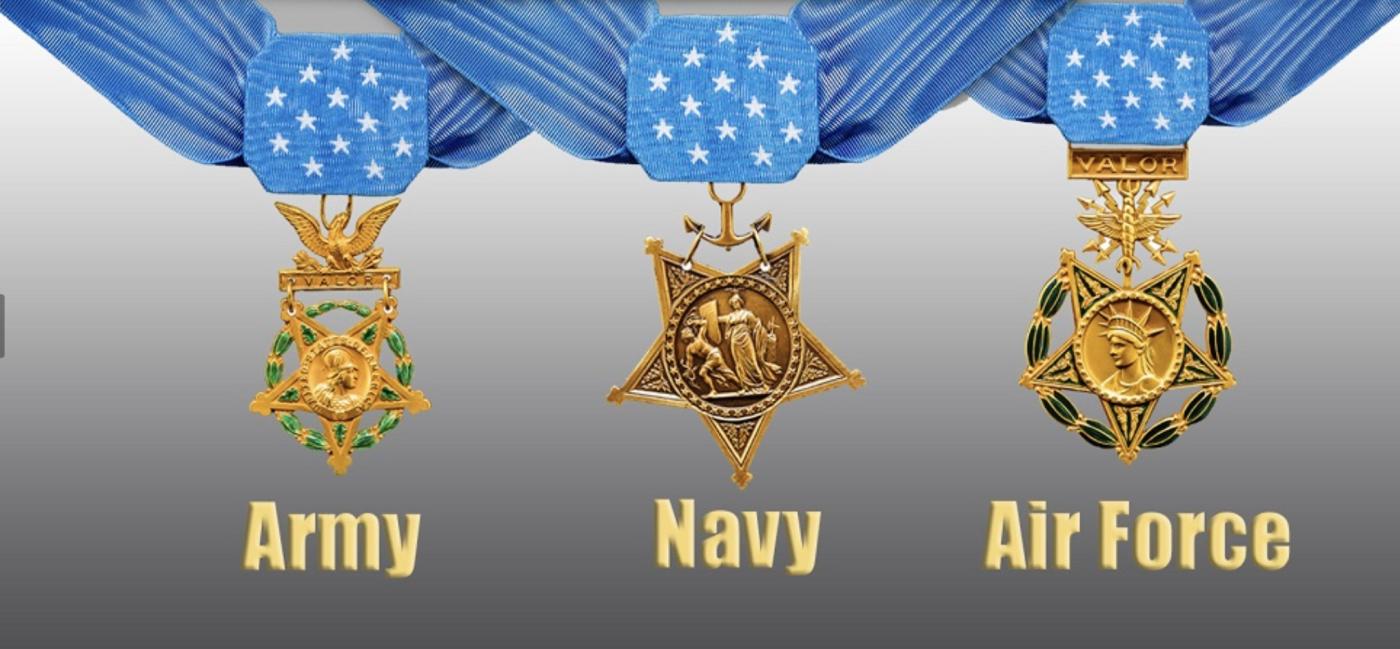
There are three versions of the Medal of Honor, reflecting the structure and traditions of the United States armed forces. The Army version is awarded to soldiers. The Navy version is awarded to sailors, Marines, and members of the Coast Guard, which shares the Navy’s design despite being a separate service in peacetime. The Air Force version is awarded to airmen and members of the Space Force. While the designs differ, the level of heroism required to earn any of them is exactly the same.
Each version has its own distinctive appearance. The Navy medal, the oldest, retains much of its nineteenth-century character. The Army medal adopted its modern form in the early twentieth century, emphasizing classical military symbolism. The Air Force initially used the Army design after becoming an independent service, but adopted a unique version in the 1960s to reflect its own identity. All three are worn around the neck on a light blue ribbon decorated with white stars, one of the most recognizable features of the award.
The creation of each Medal of Honor is tightly controlled. Government authorities oversee the designs to ensure accuracy and security, while production is handled through official government channels. Only a very small number of medals are made, and they are produced to exacting standards. Historically, both the United States Mint and prominent American jewelers have been involved in their manufacture, underscoring the importance placed on craftsmanship and authenticity.
Presentation of the Medal of Honor is a solemn national event. It is personally awarded by the President of the United States. When the recipient is alive, the President places the medal around their neck. When the award is made posthumously, it is presented to the service member’s family, often during a deeply emotional ceremony attended by senior military leaders and fellow service members.
The actions that lead to the Medal of Honor are exceptional even by wartime standards. Recipients have charged enemy positions alone, repeatedly exposed themselves to intense fire to rescue wounded comrades, or continued to fight despite devastating injuries. In every case, the individual knowingly risked their life in a way that went far beyond what was expected of them. Each recommendation undergoes an exhaustive review process, sometimes lasting years, to ensure the facts fully support the award.
Since its creation, just over 3,500 Medals of Honor have been awarded. Most were earned during the Civil War, when the scale of the fighting and early standards led to a large number of awards. In the modern era, the Medal of Honor is extremely rare. Nineteen men have received it twice for separate acts of heroism, and no one has ever received it more than twice. In the early twentieth century, some awards were reviewed and revoked when they were found not to meet later, stricter standards.
Today, the Medal of Honor remains the ultimate symbol of military valor in the United States. It represents courage under fire, devotion to comrades, and a willingness to place others’ lives above one’s own, embodying the highest ideals of service and sacrifice.