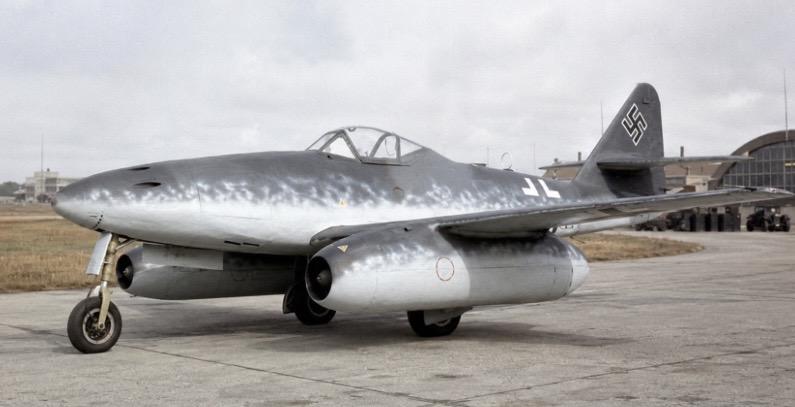
ME 262 jet
On 18 July 1942, one of the most important advances in military aviation took place when the Messerschmitt Me 262 flew for the first time using jet power alone. Taking off from Leipheim airfield in Bavaria, the third prototype, designated V3, was flown by Messerschmitt test pilot Fritz Wendel and powered by two Junkers Jumo 004 turbojet engines. Although the flight lasted only around twelve minutes, it demonstrated that a practical, high-performance jet fighter was possible and marked a decisive step towards the modern age of military aviation.
This was not technically the first time the aircraft had left the ground. The original prototype had made its maiden flight on 18 April 1941, but Germany’s early jet engines were not yet sufficiently reliable or readily available. It was therefore fitted with a conventional Junkers Jumo 210 piston engine in its nose, driving a propeller. Later test aircraft retained the nose-mounted engine while experimental BMW turbojets were fitted beneath the wings. This precaution proved wise when both BMW engines failed during an early test flight and the pilot was able to land using the conventional powerplant.
By July 1942, the more promising Junkers Jumo 004 engines had become available. The piston engine was removed from the third prototype, allowing it to fly entirely under jet power. During the take-off run, Wendel encountered an unexpected problem. The aircraft still had conventional tailwheel landing gear, and the airflow over the tail was insufficient to raise it at the required speed. He briefly applied the brakes, causing the tail to lift and allowing the machine to become airborne. Later versions were redesigned with tricycle landing gear, placing a nose wheel beneath the forward fuselage and two main wheels beneath the wings.
Development had begun before the outbreak of the Second World War. In 1938 the German Air Ministry issued a requirement for an aircraft capable of flying for at least one hour at a speed of around 850 kilometres per hour. This was far beyond the normal performance of the piston-engined fighters then entering service. Messerschmitt began work on the project in 1939 under the designation Projekt 1065.
The new fighter was designed by a team working for Messerschmitt AG rather than by one individual alone. Willy Messerschmitt, the company’s chief designer and guiding figure, oversaw the firm responsible for the programme, but much of the detailed design work was led by engineer Dr Waldemar Voigt. His team developed the aerodynamic layout, internal structure and systems required to create an aircraft unlike anything the company had previously built. The project also demanded close cooperation with BMW and Junkers, whose engineers were attempting to turn the still-experimental turbojet engine into a practical source of military power.
Its slightly swept wings were not originally introduced primarily to overcome the problems of very high-speed flight, as swept wings would be on later jet aircraft. The sweep was partly adopted to maintain the correct centre of gravity after the engines and other components were positioned on the airframe. Nevertheless, the resulting shape gave the fighter a remarkably modern appearance and contributed to its effective performance at high speed.
Production was mainly undertaken by Messerschmitt AG, although wartime manufacture eventually involved a large network of subcontractors, component suppliers and dispersed assembly facilities. Important work was carried out at locations including Augsburg, Regensburg, Leipheim and Obertraubling. As Allied bombing intensified, German aircraft production was increasingly moved into smaller factories, tunnels, forests and underground installations in an attempt to protect it from air attack.
One of the most ambitious production schemes involved the construction of large underground factories where components could be manufactured beyond the reach of most Allied bombing. Forced labourers, concentration camp prisoners and foreign workers were employed under appalling conditions in several of these facilities. The technological achievement represented by the aircraft cannot therefore be separated from the brutality of the German wartime production system that helped to build it.
The main production version was powered by two Junkers Jumo 004B turbojet engines. Each produced roughly 900 kilograms of thrust, allowing the fighter to reach speeds of approximately 540 miles per hour, or around 870 kilometres per hour. This made it considerably faster than the best Allied piston-engined fighters. A pilot flying a Spitfire, Mustang or Thunderbolt could not normally catch it in level flight once it had accelerated to full speed.
The Jumo 004 was itself a revolutionary design, but it was also one of the aircraft’s greatest weaknesses. Germany faced severe shortages of heat-resistant metals such as nickel, cobalt and chromium, which were required to manufacture durable turbine blades. Junkers engineers were forced to use less suitable materials, greatly reducing engine life. Some examples lasted only between ten and twenty-five operational hours before requiring replacement or major repair.
The engines also responded slowly to throttle movements. If a pilot advanced the throttles too quickly, fuel could flood the combustion chambers, causing excessive heat, turbine damage or an engine fire. Great care was required, particularly during take-off, landing and combat manoeuvres. The low-mounted engine intakes were also vulnerable to debris being sucked in while operating from damaged or poorly maintained airfields.
The aircraft had originally been intended primarily as a high-speed interceptor. Germany was increasingly threatened by large formations of American and British bombers, and conventional Luftwaffe fighters were suffering heavy losses while attempting to break through the escorts. The new jet offered the possibility of attacking bomber formations at speeds that made interception by Allied fighters extremely difficult.
Its standard fighter armament was exceptionally powerful. The Me 262A-1a carried four 30 mm MK 108 cannon concentrated in the nose. These weapons fired heavy explosive shells capable of destroying a four-engined bomber with only a small number of hits. Later machines could also carry R4M air-to-air rockets beneath their wings. A salvo could be fired into a bomber formation from outside the most effective range of the bombers’ defensive machine guns.
Despite its promise, development was repeatedly delayed. The greatest problem was the shortage and unreliability of suitable jet engines, but there were also shortages of materials, production difficulties, changing requirements and disagreements within the German leadership. The Luftwaffe had not expected to fight a long defensive war over Germany, and early in the conflict many senior officers believed conventional aircraft would remain sufficient.
Adolf Hitler also became closely involved in the programme. He saw the jet not only as a fighter but as a fast bomber capable of attacking Allied invasion forces. He insisted that it should be adapted to carry bombs, producing the Me 262A-2a Sturmvogel, or Storm Bird. Fighter versions were generally known as the Schwalbe, meaning Swallow.
The extent to which Hitler’s interference alone delayed the programme remains debated. The aircraft already faced serious engine and manufacturing difficulties and could not simply have entered mass service in 1942. However, the demand to develop and produce bomber versions certainly complicated the project and diverted attention from the interceptor role in which it was most effective.
Operational service began during 1944. One of the first units to evaluate the jet in combat was Erprobungskommando 262, commanded by Major Walter Nowotny, one of Germany’s most successful fighter pilots. The unit tested tactics, trained pilots and attempted to intercept Allied aircraft while dealing with continuing technical failures.
The first recorded combat involving the type occurred on 25 July 1944 when a jet attacked an RAF de Havilland Mosquito reconnaissance aircraft over southern Germany. The Mosquito escaped, but the encounter demonstrated that the new fighter was entering the war. On 8 August 1944, an aircraft flown by Leutnant Joachim Weber was credited with shooting down a Mosquito, one of the earliest confirmed victories achieved by an operational jet fighter.
Nowotny’s experimental unit suffered from accidents, engine failures, fuel shortages and Allied attacks on its airfields. Nowotny himself was killed on 8 November 1944 after engaging American bombers and fighters. Witnesses saw his aircraft descending in flames near Achmer, although it remains uncertain whether he was shot down by an Allied fighter or suffered an engine failure while attempting to return to base.
The most important operational formation was Jagdgeschwader 7, which became the world’s first jet fighter wing. Its pilots included several experienced Luftwaffe veterans who developed specialised tactics for attacking American bomber formations. They would approach at high speed, fire their cannon or rockets and continue through the formation before Allied escorts could easily respond.
The great speed provided a major advantage, but it also created difficulties. The closing rate against a bomber could be so high that a pilot had only a few seconds to aim and fire. The MK 108 cannon had a relatively low muzzle velocity, requiring careful judgement of range. A fighter approaching too quickly could overshoot the formation before achieving an effective firing position.
The jet also had a wide turning circle and was not intended for prolonged turning combat against more agile piston-engined fighters. Allied pilots learned not to chase it in level flight. Instead, they attempted to attack when it was taking off, landing, climbing slowly or returning with little fuel. The engines were slow to produce thrust at low speed, making the aircraft particularly vulnerable during its approach to an airfield.
Allied fighters began patrolling near known jet bases, waiting for the German aircraft at their weakest moments. Conventional Luftwaffe fighters and anti-aircraft guns were sometimes assigned to protect the airfields during take-off and landing. Several jets were destroyed in the air or on the ground before they could use their superior speed.
Among the most famous units was Jagdverband 44, formed in the final months of the war under Generalleutnant Adolf Galland, the former Inspector of Fighters. Galland had long argued that the aircraft should be concentrated in the interceptor role. His formation gathered several highly decorated pilots and achieved a number of victories against Allied aircraft during March and April 1945.
Other versions were used for reconnaissance, training, night fighting and fighter-bomber duties. Two-seat Me 262B aircraft were adapted for night operations and fitted with radar equipment. These machines were employed against RAF Mosquito bombers and reconnaissance aircraft operating over Germany. Although only a small number became operational, they demonstrated the possibilities of radar-equipped jet night fighters.
Approximately 1,400 airframes were completed by the end of the war, although estimates vary and only a fraction were available for combat at any one time. Many completed aircraft lacked engines, fuel, trained pilots or serviceable airfields. Others were destroyed on the ground, damaged during transport or abandoned before they could be delivered to operational units.
Its actual contribution to the German war effort was therefore limited. Pilots claimed hundreds of Allied aircraft destroyed, particularly heavy bombers, but the jet arrived too late and in too few numbers to affect the outcome of the air war. Germany was by then suffering from overwhelming Allied air superiority, severe fuel shortages, collapsing transport networks and the loss of experienced aircrew.
The aircraft also required specialised training at a time when Luftwaffe pilot preparation had been drastically reduced. Young pilots often entered combat with insufficient flying experience, while the unfamiliar characteristics of jet propulsion made the transition particularly dangerous. Accidents and mechanical failures destroyed many machines without any involvement from the enemy.
The Me 262 was not the world’s first aircraft to fly using jet propulsion. That achievement belonged to the German Heinkel He 178, which first flew in August 1939 as an experimental aircraft. Britain’s Gloster E.28/39 followed in May 1941. Its true importance was that it became the world’s first jet-powered fighter to enter operational combat service in meaningful numbers.
Its appearance forced the Allies to take jet technology seriously. Britain already had the Gloster Meteor in development and introduced it into service during 1944, although it was initially used mainly against V-1 flying bombs and never met its German counterpart in combat. The United States was also working on jet aircraft, including the Bell P-59 Airacomet and the later Lockheed P-80 Shooting Star, but neither played a significant combat role in Europe before Germany surrendered.
After the war, the Allies captured complete aircraft, engines, drawings, components and members of the German design and engineering teams. Examples were taken to Britain, the United States, France and the Soviet Union for detailed examination. Test pilots evaluated their performance while engineers studied the aerodynamics, armament, engines and construction methods.
The design directly and indirectly influenced post-war aircraft development. Its combination of swept wings, underslung engines, heavy nose armament and high-speed performance offered valuable lessons to every major aviation power. It was not a perfect blueprint for later fighters, but it helped confirm that piston-engined combat aircraft were approaching the limits of their development and that the future belonged to the turbojet.
The events of 18 July 1942 therefore represented far more than the successful test of another prototype. Fritz Wendel’s flight proved that a twin-engined fighter could take off, fly and land using turbojet power alone. It opened the path towards an aircraft that would eventually attack Allied bombers at speeds previously considered almost impossible.
The Me 262 was introduced too late, suffered from unreliable engines and was produced by a German war economy already close to collapse. It could not reverse Germany’s defeat, and its successes were too limited to alter the strategic situation. Nevertheless, it was one of the most important aircraft of the Second World War. It transformed ideas about speed, interception and aerial combat and gave the world a glimpse of the jet-powered air forces that would dominate the decades following 1945.