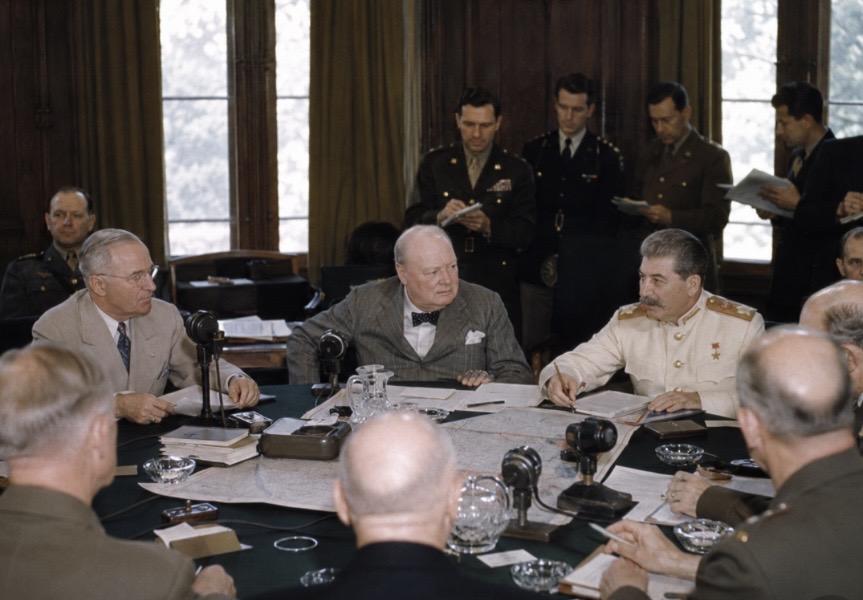
Potsdam Conferance
The Potsdam Conference, held from 17 July to 2 August 1945, was the final major meeting between the principal Allied leaders during the Second World War. Taking place at Cecilienhof Palace near Berlin, the conference brought together representatives of Britain, the United States and the Soviet Union at a moment when Nazi Germany had been defeated, but the war against Japan was still continuing. The discussions at Potsdam would shape the occupation of Germany, influence the future political division of Europe and expose the growing mistrust that was beginning to develop between the former wartime allies.
The conference was attended by Soviet leader Joseph Stalin, American President Harry S. Truman and British Prime Minister Winston Churchill. However, the British general election results were announced during the meeting, and Churchill was replaced by the new Labour Prime Minister Clement Attlee on 28 July. The change meant that only Stalin remained from the three leaders who had attended the earlier Tehran and Yalta conferences. Franklin D. Roosevelt had died in April 1945, leaving Truman to take over the presidency with relatively little experience of high-level international diplomacy.
The choice of Potsdam as the location was highly symbolic. Berlin had been devastated during the final battles of the war in Europe, and much of the German capital lay in ruins. Cecilienhof Palace, which had survived with comparatively little damage, provided a suitable and secure venue. The sight of destroyed buildings, displaced civilians and the remains of Hitler’s regime served as a powerful reminder of the consequences of the conflict and the scale of the task facing the victorious Allies.
The principal purpose of the conference was to decide how defeated Germany would be governed and rebuilt. Germany had already been divided into four occupation zones controlled by Britain, the United States, the Soviet Union and France. Berlin, although located deep inside the Soviet occupation zone, was also divided into four sectors. The Allies agreed that Germany should be treated as a single economic unit, but in practice the different occupation authorities increasingly followed separate policies.
A central part of the Potsdam Agreement was the programme often described as the four Ds: demilitarisation, denazification, democratisation and decentralisation. Germany was to be completely disarmed, and its armed forces, military organisations and war industries were to be dismantled. The Nazi Party and its associated institutions were to be abolished, Nazi laws repealed and leading figures prosecuted for war crimes. Political life was to be rebuilt on democratic principles, while excessive central control of government and industry was to be reduced.
The Allies also discussed the punishment of Nazi leaders. The decision was made to bring major war criminals to trial, leading to the International Military Tribunal at Nuremberg, which opened later in 1945. These trials were intended not only to punish individuals responsible for aggression, mass murder and persecution, but also to establish a legal record of the crimes committed by the Nazi regime.
Reparations were another major source of disagreement. The Soviet Union had suffered immense destruction and loss of life during the German invasion and demanded substantial compensation. Western leaders were concerned that excessive reparations might destroy Germany’s economy and repeat the mistakes made after the First World War. A compromise was reached under which each occupying power would take reparations mainly from its own zone. The Soviet Union was also permitted to receive a proportion of industrial equipment from the western zones in exchange for food, coal and other materials from the east.
The future borders of Germany and Poland were also discussed. The Allies provisionally accepted the movement of Poland’s western frontier to the Oder and Western Neisse rivers. Large areas of eastern Germany were placed under Polish or Soviet administration, including Silesia, Pomerania and southern East Prussia. The German city of Königsberg and the surrounding territory were transferred to the Soviet Union and later became Kaliningrad.
These territorial changes led to one of the largest population movements in European history. Millions of ethnic Germans living in Poland, Czechoslovakia and Hungary were expelled or fled westward. The Potsdam Agreement stated that such transfers should be carried out in an orderly and humane manner, but in reality many civilians suffered violence, hunger, exposure and death. The expulsions created lasting bitterness and added to the humanitarian crisis already facing post-war Europe.
The conference also considered the political future of Poland. At Yalta, the Allies had agreed that a broader Polish government should be created and free elections held. By the time of Potsdam, the Soviet-backed authorities had established firm control. Britain and the United States recognised the new Polish Provisional Government of National Unity, although doubts remained about whether genuinely free elections would take place. These disagreements over Poland became an early sign of the emerging division between the Soviet Union and the Western powers.
Although Germany had surrendered, the war against Japan remained unresolved. During the conference, Truman received confirmation that the United States had successfully tested the world’s first atomic bomb in New Mexico on 16 July 1945. He informed Stalin that America possessed a new weapon of extraordinary power, although he did not provide full details. Stalin appeared calm, partly because Soviet intelligence had already provided information about the American atomic programme.
On 26 July, the United States, Britain and China issued the Potsdam Declaration, calling upon Japan to surrender unconditionally. The declaration warned that refusal would result in prompt and utter destruction. It demanded the elimination of Japanese militarism, the occupation of Japanese territory, the punishment of war criminals and the establishment of a peaceful and democratic government. Japan did not immediately accept the terms.
In the days after the conference, the United States dropped atomic bombs on Hiroshima on 6 August and Nagasaki on 9 August. The Soviet Union declared war on Japan on 8 August and launched a major offensive against Japanese forces in Manchuria. Japan announced its intention to surrender on 15 August, bringing the Second World War to an end.
Personal relations between the leaders at Potsdam were more strained than at earlier Allied conferences. Truman was less willing than Roosevelt had been to accommodate Stalin, while Soviet control over Eastern Europe caused increasing concern in Britain and the United States. Stalin believed that Soviet security required friendly governments along the western borders of the USSR, while Western leaders feared the expansion of communist influence.
Churchill was particularly suspicious of Soviet ambitions and had become convinced that Europe was in danger of being divided. His replacement by Attlee did not cause a major change in British policy, but it altered the atmosphere of the conference. Attlee and his new Foreign Secretary, Ernest Bevin, arrived with limited time to familiarise themselves with the negotiations, although Bevin would later become one of the strongest British opponents of Soviet expansion.
The Potsdam Conference did not formally begin the Cold War, but it revealed many of the tensions that would soon dominate international affairs. The wartime alliance had been held together by the common need to defeat Nazi Germany. Once that enemy had disappeared, disagreements over ideology, security, territory and economic reconstruction became increasingly difficult to conceal.
The decision to divide Germany into occupation zones was originally intended as a temporary arrangement. However, cooperation between the Allies soon broke down. In 1949, the western zones became the Federal Republic of Germany, commonly known as West Germany, while the Soviet zone became the German Democratic Republic, or East Germany. Berlin remained divided and became one of the most dangerous points of confrontation during the Cold War.
Many of the decisions taken at Potsdam had consequences that lasted for decades. The redrawing of borders permanently changed the map of Central and Eastern Europe. The removal of German populations transformed the ethnic character of entire regions. The occupation and reconstruction of Germany eventually produced two rival German states, each aligned with a different political and military bloc.
The conference also demonstrated the changing balance of world power. Britain remained one of the victorious nations, but the war had severely weakened its economy and global influence. The United States and the Soviet Union emerged as the two dominant military powers. Their rivalry would shape international politics for nearly half a century.
The Potsdam Conference was therefore both an ending and a beginning. It marked the final stage of Allied cooperation during the Second World War and established the immediate arrangements for dealing with defeated Germany. At the same time, it exposed the political divisions that would separate Europe into opposing camps. Decisions made inside Cecilienhof Palace in the summer of 1945 helped create the post-war world, but they also laid the foundations for the confrontation that became known as the Cold War.