On this day in military history…
The Second Battle of Guam began on 21 July 1944, when American forces landed on the Japanese-held island as part of the wider campaign to recapture the Mariana Islands. The battle lasted until 10 August 1944 and ended with Guam returned to United States control after more than two and a half years of Japanese occupation.
Guam was the largest and southernmost of the Mariana Islands and had been an American possession since the Spanish-American War of 1898. When Japan entered the Second World War in December 1941, the island was defended by only a small force of United States Marines, sailors and local Chamorro militia. Japanese troops invaded on 10 December 1941 and quickly overwhelmed the defenders. Guam then became the first inhabited American territory to fall to Japan during the war.
The Japanese occupation was a difficult and often brutal period for the island’s Chamorro population. Many civilians were forced to work for the occupying troops, food and supplies were confiscated, and suspected resistance supporters were imprisoned, beaten or executed. As the American advance across the Pacific moved closer, Japanese treatment of the local population became increasingly severe.
By 1944 the United States had begun pushing towards the Japanese home islands through a series of amphibious operations across the central Pacific. The capture of the Marianas was considered vital because the islands were within range of Japan for the new Boeing B-29 Superfortress heavy bomber. Airfields built on Guam, Saipan and Tinian would allow American aircraft to conduct sustained bombing raids against Japanese industrial centres.
The invasion of Guam was originally planned for 18 June 1944, only a few days after the landings on nearby Saipan. However, unexpectedly strong Japanese resistance on Saipan and the approach of the Japanese fleet delayed the operation. The resulting Battle of the Philippine Sea ended in a major American naval victory and destroyed much of Japan’s remaining carrier air strength. Once Saipan was secure and the naval situation had stabilised, preparations for Guam resumed.
The American invasion force was commanded by Major General Roy Geiger of the III Amphibious Corps. The main assault units were the 3rd Marine Division, the 1st Provisional Marine Brigade and the US Army’s 77th Infantry Division. More than 50,000 American servicemen were eventually committed to the operation.
The Japanese garrison was commanded by Lieutenant General Takeshi Takashina and consisted of approximately 18,000 to 20,000 troops, including army soldiers, naval personnel and construction units. The defenders had spent months preparing caves, bunkers, trenches and artillery positions across the island. Guam’s steep ridges, dense jungle, rivers and rugged coastline gave the Japanese many natural defensive advantages.
Before the landings, American aircraft and warships subjected Guam to one of the most intense bombardments yet seen in the Pacific War. Battleships, cruisers and destroyers fired thousands of shells at coastal positions, while carrier aircraft attacked airfields, gun emplacements and supply areas. Underwater demolition teams also cleared reefs and obstacles from the landing beaches.
Despite the enormous bombardment, many Japanese positions survived. The defenders had dug deeply into the island’s hills and caves, allowing them to emerge once the naval gunfire lifted.
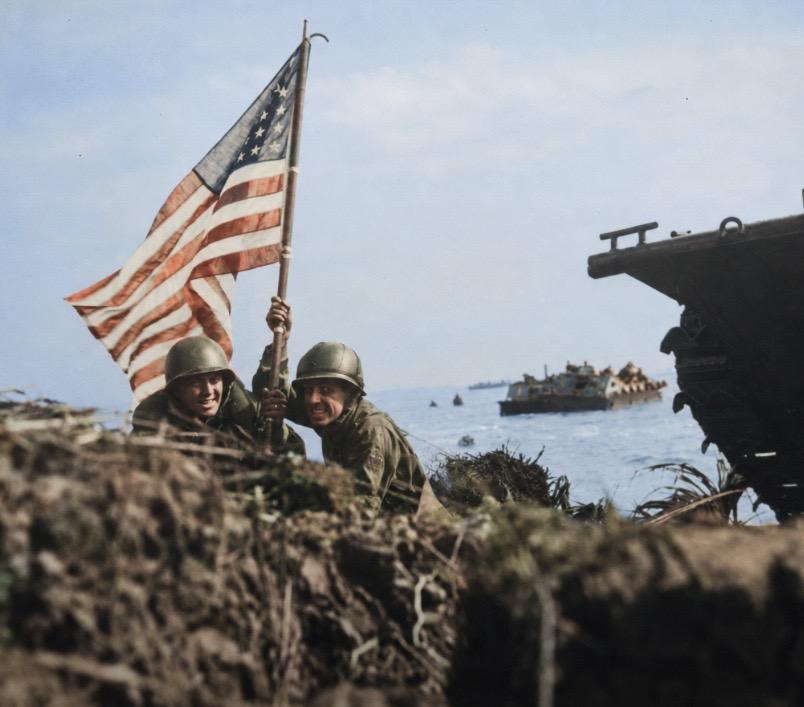
At dawn on 21 July 1944, American Marines began landing on beaches on both sides of the Orote Peninsula on Guam’s western coast. The 3rd Marine Division landed to the north near Asan, while the 1st Provisional Marine Brigade came ashore further south near Agat. The two forces intended to secure separate beachheads before joining together and cutting off the Orote Peninsula.
The landings were difficult from the beginning. Guam was surrounded by coral reefs that prevented conventional landing craft from reaching the shore. Amphibious tractors carried the first assault waves across the reefs, but many following troops had to transfer into smaller boats or wade through shallow water while under fire.
Japanese artillery, mortars and machine guns opened fire on the approaching Americans. Landing beaches were swept by shells from positions hidden in the hills, and several landing craft and amphibious vehicles were destroyed. Marines struggled inland through heavy fire, thick vegetation and steep ground.
The northern beachhead around Asan proved particularly dangerous. Japanese forces occupied high ground overlooking the beaches and poured fire down onto the advancing Marines. Units fought for control of ridges, caves and fortified positions, often at extremely close range. Flame-throwers, grenades, demolition charges and tanks were used to destroy bunkers that could not be taken by rifle fire alone.
In the south, Marines landing near Agat also faced determined opposition. Japanese troops defended bridges, roads and high ground while American engineers worked to clear mines and create routes for vehicles. Progress was slow, but by the end of the first day both American beachheads had survived.
The Japanese launched major counterattacks during the nights following the invasion. On the night of 25–26 July, thousands of Japanese soldiers attacked American positions in a desperate attempt to drive the invaders back into the sea. Some units broke through sections of the Marine line and close fighting took place around command posts, artillery positions and supply areas.
American troops responded with machine-gun fire, artillery and naval gunfire. The attacks were eventually repelled with devastating losses. The failed counteroffensive cost the Japanese many experienced soldiers and weakened their ability to resist the continued American advance.
Lieutenant General Takashina was killed by American fire on 28 July while attempting to move his headquarters. Command passed to Lieutenant General Hideyoshi Obata, who recognised that the battle could not be won but ordered his remaining troops to continue fighting.
One of the main American objectives was the Orote Peninsula, which contained an important airfield and the entrance to Apra Harbor. Marines gradually sealed off the peninsula before attacking the Japanese positions there. The defenders fought from caves, bunkers and thick jungle, but by the end of July the peninsula had been secured.
The capture of Apra Harbor gave the Americans an excellent naval anchorage, while the airfield on Orote Peninsula provided an important base for fighter aircraft. Engineers and construction units quickly began repairing damaged facilities and expanding roads, airfields and supply areas.
After the northern and southern beachheads joined, the Americans began a steady advance towards the northern part of Guam. The US Army’s 77th Infantry Division entered the battle and helped push through the island’s difficult central terrain. The soldiers often had to move along narrow jungle tracks while Japanese troops fired from hidden caves and ridges.
The battle became a series of attacks against fortified hills and pockets of resistance. Heavy rain turned roads into mud and made movement difficult. Tropical heat, insects and water shortages added to the strain. Japanese snipers and small groups frequently infiltrated American lines at night.
Mount Barrigada and other high ground became the scene of particularly hard fighting. The Japanese defenders used natural caves and prepared positions to delay the American advance. American artillery and aircraft repeatedly struck these areas before infantry units moved in to clear them.
As the Americans advanced northwards, the Japanese garrison began to disintegrate. Units became separated, supplies ran low and communication broke down. Some soldiers attempted suicidal attacks, while others withdrew into the jungle and caves to continue resisting.
On 10 August 1944, organised Japanese resistance was declared to have ended. General Obata sent a final message to his superiors before dying, probably by suicide, during the last stages of the fighting. Although the island was officially secured, Japanese soldiers continued to hide in the jungle for months and even years afterwards.
American casualties during the battle included more than 1,700 killed and approximately 6,000 wounded. Japanese losses were far greater. More than 18,000 Japanese troops were killed, while only a small number were taken prisoner.
The Chamorro population also suffered heavily. Hundreds of civilians had been killed during the Japanese occupation and the fighting. Shortly before the American landings, Japanese troops carried out massacres at several locations, including caves near Fena and Tinta. Many islanders were forced to march into the interior, where they endured hunger, violence and exposure.
For the people of Guam, the American landing on 21 July became known as Liberation Day. The date remains one of the island’s most important annual commemorations. Parades, ceremonies and memorial events honour those who suffered during the occupation and those who fought to liberate the island.
After the battle, Guam was transformed into a major American military base. Engineers constructed large airfields at North Field, Northwest Field and Harmon Field. B-29 bombers operating from the Marianas later carried out devastating raids against Japan.
Apra Harbor became a vital naval base, supporting ships and submarines operating across the western Pacific. Hospitals, ammunition depots, fuel storage areas and repair facilities were also established across the island.
The recapture of Guam was strategically important because it restored American territory, secured a major naval and air base and strengthened the Allied advance towards the Philippines and Japan. Along with the capture of Saipan and Tinian, the victory placed the Japanese home islands within reach of sustained American air attack.
The Second Battle of Guam also demonstrated the determination of Japanese defenders to continue fighting even when defeat was inevitable. The use of caves, jungle positions and night attacks foreshadowed the even more costly battles that would follow on Peleliu, Iwo Jima and Okinawa.
One of the most remarkable stories connected with the battle was that of Japanese Sergeant Shoichi Yokoi. He remained hidden in Guam’s jungle after the island had been recaptured and survived for nearly twenty-eight years. He was finally discovered by local fishermen in January 1972. Yokoi later explained that he had been too ashamed to surrender and had survived by hunting, fishing and using plants from the jungle.
The Second Battle of Guam was therefore more than another island assault in the Pacific campaign. It was the liberation of an American territory, the end of a brutal occupation and a major step towards the final defeat of Japan. The fighting left deep scars on the island and its people, but 21 July 1944 continues to be remembered as the day Guam’s liberation began.