1st Polish Armoured Division
The soldiers of the 1st Polish Armoured Division entered the Netherlands on 16 September 1944. Their first objective was the eastern part of Zeeuws-Vlaanderen. Many of the men had already travelled across half of Europe before reaching Dutch soil. Some had fought in Poland in 1939 and escaped through Hungary or Romania. Others had served in France in 1940 before reaching Britain. They had lost their country, rebuilt their units abroad and spent years preparing to return to the continent. Their commander was Major General Stanisław Maczek, one of the most experienced Polish officers in mobile warfare. Under his command, the division would fight in Zeeland, North Brabant and Drenthe before ending the war at the German naval base of Wilhelmshaven.
Maczek had commanded the Polish 10th Motorised Cavalry Brigade during the German invasion of 1939. His troops fought a series of delaying actions in southern Poland and carried out several successful counterattacks. The Polish army was eventually trapped between Germany and the Soviet Union, which invaded from the east on 17 September. Maczek crossed into Hungary with the remains of his formation and later escaped to France. There he received command of another Polish motorised unit. After the fall of France in June 1940, he reached Britain and began rebuilding his troops again. The 1st Polish Armoured Division was officially formed in Scotland on 25 February 1942. At first, it guarded the Scottish coast against a possible German invasion. Training continued for more than two years.
By the summer of 1944, the division had more than 15,000 men and nearly 400 tanks. It followed the organisation of a British armoured division and used British and American equipment. Most of its tank crews used Shermans, while the reconnaissance units used lighter and faster vehicles. Infantry, artillery, engineers and anti-tank troops travelled with the armoured regiments. The division’s badge showed the helmet and wing of a Polish hussar in black on an orange field. The men came from different backgrounds, but they shared the same problem. Many had little or no contact with their families in occupied Poland.
The division landed in Normandy at the end of July 1944 and entered battle near Falaise in August. The Allies were trying to surround large German forces before they could escape eastwards. Maczek’s troops captured important positions around Mont Ormel and Chambois. The Germans attacked them from several directions in an attempt to break out of the encirclement. The fighting caused heavy losses, although it also established the division’s reputation among the Allied armies. After receiving new men and vehicles, the Poles followed the German retreat through northern France and Belgium. They liberated towns including Ypres and Tielt before reaching the Dutch border.
The first Polish units crossed into Zeeland on 16 September. The landscape presented immediate problems. Canals, dykes and flooded fields restricted the movement of tanks. Heavy vehicles had to remain on narrow roads, where German guns could cover bridges and crossroads. A destroyed bridge could stop an entire column. The fighting around Axel became the division’s first serious battle in the Netherlands. Polish infantry and engineers tried to cross the canal between Axel and Hulst while German troops fired from prepared positions. The first attempts were costly. Maczek’s men eventually found another route and approached Axel from a bridgehead near Kijkuit. The town was liberated on 19 September. By the following day, the Germans had been driven from the eastern part of Zeeuws-Vlaanderen.
The division was then moved back through Belgium and entered the Netherlands again south of Baarle-Nassau on 1 October. German troops destroyed several Polish vehicles and then withdrew to new defensive lines. Fighting around Baarle-Nassau continued for days. The advance was much slower than the rapid pursuit through France and Belgium. Heavy rain turned fields into mud, while ammunition and fuel had to travel over crowded roads from supply areas far behind the front.
In late October, the Allies began a larger offensive to clear North Brabant. Breda became one of Maczek’s main objectives. The city was an important road and railway centre, and German commanders had prepared to defend it. Maczek wanted to avoid a battle that would destroy the centre and kill large numbers of civilians. He therefore decided against a heavy preliminary bombardment. Polish units moved around Breda, attacked German positions on the outskirts and threatened the roads needed for a retreat. The defenders faced the danger of being surrounded if they stayed too long. Polish soldiers entered the city on 29 October 1944. There had been fighting in the suburbs and nearby villages, but Breda escaped the large-scale destruction suffered by many other European towns.
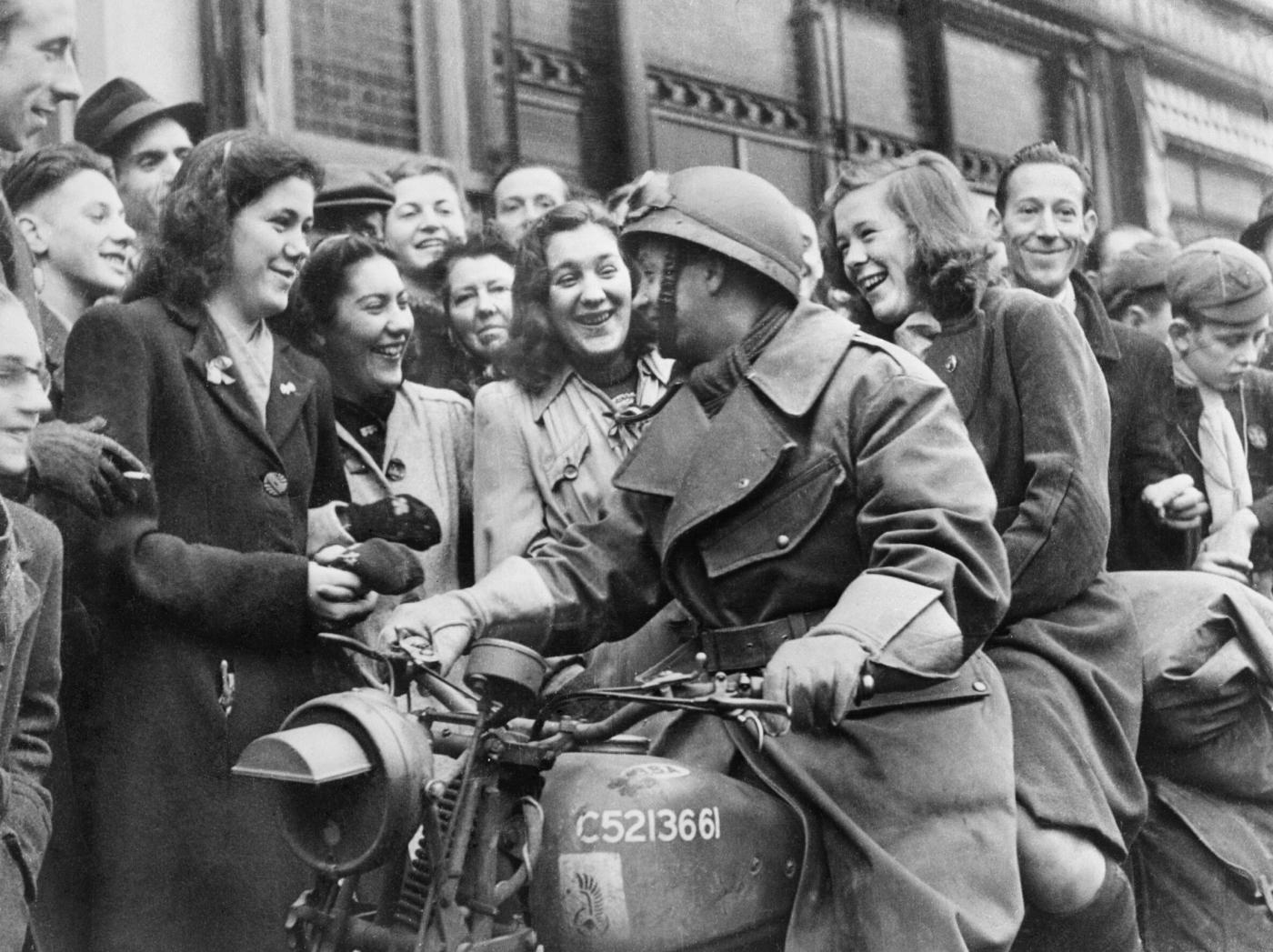
Dutch flags appeared from windows as the Germans withdrew. Civilians filled the streets and surrounded the Polish tanks. They offered the soldiers flowers, food and drinks. Some had written messages of thanks in Polish: Dziękujemy Wam Polacy. The welcome made a strong impression on men who had been away from their own country for years. Photographs taken during the liberation show Shermans and other Polish vehicles almost disappearing beneath crowds of civilians. The relationship between Breda and the division began during those first hours. It would continue long after the war. The liberation also gave the Allies control of an important transport centre, but Maczek’s campaign in North Brabant was far from finished.
The division continued north towards the Mark Canal, Made and Moerdijk. German troops destroyed bridges and used waterways as new defensive lines. Polish engineers worked under fire to build crossings for tanks and infantry. The wet ground again made movement difficult, and several villages were badly damaged. By early November, the Germans had been pushed back across the Maas. Maczek’s division then spent the winter of 1944 and 1945 in North Brabant. Its men guarded the front along the river, carried out patrols and exchanged artillery fire with German positions. V-1 flying bombs regularly passed overhead on their way to Antwerp and other Allied targets. Behind the lines, Polish soldiers stayed with Dutch families and became part of local life. Friendships developed, and some men formed relationships with Dutch women.
In April 1945, the division was transferred to the eastern Netherlands for the final Allied advance. Polish columns moved through Drenthe towards the German border. Emmen was liberated on 10 April, after which the advance continued through towns and villages in the north-east. On 12 April, after crossing into Germany, a Polish detachment reached the prisoner of war camp at Oberlangen. The soldiers found more than 1,700 Polish women who had fought in the Warsaw Uprising. Many of Maczek’s men had received little news from Poland and did not know what had happened to their families. The meeting at Oberlangen became one of the most emotional events in the division’s campaign.
Maczek’s troops continued towards the North Sea. On 6 May 1945, they occupied Wilhelmshaven and accepted the surrender of the German naval base. Large numbers of German soldiers, ships and military supplies fell into Allied hands. The campaign of the 1st Polish Armoured Division had ended. Its soldiers had travelled from Normandy through France, Belgium and the Netherlands into Germany. Victory did not bring an easy return home. Poland was now controlled by a communist government supported by the Soviet Union. Some soldiers returned despite the risks, while others feared arrest or discovered that their former homes were now inside Soviet territory. Many remained in Britain, Canada, Belgium or the Netherlands.
Maczek settled in Scotland, but Breda continued to regard him as its liberator. Polish military cemeteries were established in and around the city. Monuments and street names kept the memory of the division alive. Veterans returned for commemorations and maintained contact with the Dutch families they had met during the war. Maczek died in Edinburgh in 1994 at the age of 102. He had asked to be buried beside his soldiers in Breda, and his grave now lies in the Polish military cemetery on the Ettensebaan. The division spent only part of its campaign in the Netherlands, but its route can still be followed through Zeeland, North Brabant and Drenthe. Breda remains the place where that history is remembered most clearly.