Martini-Henry Rifle
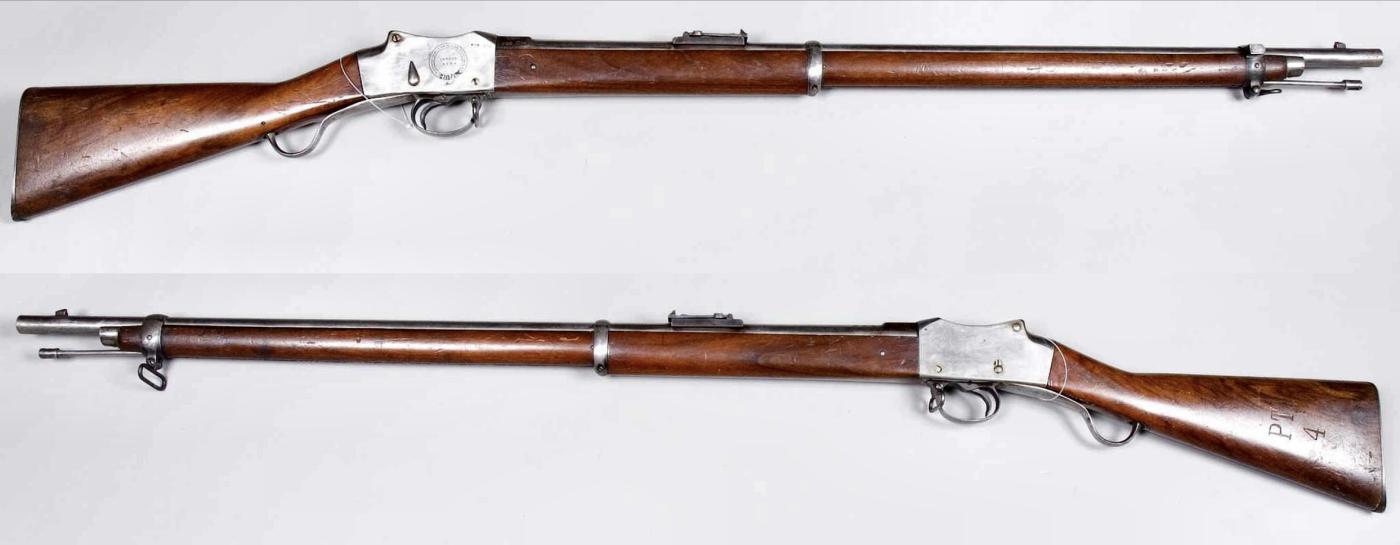
The rifle most people mean when they say “Victorian martini henry” is the Martini-Henry, the standard British service arm of the late Victorian era. It was designed around 1870–1871 by combining two different ideas: the falling-block single-shot action invented by the Swiss engineer Friedrich von Martini, and the rifled barrel system developed by the Scottish gunmaker Alexander Henry. Martini designed the simple, very strong breech mechanism in which a lever drops the block, ejects the spent case and cocks the striker in one motion, while Henry supplied the polygonal rifling pattern that gave the weapon its accuracy and ability to handle large black-powder cartridges. The British Army adopted it officially in 1871 as the Mark I, and it went through a long series of improvements until the Mark IV of the late 1880s.
These rifles were manufactured primarily in Britain at the Royal Small Arms Factory at Enfield and by a network of private contractors such as Birmingham Small Arms, London Small Arms, and several Birmingham trade makers. Production also took place in smaller numbers in colonial arsenals and abroad under licence. Across all marks and carbines, well over one million examples were produced, with most estimates falling between 1.2 and 1.5 million. They armed British regular troops, colonial forces, and many units in India, Africa and Australia, and they remained in service long after being officially replaced by the bolt-action Lee-Metford and Lee-Enfield.
The weapon fired a very large and powerful black-powder cartridge known as the .577/450. The name comes from its design: it used a bottlenecked brass case that was roughly .577 inches in diameter at the base and necked down to take a .45-calibre bullet. The standard military load used a 480 to 485 grain lead projectile wrapped in paper, propelled by about 85 grains of black powder. Muzzle velocity was roughly 1,300 to 1,350 feet per second, which sounds slow by modern standards but, because of the bullet’s great weight, it delivered enormous stopping power. At close and medium ranges it could punch through thick timber, sandbags, and even the shields and cover used by many 19th-century warriors.
In terms of accuracy, a well-made service rifle of this type in good condition was surprisingly precise. The Henry rifling, with its shallow polygonal grooves, gave excellent consistency. Trained soldiers were expected to hit man-sized targets at 400 yards, and volley fire was taught out to 1,200 yards. In practice, an individual rifleman could reliably hit a human target at 300 to 400 yards, and skilled marksmen could do so at greater distances. As for how far it could kill, the heavy bullet remained lethal well beyond 1,000 yards, since gravity and retained energy would still allow it to inflict fatal wounds at extreme range if it struck someone.
Bayonets could also be fitted. A standard socket bayonet slid over a lug near the muzzle and locked in place. The usual triangular blade was long and stout, effectively turning the firearm into a short spear for close combat. This was considered essential in Victorian warfare, where bayonet charges and last-ditch hand-to-hand fighting were still expected. Some later carbines and variations used slightly different bayonets, but the principle remained the same, and bayonet drill stayed a core part of British infantry training throughout its service life.
Today these rifles are highly collectable. Their value depends on condition, originality, and markings. A worn but intact example can still be found for a few hundred pounds or dollars, while a well-preserved specimen with matching numbers and clear Enfield or BSA markings can fetch well over a thousand, and rare marks or colonial variants can go much higher. They are popular not just with collectors but also with historical shooters and reenactors, although firing them requires carefully loaded ammunition because the original black-powder cartridges are obsolete and modern high-pressure smokeless loads would be dangerous.
One of the most interesting things about this arm is the way it became almost legendary in colonial wars, especially during the Anglo-Zulu War of 1879. At battles such as Rorke’s Drift, small groups of British soldiers held off vastly larger forces, largely because its power, reliability and rapid single-shot handling gave them a decisive advantage. The action was fast for a single-shot design, allowing a trained soldier to fire 10 to 12 aimed rounds per minute, and even more in emergencies. It also had a reputation for punishing recoil and for heating up so much in sustained fire that the metal could burn the user’s hands, leading soldiers to wrap cloth around the barrel. Despite its quirks, it remains one of the most iconic weapons of the Victorian age, symbolising both the height of black-powder military technology and the global reach of the British Empire.