Mark 9 Depth Charge
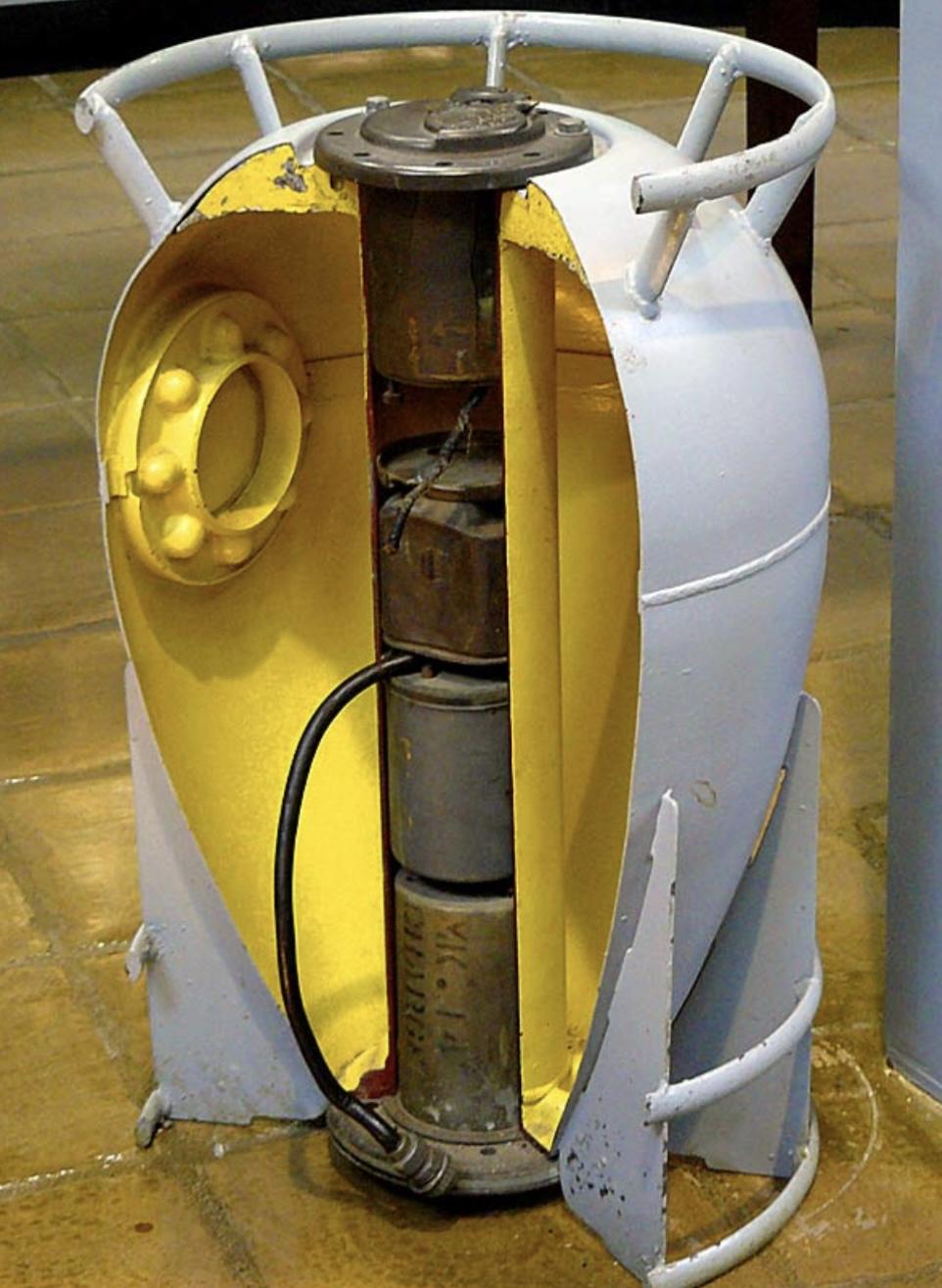
The Mark 9 depth charge was one of the principal American anti-submarine weapons of the later Second World War, and although it was a U.S. Navy design, it also appeared in the hands of many Allied crews operating American ships and aircraft. A cutaway view helps show how its streamlined casing, fuze system and internal explosive elements worked together to produce a timed underwater detonation.
The charge’s outer body was a steel cylinder with rounded nose and tail sections. Earlier depth charges with flat ends slowed down as they fell through the water, giving submarines more time to maneuver away. The Mark 9’s curved shape reduced drag so it sank faster and more predictably. Inside this casing sat the explosive filling, usually Torpex in later models, a powerful formulation that produced a stronger pressure wave underwater than the older amatol mixtures. The filling surrounded a central booster cavity, which linked the small firing components in the nose to the main explosive body.
At the front of the depth charge was the hydrostatic fuze. This device did not react to impact but instead to increasing water pressure. As the charge dropped, the surrounding pressure steadily rose and acted on a diaphragm or bellows inside the fuze. When the preset depth was reached, that pressure compressed the mechanism enough to release the firing sequence. A tiny detonator activated first, followed by the booster, and finally the main Torpex filling. Depth settings could be adjusted manually before launch, allowing crews to tailor the detonation point anywhere from relatively shallow to several hundred feet depending on where they believed a submarine was operating.
The tail section carried stabilising fins to keep the depth charge oriented correctly as it descended. These fins prevented tumbling, ensured an even descent, and helped the fuze experience water pressure in a predictable way. Later versions sometimes added weight rings or additional streamlining to increase sinking speed further, enabling attacks before a submarine could turn away or change depth rapidly.
When viewed in cutaway, the internal structure appears straightforward: the external casing, the explosive filling packed around the booster, the fuze with its pressure-sensitive components, and the finned tail assembly. But these parts formed a carefully balanced mechanism. The casing had to remain intact long enough for the explosive pressure wave to build properly, yet still rupture at detonation. The fuze had to remain safe until submerged, then arm gradually and reliably. And the hydrodynamic shape had to carry the weapon to the set depth quickly enough to prevent enemy evasion.
The Mark 9 was deployed from racks, K-guns on ship decks, and from aircraft patrols. Its safety features meant nothing happened upon water impact; only the rising pressure could arm it. As the charge descended, the fuze progressed through its arming stages until the preset depth triggered the explosion, producing a shockwave capable of damaging submarine hull plating or machinery even without a direct hit.
Although the Mark 9 originated with the U.S. Navy and became standard on American destroyers, destroyer escorts and anti-submarine aircraft, it also saw service in several Allied navies. Through Lend-Lease many British, Canadian and Free French crews operated U.S.-built ships or American-designed aircraft such as Liberators, Catalinas and Avengers. These platforms were fitted for U.S. ordnance, so they generally used the Mark 9 as supplied. Where the Royal Navy operated its own ships with British-pattern launchers, it continued to rely mainly on its own depth charges, such as the Type D and the Mark VII. As a result, the Mark 9 was not universal across all Allied fleets, but it was widely employed wherever American equipment was used.
Seen in outline or in cutaway, the Mark 9 shows how a simple-looking steel cylinder combined hydrodynamics, controlled fuze engineering and improved explosives to create an effective underwater weapon. It represented an advance over earlier depth charges and helped narrow the gap between surface ships and the increasingly capable submarines they faced in the mid-war years.