Madsen M-50
The M-50 is one of those Cold War submachine guns that quietly spread across the world without ever becoming widely known. Designed in Denmark around 1950, it was intended to be inexpensive, rugged, simple to operate and easy to mass-produce. The weapon was developed by Dansk Industri Syndikat, or DISA, the same company famous for its earlier light machine gun family. Engineer Erik Sætter-Lassen refined the earlier postwar M/46 into the improved model that entered production at the start of the decade.
Manufacture took place in Denmark for several decades, with production continuing into the 1980s. Brazil later produced a licensed version, the INA Model 953, chambered in .45 ACP. While no official total was published, surviving serial numbers and export patterns suggest that tens of thousands were made, enough to ensure global distribution throughout Latin America, Asia, Europe and Africa.
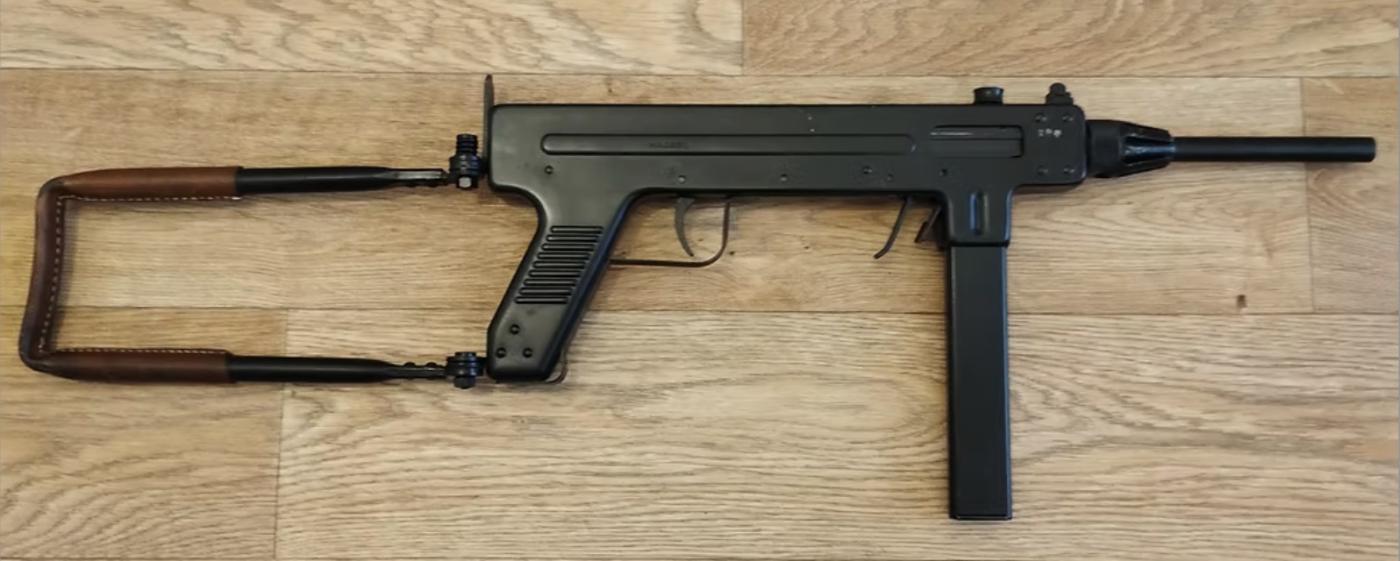
Mechanically, the firearm is a straightforward open-bolt, blowback submachine gun capable only of full-automatic fire. The standard chambering is 9×19 mm Parabellum and it feeds from a 32-round box magazine. Its intentional, moderate cyclic rate—about 550 rounds per minute—gives it a controllable, steady feel in short bursts. The Brazilian .45 ACP variant kept the same operating system but fired a larger, slower round.
Weighing around 3.15 kilograms unloaded and measuring roughly 795 millimetres with its folding stock extended, the weapon is compact and easy to handle. A 200-millimetre barrel and fixed rear sight were chosen for close-range engagements. Its effective range is about 100 metres, where it delivers reliable, practical accuracy; beyond that it behaves like most open-bolt submachine guns, better suited to area fire.
One of its most distinctive traits is its clever, low-cost construction. The entire receiver, grip and magazine housing are formed from just two stamped steel halves that hinge open like a clamshell. A conical barrel nut at the front locks the assembly, making disassembly for cleaning incredibly quick. Even the hollow grip serves as a small storage compartment for a loading tool. These features made it very easy to maintain in the field.
The tubular steel stock folds along the right side and has a leather-covered shoulder piece for comfort. Safety features include a conventional selector safety and an additional grip safety behind the magazine well, preventing the bolt from moving forward unless the weapon is held correctly. This helped minimise accidental discharges, a common issue with open-bolt systems.
Denmark issued it to both military and police, but the majority of production went abroad. Early customers included Argentina, Chile, Uruguay, El Salvador, Thailand and Brazil. The design saw action in several early Cold War conflicts such as the Korean War, First Indochina War and Malayan Emergency, typically in the hands of local or allied forces.
During the Vietnam War, it was used by certain South Vietnamese units, irregular groups and occasionally by US Special Forces and CIA personnel seeking a compact, reliable gun for jungle operations. Across Latin America it appeared in both police and military service, and later in the hands of insurgent and paramilitary groups during periods of political turmoil.
Portugal used the design during its long African colonial conflicts, and Britain evaluated it in the early 1950s before eventually selecting the Sterling. The gun later surfaced with non-state groups around the world thanks to its simplicity, low cost and durability.
Though lacking the glamour of more famous submachine guns, the M-50 earned a reputation as a no-nonsense tool: plain, dependable and built for real-world conditions. Its longevity and global spread reflect how well it met the needs of the era.