M1917 Light Tank
The story of how the United States acquired the design rights for its first tank is closely tied to the urgent circumstances of the First World War and the revolutionary French Renault FT light tank, which fundamentally shaped American armoured development.
When the United States entered the First World War in April 1917, it possessed no tanks and had no domestic design ready for production. The British and French had already deployed tanks in combat, but American industry lacked both experience and infrastructure in this new form of warfare. Faced with immediate operational needs, the U.S. Army chose not to attempt a completely original design but instead to adopt a proven foreign vehicle. The French Renault FT, introduced in 1917, was selected because it was relatively simple, mechanically practical, and suitable for mass production.
The acquisition of the design was formalised in 1917 through an agreement between the United States and France. Rather than simply purchasing finished tanks, the arrangement focused on licensed production. France agreed to provide plans, technical drawings, and engineering guidance so that American industry could manufacture the tank domestically. This approach was necessary because French factories were already working at full capacity to supply their own army and could not produce the large numbers required by the United States.
As an interim solution, France supplied the United States with 144 Renault FT tanks. These equipped American units in France and were the only tanks actually used by U.S. forces in combat during the war. At the same time, an ambitious programme was launched to produce the tank in the United States under the designation M1917.
In 1917 and 1918, the U.S. Army placed orders for approximately 4,440 tanks. Production contracts were distributed among several American companies, including Van Dorn Iron Works of Cleveland, the Maxwell Motor Company of Dayton, and the C. L. Best Company. Each firm was tasked with manufacturing components or assembling complete vehicles, reflecting the distributed nature of American industrial production at the time.
Despite the urgency, the programme encountered significant delays. The United States had to build an entire tank production capability from scratch, including armour plate manufacturing, engine supply, and the coordination of multiple contractors. Even though the Renault FT was relatively simple compared to later tanks, reproducing it proved far more difficult than expected. As a result, no American-built M1917 tanks reached the front before the Armistice in November 1918.
Production continued after the war, and ultimately about 950 M1917 tanks were completed. This made it the first tank to be produced in substantial numbers in the United States, even though it arrived too late to influence the outcome of the conflict.
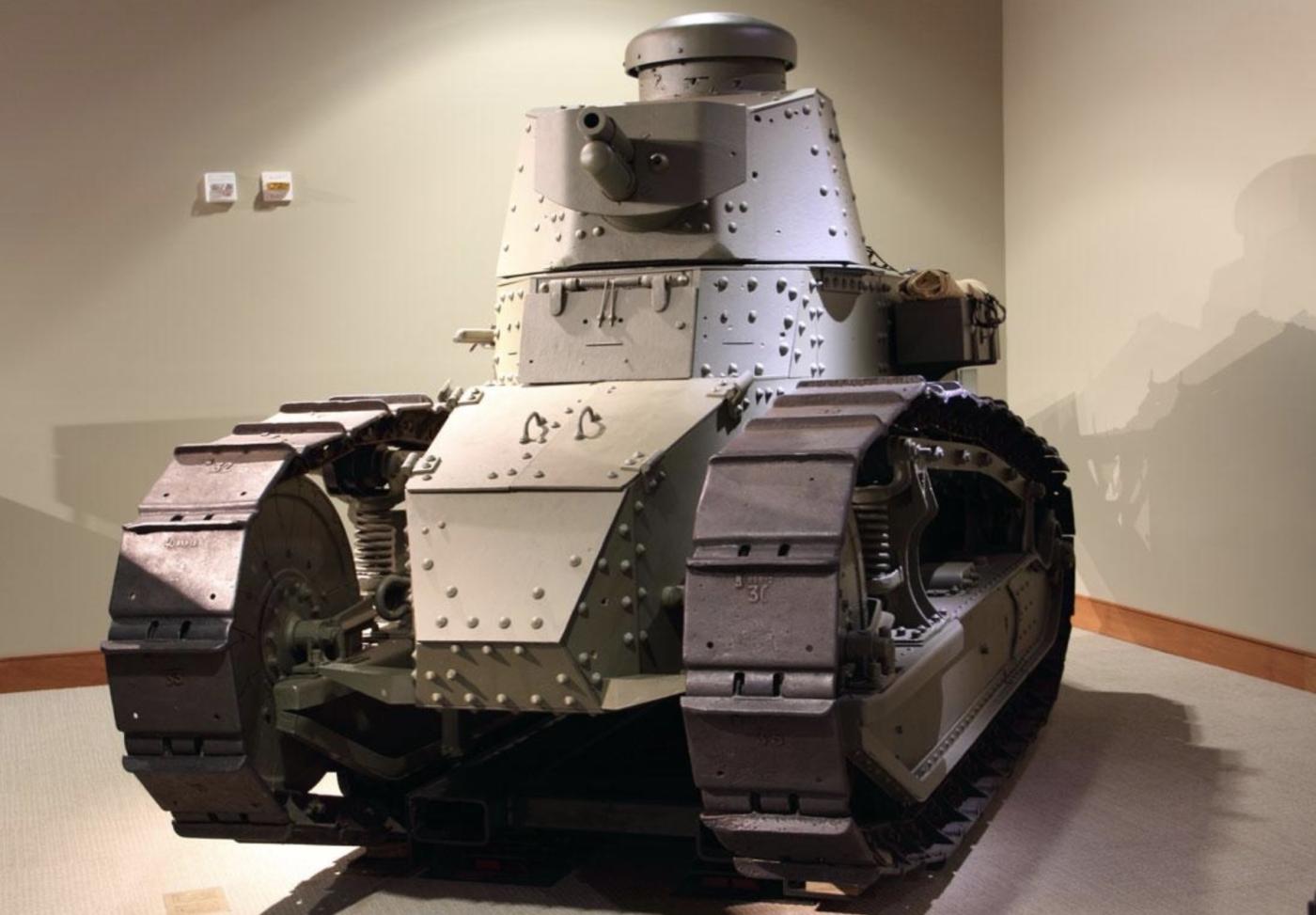
The M1917 was very closely based on the Renault FT but incorporated several important differences reflecting American materials, manufacturing methods, and standardisation. One of the most significant changes was the engine. The original French tank used a Renault automobile-derived engine, whereas the American version was fitted with a Buda HU four-cylinder engine. This required alterations to the cooling system and internal layout and was one of the main causes of production delays.
Armament was also modified. The French Renault FT was equipped either with a 37 mm Puteaux gun or an 8 mm Hotchkiss machine gun. The American M1917 instead used a 37 mm M1916 gun or a Marlin Rockwell machine gun, later replaced in some cases by the Browning M1919. These changes reflected American preferences for standard weapons and ammunition.
There were also differences in turret and construction. The French produced several turret types depending on the manufacturer, including cast and riveted designs. The American version standardised production methods but used different manufacturing techniques suited to U.S. industry. Minor changes were made throughout the vehicle, including adjustments to the hull, suspension, and internal fittings.
The M1917 was slightly heavier than the original Renault FT, weighing around 7.25 tons compared to roughly 6.5 tons. Its performance in terms of speed and range remained broadly similar, although the different engine gave it somewhat distinct handling characteristics.
One of the most revealing aspects of the programme was how difficult it proved to transfer even a relatively simple military design between allied nations. The United States had to develop new industrial processes and supply chains, and in doing so effectively created its own version of the tank rather than an exact copy.
The Renault FT itself was a groundbreaking design, introducing the layout that would become standard for tanks worldwide: a rotating turret mounted on top, the engine positioned at the rear, and the crew compartment at the front. By adopting this design, the United States not only solved an immediate wartime problem but also established the foundation for its future armoured forces.