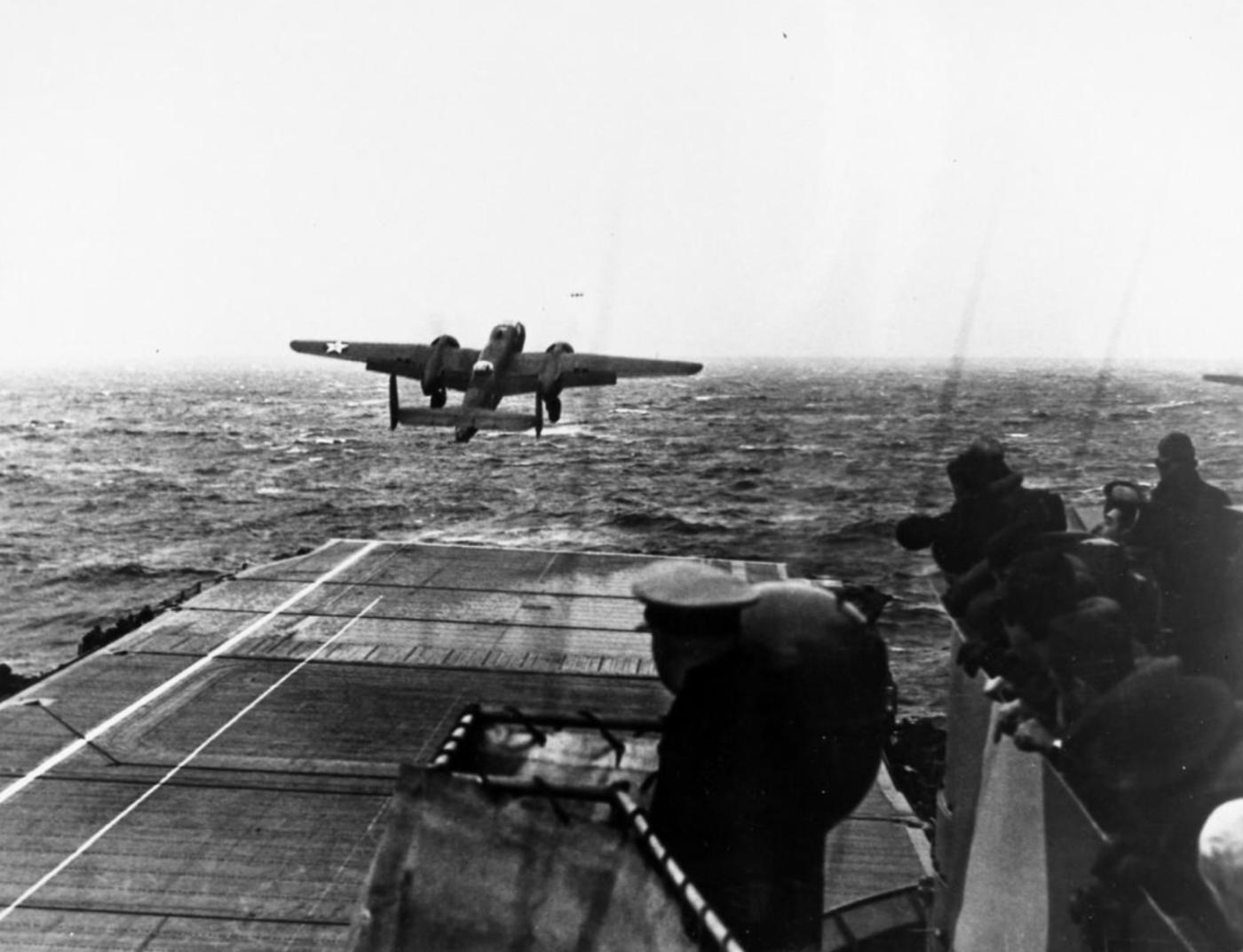
Doolittle raid
The Doolittle Raid was one of the most daring and symbolic operations of the Second World War, taking place on April 18, 1942. It marked the first time the United States carried out an air attack on the Japanese home islands, just months after the shock of the attack on Pearl Harbor. Led by James H. Doolittle, the mission was designed not only to strike Japan but also to lift American morale during a difficult period of the war.
Doolittle himself was already a highly respected figure in aviation. Born in 1896, he built a reputation as a pioneering test pilot and aeronautical engineer, even earning a doctorate from the Massachusetts Institute of Technology. His work in developing instrument flying techniques allowed pilots to navigate safely in poor visibility, a breakthrough that had lasting importance in aviation. By the time the United States entered the war, his experience and leadership made him an ideal choice to command such a bold and unconventional mission.
In the aftermath of Pearl Harbor, American leaders were eager to show that Japan was not beyond reach. The idea of launching bombers from an aircraft carrier was proposed and eventually developed into a workable plan under Doolittle’s guidance. The chosen aircraft was the B-25 Mitchell, a medium bomber that had never been used for carrier operations before. This meant crews had to undergo intense training to master short takeoffs, while the aircraft themselves were heavily modified to carry extra fuel and reduce weight.
Sixteen of these bombers were loaded onto the aircraft carrier USS Hornet (CV-8), which sailed across the Pacific escorted by USS Enterprise (CV-6) and a supporting task force. The plan was to get as close as possible to Japan before launching the planes, which would then bomb key targets and continue on to China.
However, the mission did not go exactly as planned. The task force was spotted by a Japanese patrol boat earlier than expected, raising fears that the element of surprise had been lost. As a result, the decision was made to launch the bombers from much farther out at sea than intended. This increased the risk significantly, as it meant the aircraft might not have enough fuel to reach their planned landing areas.
Despite rough seas and the shortened takeoff distance, all sixteen bombers successfully lifted off the carrier deck. It was an extraordinary achievement in itself, as these were large land-based aircraft taking off from a moving ship. The crews then flew toward Japan, targeting cities including Tokyo, Yokohama, Nagoya, and Kobe.
Once over Japan, the bombers encountered relatively light resistance. They dropped their bombs on a range of industrial and military targets such as factories, oil facilities, and dockyards. Although some fires were started and infrastructure was damaged, the overall physical impact of the raid was limited compared to later bombing campaigns.
The greatest challenge came after the attack. Because of the extended launch distance and worsening weather conditions, most of the crews ran out of fuel before reaching their intended landing sites. Many were forced to bail out over China or crash-land. Chinese civilians and resistance fighters played a crucial role in helping many of the airmen escape, often at great personal risk.
Not all were so fortunate. Several crew members were captured by Japanese forces, and some were executed. In response to the raid and the assistance given to the Americans, Japan launched a brutal अभियान in China known as the Zhejiang-Jiangxi Campaign, which resulted in the deaths of hundreds of thousands of Chinese civilians and soldiers. One bomber diverted to the Soviet Union, where its crew was interned for over a year before eventually making their way back to Allied territory.
Although the raid caused only minor physical damage, its psychological and strategic effects were enormous. In the United States, it provided a much-needed boost in confidence and proved that Japan could be struck. Doolittle, who had feared failure and possible punishment, was instead celebrated as a hero, receiving the Medal of Honor and a promotion.
For Japan, the raid was a shock. It exposed weaknesses in homeland defense and prompted a shift in military strategy. Determined to prevent further attacks, Japanese leaders expanded their defensive perimeter in the Pacific. This decision contributed to the events leading up to the Battle of Midway, where Japan suffered a decisive defeat that changed the course of the war.