M1897 Shotgun
The U.S. shotgun officially adopted in 1897 became one of the most distinctive and feared infantry weapons ever carried by American troops. Its origins lie not on the battlefield but in the workshop of John Moses Browning, one of the most influential firearms designers in history. At the end of the 19th century, repeating shotguns were still developing, and earlier designs struggled with the new smokeless powder ammunition. Browning addressed these issues by strengthening the action and receiver, creating a robust pump-operated shotgun capable of handling higher pressures with reliability.
Winchester Repeating Arms Company introduced the design in 1897, and it quickly proved successful both commercially and mechanically. One of its most recognizable features was the exposed hammer, a trait that later disappeared from most pump shotguns. This allowed users to see the weapon’s condition at a glance and to cock the hammer silently when needed. Another unusual characteristic was the lack of a trigger disconnector, meaning the gun could fire each time the action was pumped while the trigger was held down. This feature, later known as slam firing, made it exceptionally fast in close combat.
Production was handled almost entirely by Winchester, with manufacturing continuing for an extraordinary sixty years, from 1897 until 1957. Over that period, more than one million examples were produced in total. These included sporting versions for hunting, short-barreled riot guns for police and security use, and military models built specifically for combat. While exact numbers are difficult to pin down, historians agree that many tens of thousands were made for U.S. military service.
The version that cemented its reputation was the trench configuration developed for the First World War. This model featured a short barrel fitted with a perforated steel heat shield and a bayonet lug designed to accept the standard M1917 bayonet. The result was a weapon perfectly suited to the brutal realities of trench warfare. Loaded with buckshot, it was devastating at short range and could clear enemy trenches with frightening efficiency.
During the fighting in France, American troops found the shotgun extremely effective, and German soldiers quickly came to fear it. Its impact was so severe that in 1918 the German government formally protested its use, claiming it violated international law. The United States rejected the complaint outright, stating that it was a lawful combat weapon and warning that any mistreatment of American prisoners carrying it would result in retaliation.
After the First World War, the shotgun remained in service rather than fading into obsolescence. It continued to be used by the U.S. military, police forces, and prison guards. When the Second World War began, it returned to frontline service, particularly alongside the newer Model 1912. In the Pacific Theater it proved especially valuable. Jungle fighting, bunker clearing, and sudden close-range encounters played directly to its strengths, and Marines relied on it heavily when assaulting fortified Japanese positions.
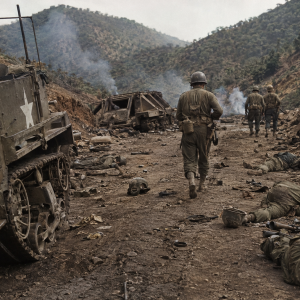
Its service did not end there. Smaller numbers were carried during the Korean War, and some were still in use during the early stages of the Vietnam War before more modern shotguns replaced them. Few firearms can claim such a long and varied military career, stretching from horse-drawn warfare to the early jet age.
Outside the battlefield, the shotgun was deeply woven into American civilian life. Law enforcement agencies favored the riot versions for their stopping power and simplicity, while hunters appreciated the durability of the sporting models. Many examples remained in regular use for decades, a testament to the strength of Browning’s design and Winchester’s manufacturing quality.
Several small details added to its legendary status. Soldiers valued the exposed hammer for silent readiness during patrols, and the rapid-fire capability made it terrifying in confined spaces. At the same time, it demanded discipline, as recoil was heavy and careless handling could be dangerous.
Today, original military trench versions are among the most desirable U.S. martial firearms for collectors. Authentic examples with original heat shields and bayonet mounts command very high prices, reflecting both their rarity and their historical importance. Reproductions exist, but originals carry the weight of having been present in some of the harshest fighting of the twentieth century.