Luftwaffe Bombing
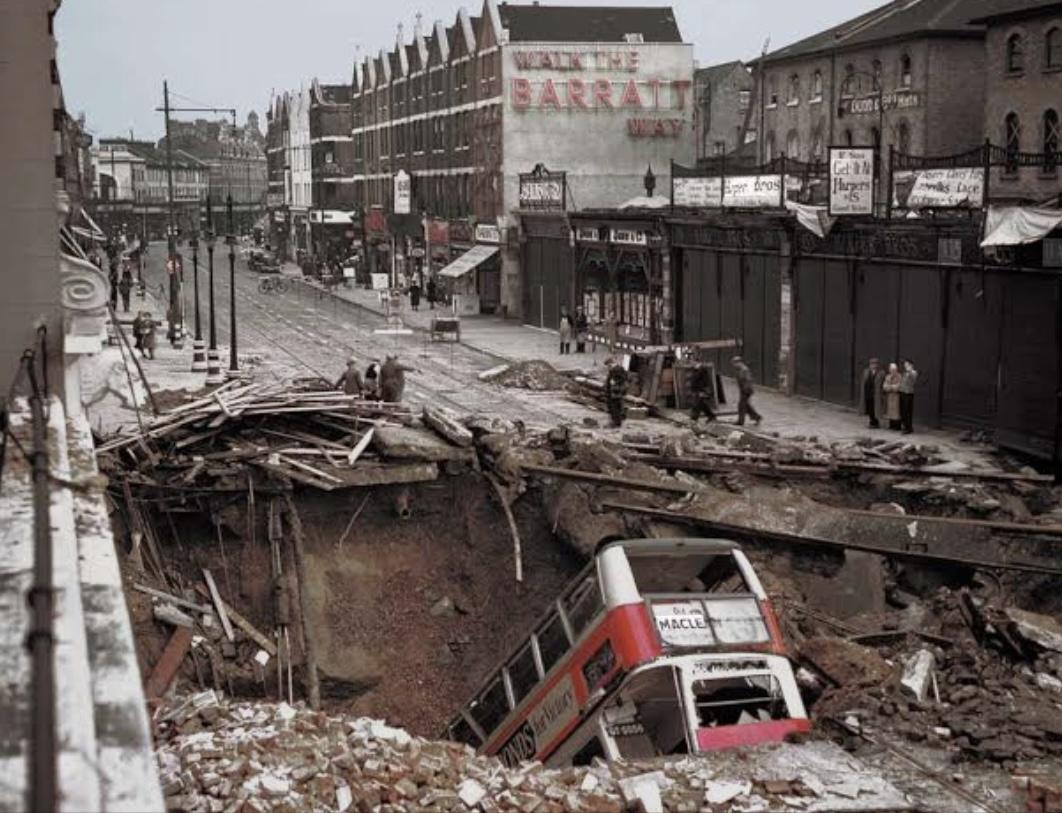
On the night of 11 January 1941, during one of the heaviest phases of the winter Blitz, a Luftwaffe raid struck the heart of the City of London and produced one of the most devastating single incidents ever to occur on the Underground. A high-explosive bomb fell at the road junction above Bank station, close to the Royal Exchange, where several major streets converge. The bomb penetrated the roadway and detonated inside the upper parts of the station, transforming the ground above into the lid of a massive explosion chamber. The blast tore open the street, creating what was widely described at the time as the largest bomb crater seen in London during the war, estimated at around 1,800 square feet.
The explosion occurred at approximately 8.05 pm, a moment when many Londoners were already underground seeking shelter from the evening raid. By early 1941 the Underground had become an unofficial refuge for thousands each night, and Bank, with its complex web of passages, escalators and platforms, drew large numbers of people who believed they were safer the deeper they went. The bomb burst in the booking hall and escalator machinery area, a comparatively shallow but critical part of the station, and the confined layout amplified the destructive effects.
Although the exact weight of the bomb has never been firmly established in a single, universally agreed figure, the scale of the crater and the depth of penetration make it clear that it was a large German high-explosive bomb rather than one of the smaller weapons commonly dropped earlier in the war. It was powerful enough to smash through the road surface and structural layers before detonating, releasing a violent pressure wave that surged down escalators and through passageways. The blast did not simply kill those closest to the point of impact; it travelled through the station like a hammer blow, turning corridors into channels of destruction.
One particularly grim detail recorded in later reports concerns the flood-prevention steel doors at the bottom of an escalator leading to what is now the Central line. These doors were open at the time. When the bomb exploded, many people sheltering at the foot of the escalator were blown through the open doors and hurled against the opposite tunnel wall. Investigators later noted that had the doors been shut, the force might instead have ruptured sections of the running tunnels themselves, underlining how finely balanced the station’s survival really was.
Casualty figures vary depending on how they were recorded, but all credible accounts agree that the loss of life was severe. Around the mid-50s were killed outright, including members of the public sheltering in the station and at least one police constable on duty, with several dozen more seriously injured. Some summaries give higher totals when injuries are included, but even the most cautious figures place the incident among the deadliest single Underground strikes of the Blitz. Nearly half of those affected were people using the station as a shelter rather than as passengers.
One of the most striking aspects of the incident is what happened afterwards. Despite the devastation above and within the station, the railway itself continued to operate. Trains were kept running beneath the wreckage, reflecting London Transport’s wartime determination to maintain services wherever physically possible. Above ground, the crater at Bank posed a major problem for the City’s road network. Debris was cleared with remarkable speed, and within weeks a temporary steel bridge was erected across the hole to allow traffic to pass once more through this vital junction.
The station did not simply spring back to normal. Emergency works focused first on safety, stabilisation and restoring essential routes, while more complex repairs followed over time. Bank reopened to passengers roughly two months after the bombing, an extraordinary turnaround given the scale of the destruction, though some damaged equipment, including escalators, required long-term replacement and continued to feature in engineering programmes for years after the war.