Wehrpass
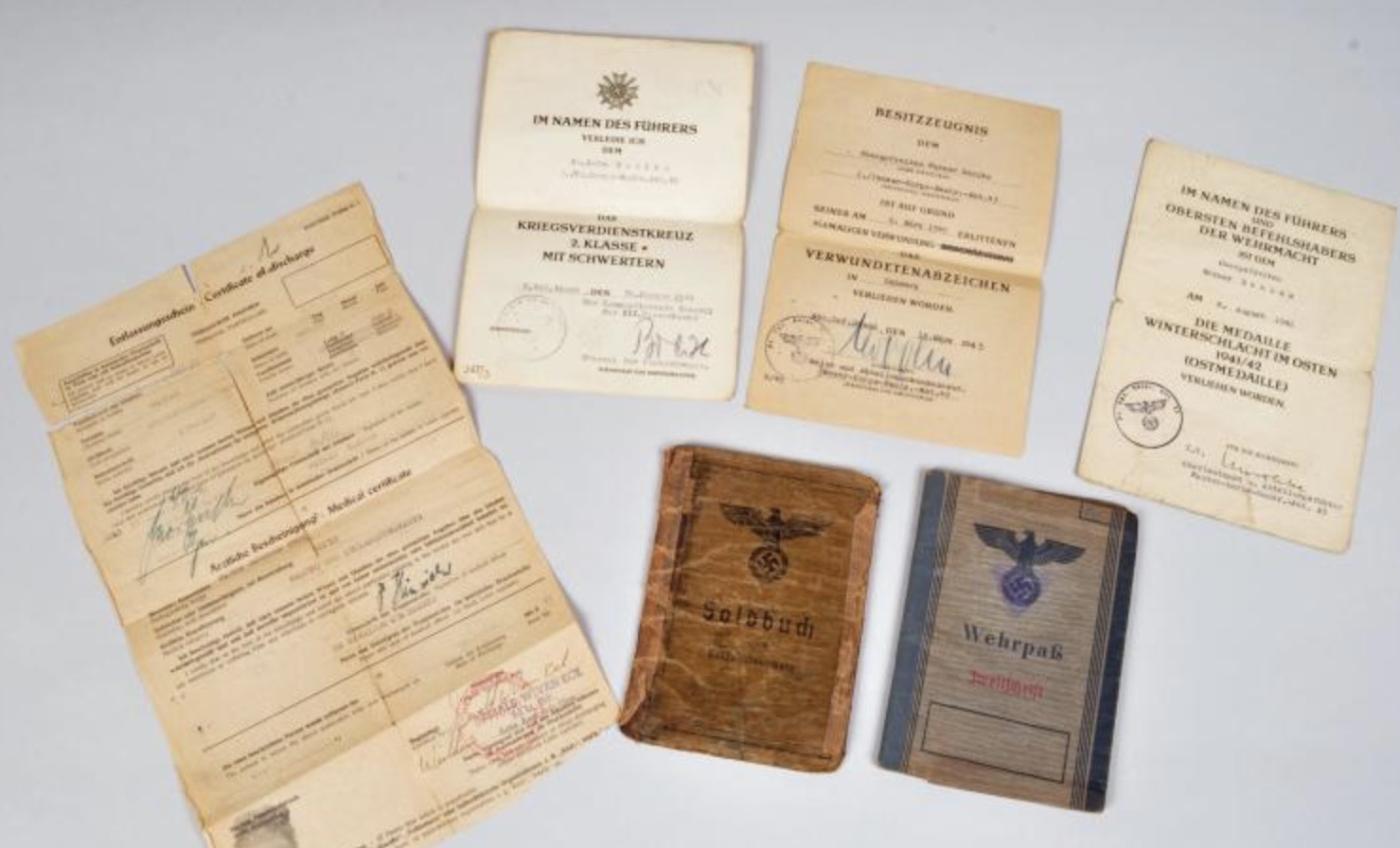
The Wehrpass was one of the most important personal military documents carried by members of the German armed forces during the period of the Third Reich. Introduced before the outbreak of the Second World War and rooted in earlier German military administrative traditions, it served as a permanent and comprehensive record of a soldier’s military life. Unlike the Soldbuch, which functioned as an everyday identification and pay document, the Wehrpass acted as the master service record, documenting a man’s recruitment, training, assignments, promotions, medical information, and operational service from the moment he became liable for military duty.
Every German male was subject to military service and therefore to registration. The Wehrpass was typically issued when a man first came under military authority, often during his initial medical examination or pre-conscription registration. It contained the individual’s personal details including full name, date and place of birth, religion, occupation, marital status, and physical description. These details ensured accurate identification and formed the foundation for tracking the individual through the complex administrative machinery of the German armed forces.
The document was designed to accompany a man throughout his entire military career, whether he served in the Heer (Army), Kriegsmarine (Navy), Luftwaffe (Air Force), or later in organizations such as the Waffen-SS. It was not usually carried on active operations once a soldier was deployed to the front. Instead, it was typically held by unit administrative offices or replacement depots to prevent loss and to maintain an accurate central record. This contrasts with the Soldbuch, which soldiers carried on their person at all times as proof of identity and for daily administrative needs such as pay, leave, and rations.
The Wehrpass contained numerous sections carefully laid out to record every stage of service. Early pages documented the soldier’s recruitment and classification, including the results of medical examinations that determined fitness for service and assignment to particular branches. German military bureaucracy placed great emphasis on physical and psychological categorization, and this information influenced where a soldier would be posted and what training he would receive.
Training records formed another significant portion of the Wehrpass. Each course or instruction period was entered with dates and locations, whether basic infantry training, technical instruction, or specialist courses such as signals, engineering, or armoured warfare. Qualifications such as driver certifications, weapons proficiency, or radio operation were also noted. This allowed commanders and administrative staff to quickly determine a soldier’s capabilities and suitability for specific roles or promotions.
Unit assignments and transfers were meticulously recorded. Every posting, from initial training units to front-line divisions and replacement battalions, appeared in chronological order. This created a continuous timeline of the soldier’s movements through the German military system. The administrative process relied heavily on these entries to manage manpower, replacements, and logistical planning. Germany’s war effort required constant reorganization and redeployment of personnel, and the Wehrpass served as a reliable central reference for each individual.
Promotions, decorations, and disciplinary actions were also entered. Awards such as the Iron Cross, War Merit Cross, or campaign medals were recorded with dates and authorizing units. Promotions in rank were similarly documented, showing the progression of a soldier’s career. Conversely, punishments ranging from minor disciplinary measures to court-martial outcomes could be included, providing a complete picture of conduct and performance.
Medical information in the Wehrpass included details of injuries, illnesses, hospitalizations, and periods of convalescence. In cases of wounds received in combat, the nature of the injury and treatment facilities were recorded. This ensured that a soldier’s medical history followed him throughout his service and influenced decisions about future deployment or eligibility for certain duties.
The administrative use of the Wehrpass was central to German military efficiency. Replacement and training units used it to process incoming personnel, verify qualifications, and determine appropriate assignments. Personnel offices relied on it to maintain accurate strength reports and manage promotions or transfers. In a highly bureaucratic military system, the Wehrpass functioned as a primary data source for the individual soldier.
The relationship between the Wehrpass and the Soldbuch illustrates the layered nature of German military documentation. The Soldbuch served as the active service booklet carried by the soldier and contained essential information needed in daily military life, including pay records, equipment issued, leave, and vaccinations. It also acted as identification if the soldier was captured or killed. The Wehrpass, however, remained the master record and could be used to issue or update a Soldbuch. In some situations, especially when soldiers were transferred or when documents were lost or damaged, information from the Wehrpass could be used to reconstruct or replace a Soldbuch. Conversely, if a Wehrpass was unavailable, the Soldbuch might temporarily serve as proof of service, but it lacked the comprehensive historical detail of the Wehrpass.
As the war progressed and Germany’s administrative systems came under increasing strain, maintaining accurate records became more difficult. Rapid mobilization, heavy casualties, and chaotic retreats sometimes led to incomplete or lost documentation. Even so, the Wehrpass system remained a cornerstone of German personnel administration throughout the war. Its detailed entries enabled authorities to track manpower, verify service for awards or pensions, and maintain a structured overview of millions of servicemen.
After the war, surviving Wehrpässe became valuable historical documents. They provide historians and families with detailed insights into individual military careers, unit movements, and the structure of the German armed forces. Because they were often kept away from the front lines, many survived intact, offering a level of detail not always found in other wartime records. They reveal the thoroughness of German military bureaucracy and its reliance on meticulous documentation to manage one of the largest armed forces in modern history.