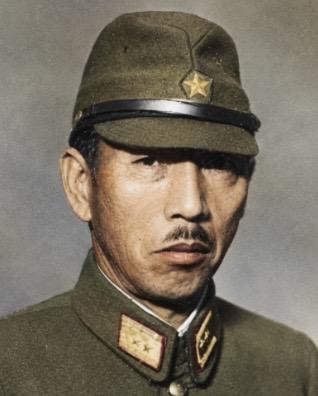
Lt General Yoshitsugu Saito
Lieutenant General Yoshitsugu Saitō was one of the Japanese commanders whose name became forever connected with the terrible Battle of Saipan. He was not one of Japan’s most famous generals before the war reached the Mariana Islands, but his final command placed him at one of the most important turning points of the Pacific War. His life followed the path of a professional officer in the Imperial Japanese Army, from military education and cavalry service to senior command in a battle that Japan could not realistically win.
He was born on 2 November 1890, at a time when Japan was changing rapidly into a modern military power. The country had already begun to look beyond its own shores and was building an army and navy capable of competing with the great powers of the world. Young men who entered the officer class in this period were trained in strict discipline, loyalty to the Emperor and the belief that personal sacrifice for Japan was the highest duty. This way of thinking shaped his whole career and helped explain the decisions he made at the end of his life.
He entered military training as a young man and graduated from the Imperial Japanese Army Academy in 1912. He was commissioned into the cavalry, a branch of the army that still carried a great deal of prestige, even though modern warfare was already beginning to change the battlefield. Horses still mattered in many armies, especially for reconnaissance and movement, but machine guns, artillery, aircraft and motor vehicles were beginning to reduce the old role of cavalry. His early service gave him a grounding in discipline, command and mobility, and he later continued his military education at the Army Staff College, where Japan trained officers for senior command and planning roles.
Graduating from the Staff College was important for any officer who wanted to rise in the Imperial Japanese Army. It opened the way to staff appointments and higher responsibility. He was not a dramatic front-line hero in his early career, but he was a capable and steady professional soldier. He moved through the ranks during the years between the two world wars, when Japan’s army became increasingly powerful and ambitious. During this period Japan tightened its grip on Korea, expanded into Manchuria and became more deeply involved in China. Officers like him served inside a military system that was growing in confidence and becoming more aggressive.
By the late 1930s, he had reached senior positions. In 1938 he became Chief of Staff of the Japanese 5th Division, an important appointment that showed he was trusted with organisation and planning. The following year he was promoted to major general and given cavalry duties connected with the Kwantung Army in Manchuria. The Kwantung Army was one of the most powerful and hard-line formations in the Japanese military. It had enormous influence in Japan’s expansion on the Asian mainland and was closely linked with the army’s aggressive policies. Service connected with it placed him within one of the most important parts of Japan’s military empire.
In 1942, he was promoted to lieutenant general. By then Japan was already at war with the United States, Britain and the other Allied powers. At first Japan had enjoyed astonishing victories, sweeping across Southeast Asia and the Pacific with great speed. British, American and Dutch possessions had fallen one after another, and for a short time Japan appeared unstoppable. But by 1942 the tide was beginning to turn. The defeat at Midway badly damaged Japanese naval power, and the long fighting at Guadalcanal showed that America had the industrial strength and determination to push back across the Pacific.
As the war turned against Japan, the defence of island strongholds became more and more important. Japan could no longer simply attack and expand. It now had to hold what it had taken. Saipan, in the Mariana Islands, became one of the key places in this defensive line. To Japan, Saipan was part of the shield protecting the home islands. To the Americans, it was a vital stepping stone. If Saipan could be captured, American forces would gain airfields close enough for B-29 Superfortress bombers to strike Japan itself. That made the island far more important than its size suggested.
His most famous command came in 1944, when he was placed in command of the Japanese 43rd Division and sent to Saipan. It was a difficult and dangerous appointment from the start. Japan’s shipping was under constant attack from American submarines and aircraft, and it was becoming harder to move troops, supplies and equipment across the Pacific. Some of the forces intended for Saipan suffered losses before they even reached the island. Once there, the defenders knew that if the Americans landed in strength, rescue or reinforcement would be unlikely.
He was not the only senior Japanese officer on Saipan. Admiral Chūichi Nagumo, famous for his role in the attack on Pearl Harbor, was also on the island. Nagumo represented the navy, while he commanded the army forces defending the ground. Both men were caught in the same collapsing situation. The Japanese army and navy had not always worked smoothly together during the war, but on Saipan there was no escaping the fact that both services were trapped in a battle of survival.
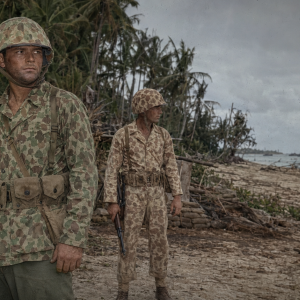
The American assault on Saipan began on 15 June 1944 after a heavy bombardment from ships and aircraft. US Marines and Army troops came ashore against strong resistance. The Japanese defenders had prepared caves, trenches, tunnels and defensive positions, using the island’s rough ground to make the American advance as costly as possible. The fighting became savage. Saipan was not a battle of wide open movement but one of ridges, cane fields, caves, villages and rocky ground, where defenders could appear suddenly from hidden positions and where every advance had to be fought for.
His men fought with determination, but they were facing overwhelming American firepower. The United States had naval guns, artillery, tanks, aircraft and a steady flow of supplies. Japan had courage and prepared positions, but courage alone could not replace food, ammunition, medical supplies or control of the sea and air. As the days passed, the Japanese defence was pushed back. The defenders were gradually forced northwards, and their position became more desperate.
The battle was also a disaster for the civilians on the island. Many Japanese civilians and local people were trapped in the fighting. Japanese propaganda had filled many with fear of what would happen if they were captured by the Americans. As the battle moved towards its end, civilians were caught between bombardment, starvation, panic and the collapse of Japanese authority. Some hid in caves, some tried to flee, and many died in terrible circumstances. Saipan became not only a military defeat for Japan but also a human tragedy.
For him, the defence of Saipan was a mission with almost no chance of success. His task was to delay the Americans, inflict as many casualties as possible and hold the island for as long as he could. In the thinking of the Imperial Japanese Army, surrender was not seen as an acceptable option. Officers and men were expected to fight to the death. This belief shaped the final stages of the battle. Instead of organising a surrender to save lives when the situation was hopeless, he prepared for one final attack.
By early July 1944, Japanese resistance on Saipan was close to collapse. Many soldiers were wounded, hungry and short of ammunition. Some had no proper weapons left. Others were barely able to walk. Yet the order was given for a final banzai charge. In the early hours of 7 July 1944, thousands of Japanese troops surged forward in one of the largest banzai attacks of the Pacific War. It was a terrifying sight. Wounded men, soldiers armed with rifles, bayonets, swords, grenades and even improvised weapons threw themselves against the American lines.
The attack struck the positions of the US Army’s 27th Infantry Division and caused heavy casualties. Some American positions were overrun in the confusion and darkness. The fighting was close, brutal and chaotic. But the charge could not change the result of the battle. American firepower eventually broke the attack, and when the fighting ended thousands of Japanese soldiers lay dead. It was a final act of desperate courage, but militarily it was hopeless. The Japanese garrison had spent its last strength.
He did not survive the fall of Saipan. As the battle reached its end, he chose suicide rather than capture. Accounts describe him committing ritual suicide in a cave, with an aide completing the act by shooting him. Admiral Nagumo also died by suicide during the final collapse. Their deaths reflected the military code they served, where capture was considered disgrace and death was seen as the only honourable end for a defeated commander.
After his death, his body was recovered by American forces. In an unusual and striking gesture, he was given a military funeral by his enemies. The Americans had fought his forces in one of the fiercest battles of the Pacific, yet his rank and position were still recognised in formal military fashion. It was a moment that showed the strange mixture of hatred, respect, duty and tradition that could exist even after such bitter fighting.
The fall of Saipan was a disaster for Japan. It broke a major part of the Japanese defensive line and gave the United States the airfields it needed in the Marianas. From there, B-29 bombers would be able to strike the Japanese home islands. The defeat also helped bring down the government of Prime Minister Hideki Tōjō, showing how serious the loss was regarded in Tokyo. Saipan proved that Japan could no longer stop the American advance across the Pacific.
Yoshitsugu Saitō is remembered mainly because of this final battle. He was not a general famous for sweeping victories or brilliant campaigns. He was a professional officer who rose steadily through the Imperial Japanese Army and ended his life commanding a doomed defence. His story shows the harsh world of the Japanese military system, where obedience, sacrifice and refusal to surrender were treated as sacred duties. On Saipan those beliefs led to courage, but also to needless death on a terrible scale.
His final stand remains one of the grim symbols of Japan’s island warfare in the Pacific. Saipan was a battle of soldiers trapped by geography, ideology and a war that had turned against them. His career ended in a cave on an island that Japan could not hold, while the battle around him opened the way for the bombing of Japan itself. His life and death are therefore tied to one of the decisive moments of the Pacific War, when the Japanese Empire’s outer shield was shattered and the road to the home islands began to open.