
On this day in military history…
The Battle of Britain was one of the most important turning points of the Second World War, fought in the skies over Britain between 10 July and 31 October 1940. It was the first major campaign in history decided almost entirely by air power, and it became the moment when Britain stood alone against Nazi Germany after the fall of France. Adolf Hitler knew that before any invasion of Britain could take place, the Royal Air Force had to be destroyed or driven from the skies. Without control of the air, the planned German invasion, known as Operation Sea Lion, could not safely cross the English Channel.
By the summer of 1940, Germany appeared almost unstoppable. Poland had fallen in 1939, then Denmark, Norway, Belgium, the Netherlands and France had all been defeated in 1940. The British Expeditionary Force had escaped from Dunkirk, but much of its heavy equipment had been left behind. Britain now faced the full weight of the German war machine, and the Luftwaffe, commanded by Reichsmarschall Hermann Göring, was ordered to crush British air defences and open the way for invasion.
The RAF defence of Britain was led by Air Chief Marshal Sir Hugh Dowding, commander of RAF Fighter Command. Dowding was not a loud or flamboyant leader, but he was calm, careful and technically minded. He understood that Britain could not afford to waste its limited number of pilots and aircraft in reckless battles. His system of defence was built around control, timing and concentration. He knew that the RAF did not need to destroy the whole Luftwaffe; it simply had to survive and prevent Germany gaining air superiority over southern England.
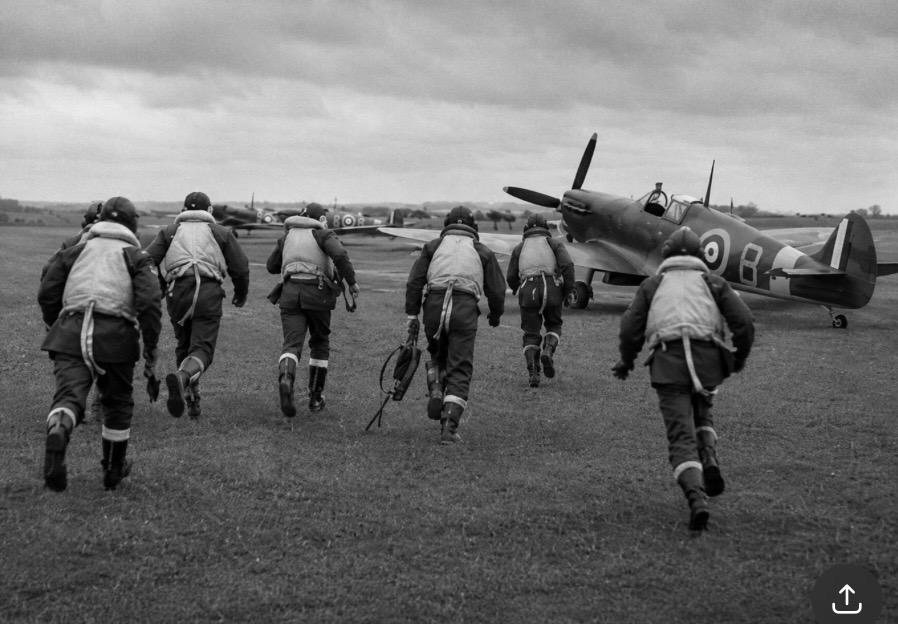
Under Dowding, Fighter Command was divided into groups. The most important during the battle were No. 11 Group, covering London and south-east England under Air Vice-Marshal Keith Park, and No. 12 Group, covering the Midlands and East Anglia under Air Vice-Marshal Trafford Leigh-Mallory. Park’s 11 Group bore the heaviest burden because it faced the main attacks crossing the Channel from France and Belgium. His pilots were often scrambled several times a day, climbing rapidly to meet incoming raids before they reached their targets.
The Battle of Britain began on 10 July 1940 with attacks on British shipping in the Channel. This first phase was intended to draw RAF fighters into combat and weaken Britain’s coastal defences. The Germans then moved on to attacking radar stations, airfields and aircraft factories. By August, the battle had become intense, with large formations of German bombers and fighters crossing the coast in daylight. The Luftwaffe used aircraft such as the Messerschmitt Bf 109 fighter, Messerschmitt Bf 110 twin-engined fighter, Heinkel He 111 bomber, Dornier Do 17 bomber and Junkers Ju 88 bomber, along with the feared Junkers Ju 87 Stuka dive bomber, though the Stuka proved too vulnerable against modern fighters and was withdrawn from the main daylight battle.
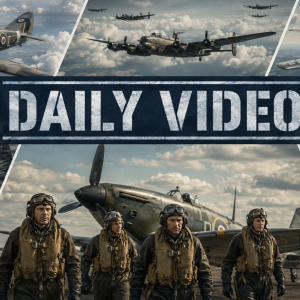
The RAF relied mainly on the Hawker Hurricane and the Supermarine Spitfire. The Spitfire became the most famous aircraft of the battle because of its elegant design and high performance, but the Hurricane actually made up the larger part of Fighter Command’s strength and destroyed many of the German bombers. The usual method was for Spitfires to take on the German fighters while Hurricanes attacked the bomber formations, though in the confusion of battle this was not always possible.
At the start of the battle, Fighter Command had roughly 640 serviceable fighters available, though the numbers changed daily due to losses, repairs and new production. The Luftwaffe had a much larger force available for the campaign, with around 2,500 aircraft of all types positioned for operations against Britain, including fighters, bombers and reconnaissance aircraft. In total, over the course of the battle, the RAF committed around 2,900 aircrew from Britain, the Commonwealth and occupied Europe. German aircrew involved numbered far higher, and the Luftwaffe could send large formations over Britain, sometimes with hundreds of aircraft in a single day.
One of Britain’s greatest advantages was not simply the Spitfire or Hurricane, but the organisation behind them. This was the Dowding System, a connected air defence network that brought together radar, observers, plotting rooms, sector stations, command centres and fighter squadrons. At the heart of this system was the Chain Home radar network, a line of tall radar towers built along the coast before the war. These stations could detect incoming aircraft while they were still far out over the sea, giving Fighter Command precious warning time.
Chain Home radar was not perfect. It could not always identify aircraft types or numbers accurately, and it was less effective at low altitude, but it gave Britain something the Luftwaffe did not fully understand at first: time. Instead of leaving fighters circling the skies wasting fuel and exhausting pilots, RAF controllers could keep aircraft on the ground until an enemy raid was detected. Once radar picked up a formation, information was passed to the Filter Room at Bentley Priory, Fighter Command’s headquarters. There, reports were checked, plotted and sent to group and sector control rooms. From there, RAF squadrons were scrambled and directed toward the incoming enemy.
This system allowed the RAF to manage the onslaught from a larger Luftwaffe force with far greater efficiency. Britain did not have to match Germany plane for plane. It could place the right squadrons in the right area at the right time. This was crucial because RAF pilots were under enormous pressure. Many flew several sorties a day, and the strain on them was severe. Some were very young, barely out of training, and they were sent into combat against experienced German pilots who had already fought over Poland, France and the Low Countries.
The Luftwaffe did try to attack the radar stations, especially in August 1940, but it failed to realise how important they were to the whole British defence system. Some stations were damaged, but most were repaired quickly, and the Germans wrongly concluded that the radar network was too difficult to destroy or not worth the effort. This was one of their greatest mistakes. As long as Chain Home and the control system remained in operation, Fighter Command could continue to see the enemy coming and respond intelligently.
The hardest period for the RAF came in August and early September 1940, when German attacks focused heavily on airfields, sector stations and aircraft production. Biggin Hill, Kenley, Hornchurch, North Weald and other vital bases came under repeated attack. Pilots were exhausted, ground crews worked under bombardment, and some sector stations were badly damaged. For a time, Fighter Command was under very serious strain. The battle was not easily won, and there were moments when Britain’s defensive system came close to being overwhelmed.
Then came a major shift. After RAF raids on Berlin, Hitler and Göring ordered the Luftwaffe to concentrate more heavily on London. On 7 September 1940, large German formations attacked the capital in what became the start of the Blitz. This caused terrible suffering for civilians, but it also relieved pressure on Fighter Command’s forward airfields. The RAF now had more room to recover, repair and reorganise. The Luftwaffe hoped that bombing London would break British morale and draw RAF fighters into a decisive battle, but it failed to achieve either result.
The most famous day of the battle came on 15 September 1940, later remembered as Battle of Britain Day. The Luftwaffe launched major attacks against London, believing the RAF was close to collapse. Instead, Fighter Command met the raids in strength. RAF squadrons rose again and again to intercept the bombers, and the German formations suffered heavy losses. Although claims made at the time were higher than later confirmed, the day proved that the RAF was far from defeated. Two days later, on 17 September 1940, Hitler postponed Operation Sea Lion. The invasion of Britain would never take place.
By the end of October 1940, daylight attacks had greatly reduced, and the Battle of Britain was considered over. The Luftwaffe had failed to destroy Fighter Command, failed to gain air superiority and failed to force Britain out of the war. The RAF lost more than 1,000 aircraft during the battle, while the Luftwaffe lost around 1,700 aircraft. More than 500 RAF aircrew were killed, while German aircrew losses were much higher, with many killed, wounded or captured. Britain had suffered heavily, but it had survived.
The battle was not fought by British pilots alone. Men from across the Commonwealth and from occupied countries joined the RAF in Britain’s defence. Pilots came from Poland, Czechoslovakia, Canada, Australia, New Zealand, South Africa, Belgium, France, Ireland, Jamaica, Rhodesia and other nations. The Polish pilots in particular earned a fierce reputation, with No. 303 Polish Squadron becoming one of the most successful fighter squadrons of the battle. These men had already seen their own countries fall and now fought with a personal determination to strike back at Germany.
The significance of the Battle of Britain was enormous. It was Hitler’s first major defeat of the war. Until then, Germany had won campaign after campaign through speed, surprise and overwhelming force. In Britain, for the first time, the German advance was stopped. The victory kept Britain in the war as a base for future operations, intelligence work, naval warfare, bombing campaigns and eventually the liberation of Western Europe. Without Britain surviving in 1940, there would have been no secure launching point for D-Day in 1944.
The battle also proved the importance of radar, command and control, aircraft production, trained pilots and national morale. It showed that air defence was not just about brave men in fast aircraft, but about a whole system working together. Radar operators, plotters, telephone staff, ground crews, armourers, mechanics, observers, firefighters, ambulance crews and factory workers all played their part. Every minute gained by radar, every repaired aircraft, every refuelled Hurricane or rearmed Spitfire helped keep Britain in the fight.
Winston Churchill captured the meaning of the battle in his famous tribute to Fighter Command when he said, “Never in the field of human conflict was so much owed by so many to so few.” The “Few” became the name given to the RAF fighter pilots who defended Britain in 1940, but the victory belonged to a wider national effort. The battle was won through courage in the air, skill on the ground and the remarkable foresight of men like Hugh Dowding, who had built a defensive system before Britain’s darkest hour arrived.
The Battle of Britain remains one of the defining moments of modern British history. It was not a vast land battle with armies moving across continents, but a struggle fought in the sky by young men whose actions shaped the future of Europe. Against a larger enemy, Britain used radar, organisation, technology, determination and courage to hold the line. The Luftwaffe came to destroy the RAF and open the door to invasion, but instead it found a defence system that bent under pressure yet did not break. In the summer and autumn of 1940, Britain stood alone, and because it stood, the war continued until victory became possible.