On this day in military history…
Operation Husky was the Allied invasion of Sicily in July 1943 and it became one of the most important turning points of the Second World War. It was the first major Allied assault on Axis-held European territory and it opened the road towards Italy itself. The operation brought together British, American, Canadian and other Allied forces in a huge combined attack by sea and air, involving warships, landing craft, aircraft, airborne troops, commandos, infantry, armour and supply units. It was not only a battle for an island, but also a test of whether the Allies could return to mainland Europe after years of German and Italian control.
By 1943 the war had begun to turn against the Axis powers. In North Africa, British and Commonwealth forces had stopped Rommel at El Alamein, and American and British forces had landed in French North Africa during Operation Torch. After months of fighting, Axis forces in Tunisia finally surrendered in May 1943, leaving the Allies in control of North Africa. From there, the next obvious question was where to strike next. Sicily stood directly in the centre of the Mediterranean, between North Africa and Italy. If the Allies captured it, they could open the sea lanes through the Mediterranean, threaten mainland Italy, and force Germany to divert troops from other fronts.
The decision to invade Sicily was agreed by Allied leaders as the next step after victory in North Africa. There were other arguments about whether the Allies should concentrate on a cross-Channel invasion of France as soon as possible, but in 1943 the forces and landing craft needed for that operation were not yet fully ready. Sicily offered a realistic target and a major strategic prize. It would also place enormous pressure on Mussolini’s Fascist regime, which was already weakened by military defeats, bombing raids, shortages and growing public discontent.
Sicily was defended by both Italian and German forces. The Italian Sixth Army formed the bulk of the island’s defence, but morale among many Italian units was poor after years of defeat and hardship. Some units fought strongly, while others collapsed quickly or surrendered in large numbers. The Germans, however, were a different matter. German formations on Sicily included tough, mobile and experienced troops such as the Hermann Göring Division and later the 15th Panzergrenadier Division. Their role became increasingly important as the campaign developed, because German commanders understood that even if Sicily could not be held forever, they could delay the Allies and evacuate men and equipment across the Strait of Messina.
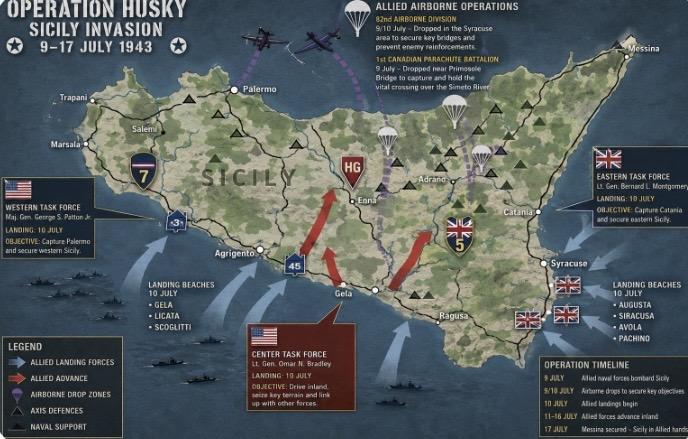
The Allied plan was ambitious. General Dwight D. Eisenhower was the overall Allied commander in the Mediterranean. General Harold Alexander commanded the ground forces. The British Eighth Army, under General Bernard Montgomery, would land in the south-east of Sicily, while the United States Seventh Army, under Lieutenant General George S. Patton, would land further west along the southern coast. Canadian troops formed part of the British Eighth Army and would fight their way inland through difficult country. The plan was to seize ports, airfields and roads, then push north and east towards Messina, the gateway to mainland Italy.
The invasion began during the night of 9th/10th July 1943. Before the seaborne landings, Allied airborne forces were dropped into Sicily to seize key points, disrupt communications and support the beach landings. British glider troops were sent towards the area around Syracuse, while American paratroopers were dropped further west. These airborne operations showed both the bravery of the troops and the serious difficulties of night airborne warfare. Strong winds, poor navigation, anti-aircraft fire and confusion scattered many men far from their intended drop zones. Some gliders crashed into the sea, drowning soldiers before they ever reached the battlefield. Others landed miles from their objectives. Yet even when scattered, many airborne troops formed small groups and attacked roadblocks, bridges and enemy positions, causing confusion among the defenders.
At sea, the invasion fleet was enormous. Thousands of vessels were involved, from battleships, cruisers and destroyers to landing craft, transport ships and support vessels. Allied naval forces carried the assault troops across from North Africa and Malta towards the Sicilian coast. The weather was difficult, with high winds and rough seas, but this also helped achieve surprise because some Axis commanders believed no major landing would be attempted in such conditions. As dawn came on 10th July, Allied troops began coming ashore across a wide front.
The British Eighth Army landed around the south-eastern corner of Sicily, including areas near Pachino, Avola and Cassibile, with Syracuse as an early objective. British and Canadian troops made good progress at first, capturing key positions and moving inland. Syracuse fell quickly, giving the Allies a useful port. The Americans landed around Gela, Licata and Scoglitti. At Gela, American troops faced strong counterattacks from Italian and German forces, including armour. The situation became dangerous, but naval gunfire from Allied warships played a crucial role. Shells from cruisers and destroyers smashed enemy tanks and troop concentrations, helping the Americans hold the beachhead.
The early landings were a success, but the campaign soon became harder. Sicily’s landscape made movement difficult. The island had mountains, narrow roads, steep valleys, dry riverbeds, stone villages and rugged high ground that favoured defenders. The summer heat was intense, dust covered men and vehicles, and water supplies were often limited. Tanks and trucks could not always move easily through the terrain, meaning infantry often had to fight forward village by village and ridge by ridge.
Montgomery’s Eighth Army originally hoped to drive quickly north along the eastern side of the island towards Catania and then Messina. However, German resistance around the Catania plain and Mount Etna slowed the advance. The Germans used the terrain skilfully, blocking roads, holding high ground and launching sharp counterattacks. The country around Mount Etna became a natural defensive barrier. British and Canadian forces faced hard fighting at places such as Lentini, Vizzini, Agira, Leonforte, Assoro and Adrano. These were not easy battles. They involved climbing, close-quarter fighting and attacks against positions that were often hidden among stone buildings, hills and ridges.
As the British advance slowed in the east, Patton’s Seventh Army pushed across western Sicily. At first, the American role had been seen partly as protecting Montgomery’s flank, but Patton wanted a more aggressive part in the campaign. His forces moved rapidly westwards, capturing Palermo on 22nd July 1943. The fall of Palermo was a major political and psychological blow. It showed that Italian control of Sicily was collapsing and gave the Americans a major success. Patton then turned his forces eastwards and began a race towards Messina.
The campaign became known partly for the rivalry between Montgomery and Patton. Both men were ambitious, forceful commanders with very different styles. Montgomery was careful, methodical and focused on set-piece operations. Patton was bold, fast-moving and determined to show what American troops could do. This rivalry helped drive the Allied advance, but it also reflected wider tensions between British and American approaches to the war. Despite this, the campaign depended on the combined strength of all Allied forces, including British, American, Canadian, naval, air and logistical units.
Air power played a major role throughout Operation Husky. Allied aircraft attacked Axis airfields, roads, bridges, ports and troop movements. Before the invasion, Allied bombing helped weaken Axis air strength on and around Sicily. During the campaign, fighters and bombers supported ground forces and made it increasingly difficult for Axis troops to move openly in daylight. However, the operation also revealed problems in Allied coordination. There were tragic friendly-fire incidents, including attacks on Allied transport aircraft carrying paratroopers. These incidents caused heavy losses and showed how difficult it was to coordinate air, land and sea forces in such a large operation.
For the Italian people and soldiers, the invasion came at a moment of deep crisis. Many Italians were tired of the war. Sicily had suffered bombing, shortages and military occupation. Some civilians welcomed the Allies or simply wanted the fighting to end. Others were caught between retreating Axis forces, advancing Allied troops and the destruction caused by battle. Italian soldiers varied greatly in their response. Some fought bravely, especially where leadership and supplies held together, while many others surrendered, deserted or went home. The collapse of morale among large parts of the Italian Army showed how fragile Mussolini’s regime had become.
The political consequences were dramatic. On 25th July 1943, while the campaign in Sicily was still underway, Mussolini was removed from power after a meeting of the Fascist Grand Council and then arrested on the orders of King Victor Emmanuel III. Marshal Pietro Badoglio became head of the Italian government. Although Italy did not immediately leave the war publicly, the fall of Mussolini was a huge result of the Allied invasion. Operation Husky had achieved far more than a military foothold; it had shaken the Axis alliance and pushed Italy towards surrender.
The Germans reacted quickly to Italy’s weakening position. They did not trust the new Italian government and began preparing to occupy key areas of Italy if the Italians changed sides. In Sicily, German commanders concentrated on delaying the Allies while organising an evacuation across the Strait of Messina. This evacuation became one of the most controversial parts of the campaign. Despite Allied control of the air and sea being much stronger than before, the Germans managed to evacuate tens of thousands of troops, along with vehicles, guns and equipment, from Sicily to mainland Italy. The evacuation was carried out with skill and discipline, using ferries, barges and small craft under cover of darkness, smoke and anti-aircraft defences.
Messina finally fell on 17th August 1943. Patton’s American troops reached the city shortly before Montgomery’s forces arrived from the south. The capture of Messina marked the end of the Sicilian campaign. The Allies had taken the island in just over five weeks. The operation had cost thousands of casualties on both sides, but it was a major Allied victory. Sicily was now in Allied hands, the Mediterranean sea routes were safer, and the path to mainland Italy was open.
Operation Husky proved that the Allies could carry out a massive amphibious invasion against defended territory. It gave valuable experience that would later be used in the Normandy landings in June 1944. Lessons were learned about landing craft, beach organisation, airborne drops, naval gunfire support, air coordination, supply build-up and cooperation between different Allied armies. Not everything went smoothly, and mistakes were made, but the operation showed that the Allies were gaining the ability to plan and execute huge combined operations.
The invasion also had a major effect on German strategy. Germany had to send more troops to Italy and the Mediterranean, tying down divisions that might otherwise have been used on the Eastern Front or later in France. Hitler now had to defend southern Europe as well as fight the Soviets in the east and prepare against a future invasion in the west. Sicily was not the final blow against Germany, but it widened the war and forced the Axis onto the defensive.
For the soldiers who fought there, Operation Husky was a hard and exhausting campaign. It was not simply a quick island landing, but a brutal fight through heat, dust, mountains and defended towns. British, American, Canadian and other Allied troops faced mines, machine guns, artillery, snipers, counterattacks and the constant strain of movement through hostile terrain. Many had already fought in North Africa and now found themselves moving into Europe itself. For them, Sicily was the beginning of a long road that would lead through Italy, France, the Low Countries and Germany.