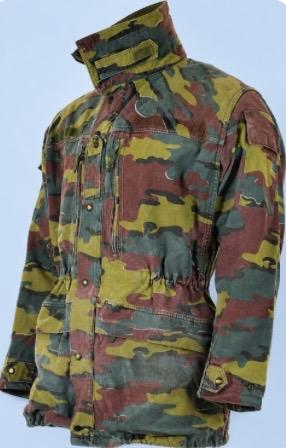
Belgian Jigsaw Camoflage
Belgian jigsaw camouflage is one of the most instantly recognisable military camouflage patterns ever used in Europe, and unlike many designs that tried to disappear into the background, this one almost became famous because of how strange it looked. With its broken puzzle-like shapes, dark greens, earthy browns, black outlines and lighter tan or khaki areas, it looked as though someone had taken pieces of woodland, mud, shadow and dry grass and locked them together like a battlefield jigsaw. It was bold, unusual and very Belgian, and for decades it gave Belgian soldiers an identity that could be spotted almost immediately among NATO troops.
The pattern first appeared in the mid-1950s, at a time when many armies were still working out what the future of combat dress should look like after the Second World War. Belgium had already been influenced by British wartime airborne camouflage, particularly the Denison smock style used by paratroopers and commandos, but the Belgians gradually developed their own distinctive look. The result was not a simple copy of British brushstroke camouflage, but a new pattern with harder, interlocking shapes that gave it the nickname “jigsaw.” It was officially associated with Belgian service from 1956 and remained in use, in different versions, until it was replaced by more modern camouflage in the 2020s.
What made Belgian jigsaw so interesting was that it did not try to be subtle when seen close up. At arm’s length it looks almost too loud, with big blocks of colour that seem more artistic than military, but camouflage is not judged by how it looks in a museum or on a hanger. It is judged by what it does to the human outline at distance. In woodland, broken ground, hedge lines, dark fields and European countryside, those large irregular patches helped split up the shape of the body, especially when a soldier was crouched, moving through vegetation or partly hidden in shadow. The black and dark green areas gave depth, the brown worked well with earth and tree trunks, and the lighter colours stopped the whole uniform becoming one dark mass.
The Belgian Army used jigsaw camouflage across many items of clothing and equipment, including jackets, trousers, parkas, smocks, helmet covers and field gear. It became especially associated with Belgian airborne, commando and elite troops, which gave it a certain status among collectors and soldiers. Over time, it spread beyond those original specialist units and became part of the wider Belgian military image. Like many long-serving patterns, it changed slightly through the years. Earlier versions could look heavier and more brush-like, while later versions such as the M1999 pattern appeared sharper, more regular and better suited to modern uniform production. The basic idea, however, remained the same: large puzzle-shaped blocks that broke up the wearer in the mixed terrain Belgium expected its forces to fight in.
One reason the design lasted so long was that Belgium’s likely battlefield during the Cold War was not desert or jungle, but the wooded and agricultural terrain of Western Europe. Belgium sat in a region that NATO considered strategically important, with roads, forests, villages, fields and industrial areas all close together. A camouflage pattern had to work in damp woodland, muddy training areas, green fields, urban edges and low light. Jigsaw was not perfect everywhere, but it was surprisingly adaptable, and its bold shapes made it effective in the kind of broken European background where small-pattern camouflage can sometimes blend into a single blur.
The pattern also gained a life outside Belgium. Belgian military influence, surplus supply and historical links helped similar jigsaw-style camouflage appear in several other countries, particularly in parts of Africa. Some nations used close copies, while others adapted the idea with different colours. This made Belgian jigsaw more than just a national uniform; it became part of a small family of camouflage designs inspired by the Belgian original. For collectors, this can make the subject fascinating but also confusing, because not every jigsaw-looking jacket is Belgian issue, and small differences in cut, fabric, colour and labels can matter a great deal.
To the soldier, jigsaw camouflage was practical field clothing, but to collectors it has become one of the most characterful European patterns of the post-war era. Original Belgian jackets and trousers are still found on the surplus market, though condition, date, unit association and early production details can affect desirability. Airborne and commando-related pieces are usually more interesting to collectors, especially if they have clear markings, original buttons, correct zips or signs of genuine service use. Later items are often easier to find, while early examples can be much harder to obtain in good condition.
Part of the appeal is that Belgian jigsaw has personality. Many camouflage patterns are difficult to tell apart unless you are a specialist, but Belgian jigsaw is different. It looks almost rebellious compared with the neat digital and multicam designs that later became common. It has a Cold War feel, a European airborne connection and a look that belongs to Belgium in the same way DPM belongs to Britain or Flecktarn belongs to Germany. It is both functional and iconic, which is not something that can be said of every military uniform pattern.
By the time Belgium moved away from jigsaw and adopted newer camouflage, the old pattern had already earned its place in military history. It had served through decades of Cold War preparation, NATO exercises, overseas deployments and changing military fashion. Its replacement made sense in a modern alliance where shared patterns and updated combat clothing are easier to supply and standardise, but something distinctive was lost when it disappeared from regular Belgian service.