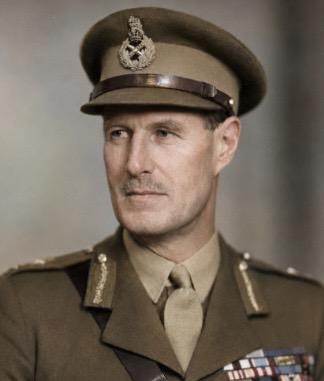
Lt General John Crocker
Lieutenant General Sir John Tredinnick Crocker was one of the most capable British commanders of the Second World War, yet he never became as widely known as Montgomery, Alexander, Horrocks or some of the other senior figures of the campaign. He was not a man who chased publicity, and in many ways that explains why his name is not remembered as strongly as it should be. He was a quiet, serious and professional soldier, respected by those who served under him and trusted by many above him. His career stretched from the trenches of the First World War to the senior leadership of the post-war British Army, and his most famous command came on D-Day when his I Corps landed on Sword and Juno beaches and carried out one of the most difficult tasks of Operation Overlord.
He was born in London in January 1896, at a time when Britain was still an empire at its height and the British Army was shaped by Victorian traditions. He did not begin his military life as a polished Sandhurst officer. Instead, he entered the Army during the First World War as a private soldier in the Artists Rifles, a unit that became well known for producing officers during the war. This beginning mattered, because he understood soldiering from the ground up. He knew what it meant to be an ordinary man in uniform before he became a commander, and that experience helped shape his direct, practical and unsentimental style of leadership.
In 1917 he was commissioned into the Machine Gun Corps, one of the hardest and most dangerous branches of the British Army on the Western Front. Machine guns dominated the battlefield, and the men who served them lived in a world of mud, wire, artillery and constant danger. He served with the 174th Machine Gun Company, connected with the 59th Division, and saw fighting during the bitter campaigns of 1917 and 1918. He experienced the later stages of Passchendaele and then the German Spring Offensive of 1918, when the German Army made its last great attempt to break the Allied line before American strength could fully arrive.
He proved himself quickly. During the First World War he was awarded both the Military Cross and the Distinguished Service Order, an impressive achievement for a young officer. These awards showed that he was not merely a staff soldier or administrator, but a brave front-line officer who had already earned respect under fire. By the end of the war he had seen the full horror of industrial warfare, and like many of the best commanders of the Second World War, he carried those lessons forward. He understood firepower, organisation, discipline and the terrible cost of bad planning.
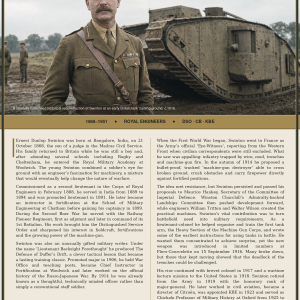
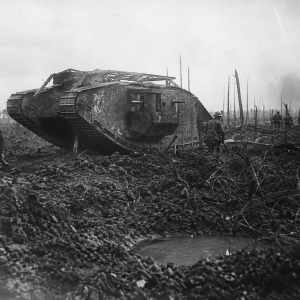
After the Armistice in November 1918, he remained connected with the Army. He later served in the Middlesex Regiment and then moved into the Royal Tank Corps, which was an important step in his career. Tanks had first appeared during the First World War as crude and unreliable machines, but between the wars they became the centre of a great military argument. Some officers saw them as infantry support weapons, while others believed armoured forces could break through and move fast in a new kind of war. He became one of the British officers who understood the importance of mechanisation, but he was never a reckless theorist. His strength was not wild ideas, but practical command and careful organisation.
During the years before the Second World War, he rose steadily through the Army. He served as an instructor and staff officer, including work connected with mobile and armoured formations. By the late 1930s he had become a senior professional soldier at a time when Britain was trying to modernise its Army while the threat from Nazi Germany grew stronger. In 1940, after the German invasion of France and the Low Countries, he commanded the 3rd Armoured Brigade during the campaign in France. The British Army was badly outmatched by the German blitzkrieg, and the campaign ended in evacuation and defeat, but for officers like him it was also a harsh education in modern mobile warfare.
After Dunkirk, Britain had to rebuild its Army while standing alone against Germany. He was given command of the 6th Armoured Division, a formation that had to be created, trained and shaped for future operations. This was one of the important periods in his rise, because it showed that he was trusted not only to command troops in battle, but also to build a fighting formation from the ground up. Training an armoured division was not simply a matter of having tanks. It required signals, maintenance, recovery vehicles, artillery, infantry cooperation, engineers, supply columns and commanders who understood speed and control. His eye for detail and firm standards made him well suited to this work.
His wartime rise continued when he was appointed to higher corps commands. In 1942 he commanded XI Corps in Britain before taking over IX Corps, which would later be sent to North Africa. Corps command was a major responsibility. A corps commander controlled several divisions and had to think beyond the battlefield directly in front of him. He had to balance infantry, armour, artillery, engineers, logistics and air support, while also working under an army commander and dealing with neighbouring formations. He had the mind for this level of command. He was not flamboyant, but steady, hard-working and serious.
In 1943 he took IX Corps to Tunisia during the final stage of the North African campaign. His corps included formations such as the 6th Armoured Division, 46th Infantry Division and 1st Armoured Division. The fighting in Tunisia was difficult country for armoured warfare, with hills, passes and strong German and Italian defensive positions. His time in active command there was cut short after he was wounded in a training accident involving a PIAT anti-tank weapon shortly before the final battle for Tunis. Even so, his service in Tunisia was recognised, and he was appointed a Companion of the Order of the Bath for his work during the campaign.
The most important chapter of his military career came when he was given command of I Corps for the invasion of Normandy. This placed him at the centre of Operation Overlord, the Allied return to north-west Europe. On D-Day, 6 June 1944, his I Corps had one of the most complex tasks of any Allied corps. It had to control landings on two beaches, Sword and Juno, while also coordinating with the airborne landings of 6th Airborne Division on the eastern flank. Under his command were British and Canadian formations, including 3rd British Division, 3rd Canadian Division, 2nd Canadian Armoured Brigade, 27th Armoured Brigade and 6th Airborne Division.
His task was enormous. His forces had to land from the sea, fight through coastal defences, link with airborne troops, secure the eastern flank of the invasion and push towards Caen. Caen was a vital road and communications centre, and the original hope was that it might fall on D-Day itself. That did not happen. German resistance, especially from armoured forces including elements of 21st Panzer Division, prevented the quick capture of the city. This failure has sometimes been viewed harshly, but the reality was that his corps had landed successfully, held its ground, protected the flank of the invasion and drawn powerful German units into battle around Caen.
The battle for Caen became one of the defining struggles of the Normandy campaign. His I Corps fought through a grinding series of operations in June and July 1944. This was not the fast open warfare that many had hoped for, but a brutal battle through villages, orchards, stone buildings, minefields and prepared German positions. The Germans defended fiercely because Caen mattered, and because British and Canadian pressure in the east helped hold German armour away from the American breakout area further west. His role was to keep the pressure on, manage difficult operations and maintain control of formations that were suffering heavy losses.
Operation Charnwood in July 1944 was one of the major battles involving his corps. The operation began with a huge bombardment and was followed by an infantry advance into northern Caen. British and Canadian troops fought their way into the city, and although the southern part of Caen remained in German hands for a time, Charnwood finally broke into the city after weeks of costly fighting. It was a harsh and controversial battle because Caen suffered terrible destruction and civilians paid a heavy price. For him and his men, it was also a battle that showed the reality of the Normandy campaign: progress was possible, but it was paid for in blood, rubble and exhaustion.
After Caen, I Corps continued to serve during the campaign in north-west Europe. His headquarters later came under First Canadian Army and took part in the advance towards the Seine and the operations along the Channel coast. These operations were important because the Allies needed ports, supply routes and secure rear areas. The fighting after Normandy is sometimes overshadowed by D-Day itself, but it was vital to the defeat of Germany in the west. He had to deal with a changing command structure, difficult relationships between senior commanders and the constant pressure of maintaining momentum after weeks of heavy fighting.
One of the personal tragedies of his war came in October 1944 when his son, Wilfrid, who was serving with the 5th Royal Inniskilling Dragoon Guards, was killed in action in the Netherlands during the fighting around ’s-Hertogenbosch. For a senior commander directing large formations across Europe, the war was not just lines on a map. He suffered the same kind of family loss that touched thousands of homes across Britain and the Commonwealth. It is one of the sad details of his story, and it reminds us that even generals were not protected from the personal cost of the war.
By 1945, as the Allied armies advanced into Germany, I Corps headquarters was moved away from its front-line role and given major administrative responsibilities in the rear areas of 21st Army Group. He had taken his corps from the beaches of Normandy through France, Belgium and Holland and into the final stage of the war in Europe. The Imperial War Museum holds material from him in April and June 1945, including his message to I Corps after hundreds of days of campaigning, praising its achievements in France, Holland and Belgium and speaking of its new duties in occupied Germany.
After the war, he continued to hold some of the most senior appointments in the British Army. He became General Officer Commanding-in-Chief Southern Command from 1945 to 1947, then Commander-in-Chief Middle East Land Forces from 1947 to 1950, a difficult post at a time when Britain was dealing with the aftermath of empire, the end of the Palestine Mandate and wider instability across the region. In 1950 he became Adjutant-General to the Forces, one of the highest posts in the British Army, responsible for major areas of personnel administration and military organisation. He served until 1953 before retiring from active service.
His honours reflected the importance of his service. He had already won the Military Cross and Distinguished Service Order in the First World War. During and after the Second World War he received further high honours, including appointment as Knight Commander of the Order of the British Empire and later Knight Grand Cross of the Order of the Bath. He was also mentioned in despatches and received foreign recognition. These honours tell only part of the story. His real achievement was that he had risen from private soldier to full general and had commanded troops in some of the most important British operations of the twentieth century.
After leaving the Army, he remained involved in public service. He served as Vice-Chairman of the Commonwealth War Graves Commission and became Lord Lieutenant of Middlesex. These roles suited a man who had spent his life in service and who understood the meaning of remembrance. The Commonwealth War Graves Commission was especially fitting, because he had seen the graves of two world wars filled by men he had served beside and commanded. His later life was quieter than his military career, but it remained connected to duty, memory and public responsibility.
Sir John Crocker died in London on 9 March 1963. He was 67 years old. His name may not have become legendary in the public imagination, but within the history of the British Army he deserves a stronger place. He was a soldier of both world wars, a decorated officer of the trenches, an armoured warfare professional, a corps commander in Tunisia and Normandy, and one of the men responsible for making the D-Day landings work on the British and Canadian beaches. He was not a showman and he did not build a myth around himself. He was the kind of commander who got on with the job, carried responsibility heavily, and helped guide British forces through some of the hardest fighting of the war.