On this day in military history…
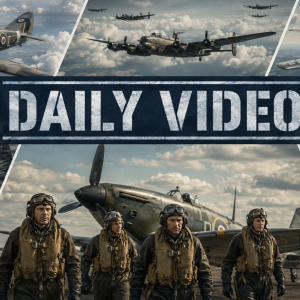
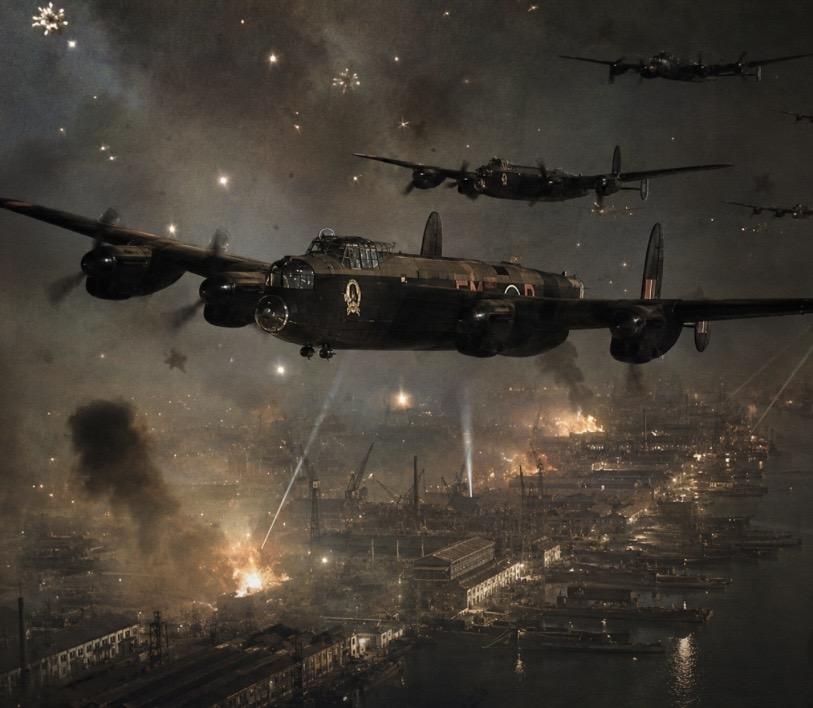
On 11 July 1942, RAF Bomber Command sent its new Avro Lancaster heavy bombers on one of the most ambitious daylight raids it had yet attempted. The target was the U-boat building yards at Danzig, now Gdańsk in Poland, a distant Baltic port far beyond the normal reach of British daylight bombing at that stage of the war. It was a bold strike, flown at a time when Bomber Command was still learning how best to use the Lancaster and when daylight operations over enemy territory remained extremely dangerous. The raid has often been remembered as the longest daylight operational flight made by RAF bombers up to that point, with the crews facing a round trip of about 1,500 to 1,750 miles depending on the route recorded.
The operation came only months after the Lancaster had entered front-line service. Bomber Command had already tested the aircraft in daring daylight attacks, including the famous Augsburg raid in April 1942, but Danzig was different. Augsburg had been a deep penetration target in southern Germany, but Danzig lay far away on the Baltic, beyond Denmark and northern Germany, and the crews would have to cross a great distance without fighter escort. The raid was therefore not simply a bombing mission; it was also a test of whether the Lancaster could be used as a long-range precision weapon in conditions where older RAF bombers would have struggled.
The operation was carried out under RAF Bomber Command, commanded at that time by Air Chief Marshal Sir Arthur Harris. The Lancasters involved came from No. 5 Group, the Bomber Command group most closely associated with early Lancaster operations. It was not a later Pathfinder-style raid with a single Master Bomber controlling the target from above; instead, the attack relied on carefully briefed crews, formation flying during the early stages, independent navigation through poor weather, and visual bombing once the aircraft reached the Baltic target area. Among the notable leaders and experienced captains involved were senior squadron figures such as Squadron Leader K. H. P. Beauchamp of No. 207 Squadron, who was later connected with gallantry awards following the Danzig operation, and Squadron Leader R. L. Hilton of No. 83 Squadron, who flew Lancaster R5868, later famous as “S for Sugar.”
A total of 44 Lancasters were dispatched against Danzig. This made it a sizeable force for such a distant and experimental daylight operation, especially when one remembers that the Lancaster was still new and only a limited number of squadrons had fully converted to the type. Some of the aircraft took off from Lincolnshire stations closely associated with the early Lancaster force. No. 207 Squadron aircraft operated from RAF Bottesford, near Grantham, while other Lancasters came from stations including RAF Scampton and RAF Langar; the preserved record for Lancaster R5868 states that it took off at 16.50 for the Danzig raid, carrying five 1,000 lb high explosive bombs and flying for 10 hours and 5 minutes.
The plan was unusual and risky. The Lancasters were to form up and fly low over the North Sea, reducing the chance of early detection. Once they were nearer enemy territory, they were expected to split up and use cloud cover over Denmark and the Baltic approaches to hide their movement. Danzig itself was expected to be clearer, allowing the crews to bomb the U-boat yards from a normal bombing height near dusk before turning west and making the long flight back to England in darkness. The thinking behind the plan showed the RAF trying to combine the surprise of low-level daylight approach with the accuracy of visual bombing, while also using the changing light to make the return journey less vulnerable.
The target mattered because Danzig was an important German-controlled Baltic port with shipbuilding and repair facilities. U-boats were one of the greatest threats to Britain’s survival in 1942. German submarines were attacking Allied shipping in the Atlantic, sinking merchant vessels, threatening convoys, and trying to cut the sea routes that carried food, fuel, weapons and men to Britain. Any attack on U-boat construction, repair or support facilities was therefore part of the wider Battle of the Atlantic. Danzig was not an easy target, but it was important enough for Bomber Command to risk a long-range strike at a time when Britain was under heavy pressure at sea.
The crews knew the distance alone made the raid extraordinary. A Lancaster was a powerful aircraft, but the long crossing demanded precise navigation, careful fuel management and discipline from every crew member. The pilots had to hold formation, often at low level, while the navigators worked across sea, cloud and hostile territory. Wireless operators, flight engineers, bomb aimers and gunners all had to remain alert for many hours. Unlike a short raid over occupied France or the Ruhr, there was little margin for serious damage, fuel miscalculation or navigational error. A badly damaged aircraft over the Baltic or northern Germany faced a long and lonely struggle home.
The weather added another layer of danger. Contemporary reports described the aircraft flying through violent thunderstorms and thick cloud, with the attack taking place in dramatic conditions over the target. Newspaper accounts spoke of lightning mixing with gunfire and bomb explosions with thunder, giving the raid an almost unreal quality. The Air Ministry reported that the attack was made from below cloud base and that the yards were heavily bombed. At around the same time, a smaller force also attacked submarine building yards at Flensburg, helping to stretch and distract German defences.
The raid achieved surprise. German fighters do not appear to have made effective contact with the main Lancaster force, which suggests the unusual route, low-level approach and weather helped protect the bombers. The greatest danger came over the target itself, where anti-aircraft fire was heavy. Of the 44 Lancasters dispatched, records state that 24 bombed Danzig and returned, while two more were shot down by flak at the target. Some aircraft failed to identify the target in time or bombed the general town area after darkness had fallen. The losses were painful, but for such a distant daylight operation they were lower than might have been expected.
One of the aircraft lost was Lancaster L7543, coded EM-Z, from No. 207 Squadron. It was flown by Flight Sergeant George Duke and was shot down during the Danzig operation. His aircraft became one of the human stories behind the statistics, a reminder that even a raid described as successful still carried a terrible cost for individual crews and families. Other crew accounts from 207 Squadron show how deeply the raid affected those who survived, particularly because the men had trained, lived and flown together in a tight operational community.
Another interesting aircraft connected with the raid was Lancaster R5868, later known as “S for Sugar,” one of the most famous surviving Lancasters. On 11 July 1942, it flew its first operational sortie to Danzig with Squadron Leader R. L. Hilton as pilot. The aircraft carried five 1,000 lb bombs and returned after more than ten hours in the air. Its record states that bombs burst on or near the target, and that after leaving the area its gunners engaged searchlights and gun positions with machine-gun fire. The attack by R5868 was recorded as being made from around 2,500 feet, which shows how close some aircraft came to the defended target area.
The Danzig raid was successful in several ways, but it was not a clean, simple victory. It proved that the Lancaster could reach very distant targets and return, that Bomber Command could mount a major daylight operation far beyond the normal operating area, and that surprise tactics could reduce fighter interception. It also struck an important U-boat-related target at a time when the submarine war was a matter of national survival. However, not every aircraft bombed accurately, and some crews were forced by weather, darkness and navigation problems to attack less precisely than planned. In that sense, it was a brave and partly successful operation rather than a decisive knockout blow.
What makes the raid especially interesting is that it belongs to a short and experimental period in Bomber Command’s war. In 1942, the RAF was still searching for methods that would make bombing more accurate and survivable. The Lancaster had the range, speed and bomb load to change what was possible, but navigation aids, target marking and bombing accuracy were still developing. Later in the war, the Pathfinder Force, improved radar, better marking techniques and massed bomber streams would transform Bomber Command’s methods. The Danzig raid came before many of those improvements had fully matured, which makes the courage of the crews even more striking.
The operation also showed the growing confidence Bomber Command had in the Lancaster. Earlier heavy bombers such as the Stirling and Halifax played important roles, but the Lancaster quickly proved itself as the aircraft that could carry heavy loads over long distances. Danzig demanded exactly those qualities. The aircraft had to lift a useful bomb load, fly deep into enemy-controlled Europe, survive bad weather and flak, and still bring its crew home across hundreds of miles of hostile airspace and sea.
For the men who flew it, the raid must have felt like an immense undertaking. They left their Lincolnshire airfields in daylight, knowing they were heading for a target so far away that no RAF bomber force had yet attempted anything quite like it by day. They crossed the North Sea, pushed on through cloud and storms, found the Baltic coast, attacked one of Germany’s important submarine centres, then turned back into the darkness for the long journey home. By the time the surviving crews landed, many had been airborne for around ten hours.
The raid on Danzig did not become as famous as Augsburg, the Ruhr battles or the later Dambusters operation, but it deserves to be remembered. It was daring, technically demanding and strategically connected to the life-and-death struggle against the U-boats. It tested the Lancaster at long range and showed what the new bomber could do in the hands of determined crews. Above all, it stands as one of those early Bomber Command operations where courage, experimentation and risk came together in a single long flight to the Baltic, carried out by men who were still helping to discover the full potential of one of Britain’s greatest wartime aircraft.