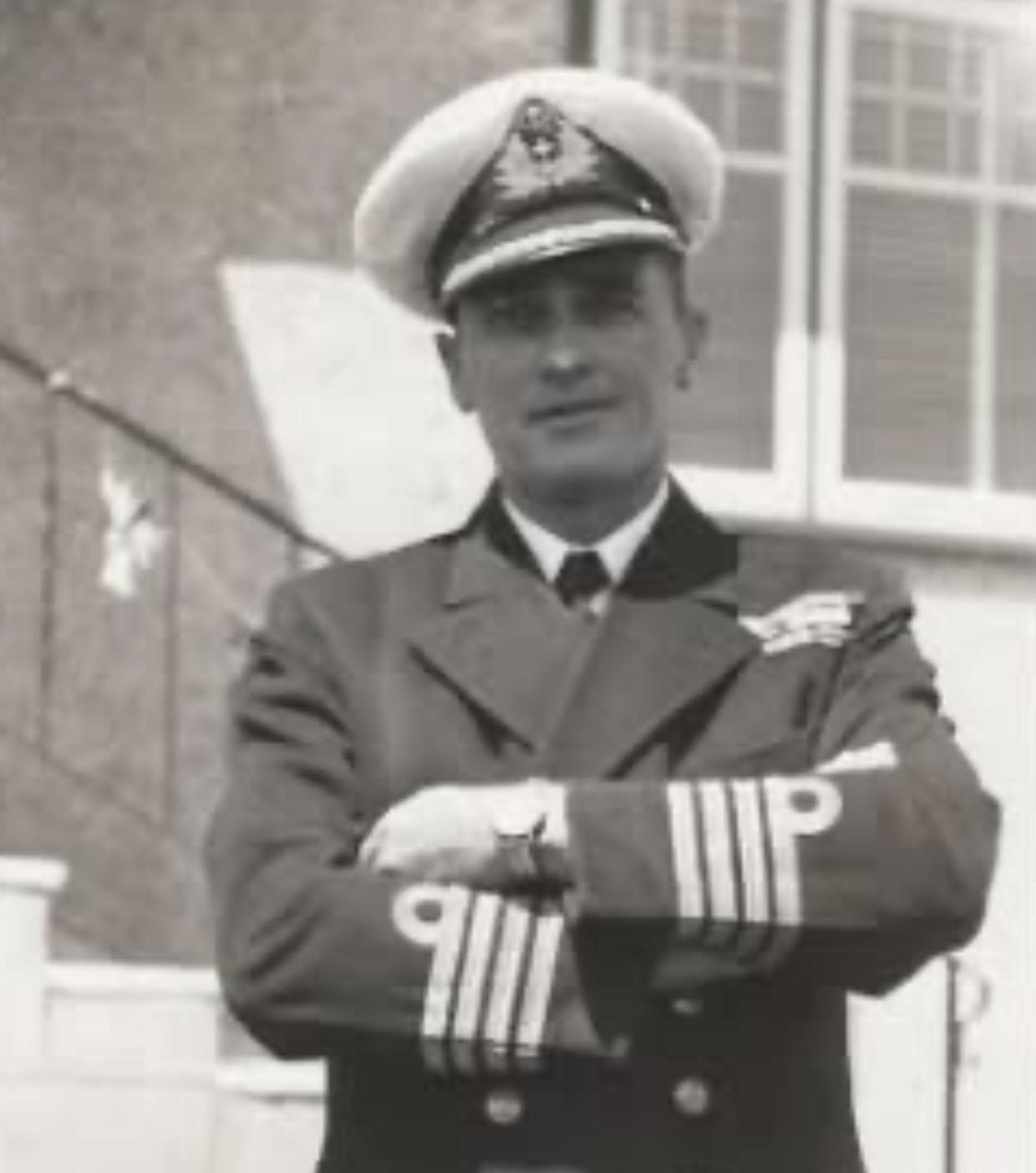
LT Commander W R Stacey
William Roland Stacey was a Royal Canadian Naval Reserve officer whose career came to prominence during the Battle of the Atlantic in the Second World War. Born on 8 July 1901 in Pangbourne, Berkshire, England, he grew up in the shadow of the First World War, at a time when naval service still carried enormous prestige within the British Empire. As a young man he emigrated to Canada, where he built his civilian life before committing himself to naval service as international tensions rose during the late 1930s.
Stacey joined the Royal Canadian Naval Reserve before the outbreak of war and was among the many reservists rapidly drawn into full-time service once hostilities began in September 1939. Like many officers of his generation, he learned his trade under pressure, gaining experience in escort duties, coastal patrols and minesweeping at a time when the Royal Canadian Navy was expanding at an unprecedented rate. Early in the war he served aboard the minesweeper HMCS Malpeque, a demanding posting that required constant vigilance against mines, submarines and air attack. His conduct during these formative years earned him a reputation as a calm and capable officer, and he was later Mentioned in Despatches in recognition of his dedication and effectiveness at sea.
As the war progressed, Stacey rose steadily through the ranks and was promoted to acting Lieutenant-Commander. By 1944 he was entrusted with ship command, first briefly with HMCS Ettrick and then with HMCS Saint John, a River-class frigate newly commissioned into the Royal Canadian Navy. These frigates formed the backbone of Allied anti-submarine warfare in the later years of the war, combining endurance, improved sonar and heavy depth-charge armament. Stacey’s command placed him at the sharp end of the Battle of the Atlantic, operating in some of the most dangerous waters around the British Isles.
Under Stacey’s leadership, HMCS Saint John took part in several successful actions against German submarines. One of the most notable occurred on 1 September 1944, when Saint John, working in cooperation with other Allied escorts, hunted down and destroyed a German U-boat after a prolonged and skilful pursuit. This engagement demonstrated Stacey’s ability to coordinate complex anti-submarine tactics while maintaining control of his ship and crew during hours of intense pressure.
His most significant success came on 16 February 1945. While operating in northern waters as part of an escort group, Saint John detected a submerged German submarine, U-309. Stacey directed a carefully executed attack using sonar tracking and depth charges, maintaining contact until the submarine was fatally damaged and sunk. The destruction of U-309 came at a late stage in the war, when Allied dominance at sea was being consolidated, but it remained a dangerous and exacting task. The sinking was a clear example of the effectiveness of well-trained escort commanders and crews in the final phase of the Battle of the Atlantic.
For his leadership and gallantry in these actions, Stacey was awarded the Distinguished Service Cross in 1945. The decoration recognised not a single moment of heroism but sustained excellence in command during operations against the enemy. Alongside his earlier Mention in Despatches, it marked him out as one of the many reservist officers whose wartime performance matched that of long-service regulars.
After the end of the war, Stacey remained involved with the Royal Canadian Navy in its reserve capacity. In the late 1940s he held the rank of Captain (Reserve) and served as commanding officer of HMCS Discovery in Vancouver, a shore establishment responsible for training reservists and supporting naval activity on Canada’s west coast. In this role he helped guide the navy’s transition from wartime expansion to peacetime organisation, passing on his operational experience to a new generation of sailors.
William Roland Stacey died in 1961. Although he was not widely known outside naval circles, his career reflects the broader story of Canada’s wartime navy: rapid expansion, intense operational demands, and the vital contribution of reserve officers to Allied victory at sea. His successful actions against German submarines, particularly the sinking of U-309 on 16 February 1945, stand as lasting evidence of his skill, determination and leadership during one of the most critical maritime campaigns of the Second World War.