Fallschirmjager knee pads
The knee pads worn by German paratroopers in the Second World War are one of those items that seem minor until you understand the very specific role they played in airborne doctrine. To the Fallschirmjäger, they were not an optional comfort item but a practical necessity shaped by how Germany trained its paratroopers to jump, land, and fight.
The idea for the knee pads did not come from a single named inventor. Instead, it emerged from the early development of German airborne forces in the mid-1930s. As parachute training expanded, accidents and injuries during landing quickly showed that standard infantry equipment was not sufficient. German airborne doctrine emphasized low-altitude static-line jumps, rapid descent, and immediate movement on landing. This exposed the knees and elbows to heavy impact forces, especially during training jumps. The knee pads were a response to these realities, developed through Luftwaffe training establishments and equipment offices rather than through an individual designer.
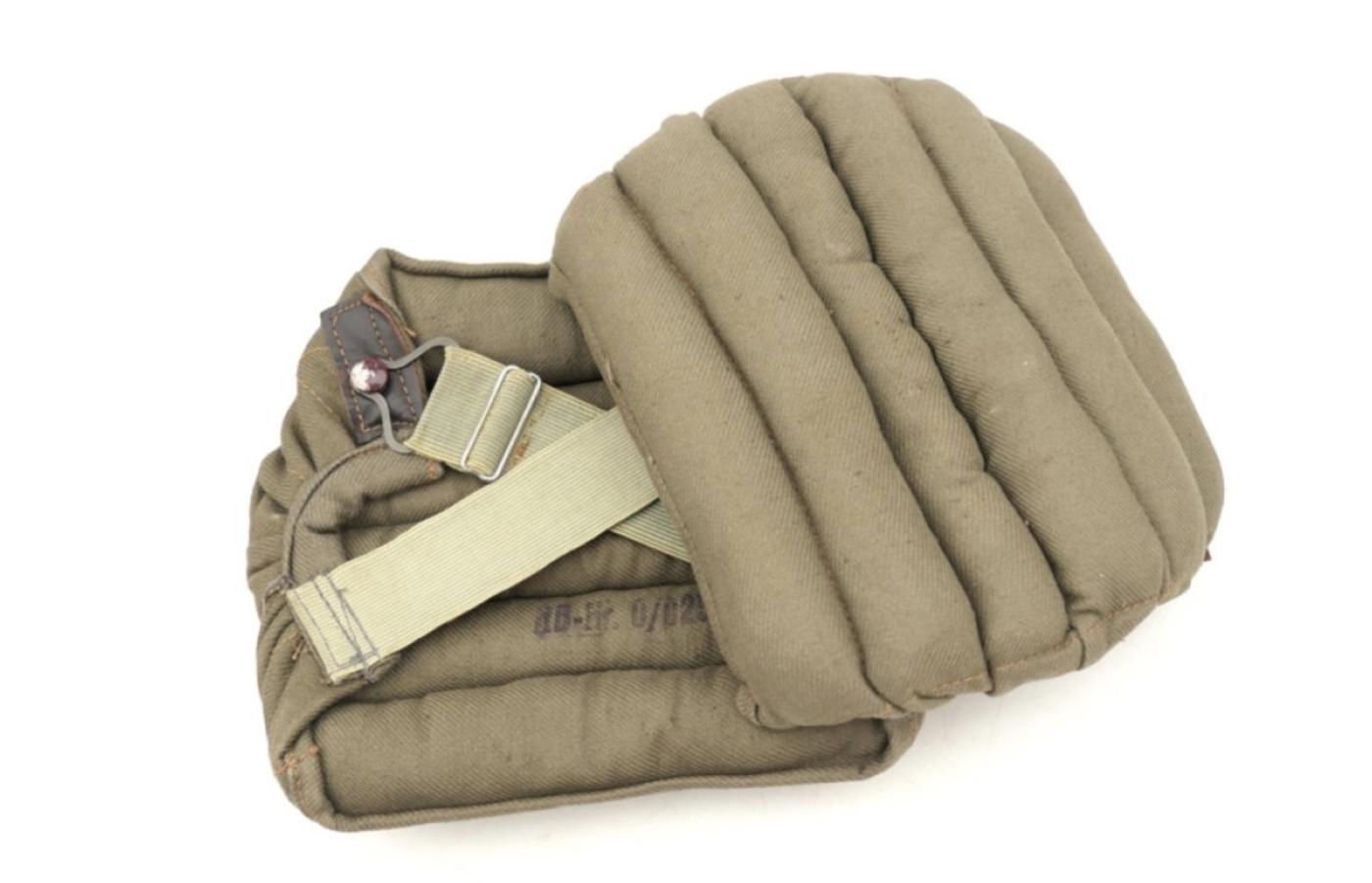
Manufacture followed the broader German wartime procurement system. The pads were produced by multiple civilian contractors under Luftwaffe contracts, rather than by a single factory. Most surviving examples are not marked with company names but instead carry Reichsbetriebsnummer markings, which were numerical codes used during the war to identify manufacturers without openly naming them. This system was intended to simplify logistics and obscure industrial information. Because of this, it is often impossible today to confidently assign a specific knee pad to a specific factory, even when markings are present.
Exact production numbers are not known. There is no widely published wartime figure for how many pairs were made, which is typical for specialized textile equipment rather than major weapons or vehicles. What can be said is that the knee pads were standard issue for Fallschirmjäger units and were produced in sufficient numbers to equip Germany’s airborne formations through several years of war. The existence of multiple material variations and markings suggests several production runs and more than one supplier.
The purpose of the knee pads was tightly linked to the German parachuting style of landing. German paratroopers descended facing forward and were trained to absorb the landing shock by allowing their knees and elbows to strike first, immediately followed by a forward roll. This rolling landing was essential for injury prevention and rapid recovery, but it placed enormous stress on the knee joints. The pads were designed to spread the force of impact across a padded surface, reducing the chance of fractures or long-term joint damage. They also protected the knees during the roll itself and during the first moments on the ground, when paratroopers might have to crawl or scramble under fire.
Construction details reflect this role. Most knee pads are oval and segmented into multiple horizontal padded tubes, often filled with kapok or similar material. This segmentation allowed the pad to flex naturally with the knee while still absorbing impact. Elastic straps crossed behind the knee and fastened to metal studs mounted on leather reinforcements, ensuring the pads stayed in place during the violent motion of landing. The design prioritized durability and security over comfort or ease of wear.
An interesting side effect of this landing method was its influence on other equipment decisions. Because the forward roll increased the risk of injury or entanglement if a long weapon were carried on the body, German paratroopers typically jumped without their rifles. Weapons were dropped separately in containers and had to be located after landing. In this sense, the knee pads are part of a wider system that shaped how German airborne troops fought in the crucial first minutes after a jump.
Several variations of the knee pads exist. The most common type is made of field-gray cloth with six padded segments. There are also tropical versions made from tan or sand-colored fabric for use in warmer climates. Rarer variants incorporate leather components or slightly different padding arrangements, such as seven segmented tubes instead of six. These differences are of particular interest to collectors, as they often reflect limited production runs or specific theaters of use.
Today, original Fallschirmjäger knee pads are highly collectible. Their appeal lies in their distinctive appearance, their direct connection to airborne operations, and their relative scarcity compared to more common uniform items. Condition plays a major role in value: intact elastic, undamaged fabric, original hardware, and clear markings all increase desirability. Matching pairs are more valuable than mismatched examples, and rare variants command significant premiums.
Market values can be substantial. Well-preserved original pairs regularly reach high three-figure prices, and especially rare or exceptional examples can exceed that. The popularity of Fallschirmjäger collecting has also led to a large number of reproductions, making authenticity a serious concern. As a result, experienced collectors place great emphasis on construction details, aging, materials, and markings.