Door Knocker
The Stielgranate 41, officially designated Stielgranate 41 für 3,7 cm Pak and more commonly remembered by Allied troops as the “door knocker,” was a curious and highly improvised German anti-tank weapon born out of necessity rather than elegance. By 1941 the German Army was facing an unpleasant surprise on the Eastern Front: Soviet tanks such as the T-34 and KV-1 possessed armour far beyond what the standard 3.7 cm PaK 36 anti-tank gun could reliably defeat. The PaK 36, once perfectly adequate against early-war tanks, suddenly earned the grim nickname “Heeresanklopfgerät,” or army door-knocker, because its conventional shells often did little more than announce the gun crew’s presence.
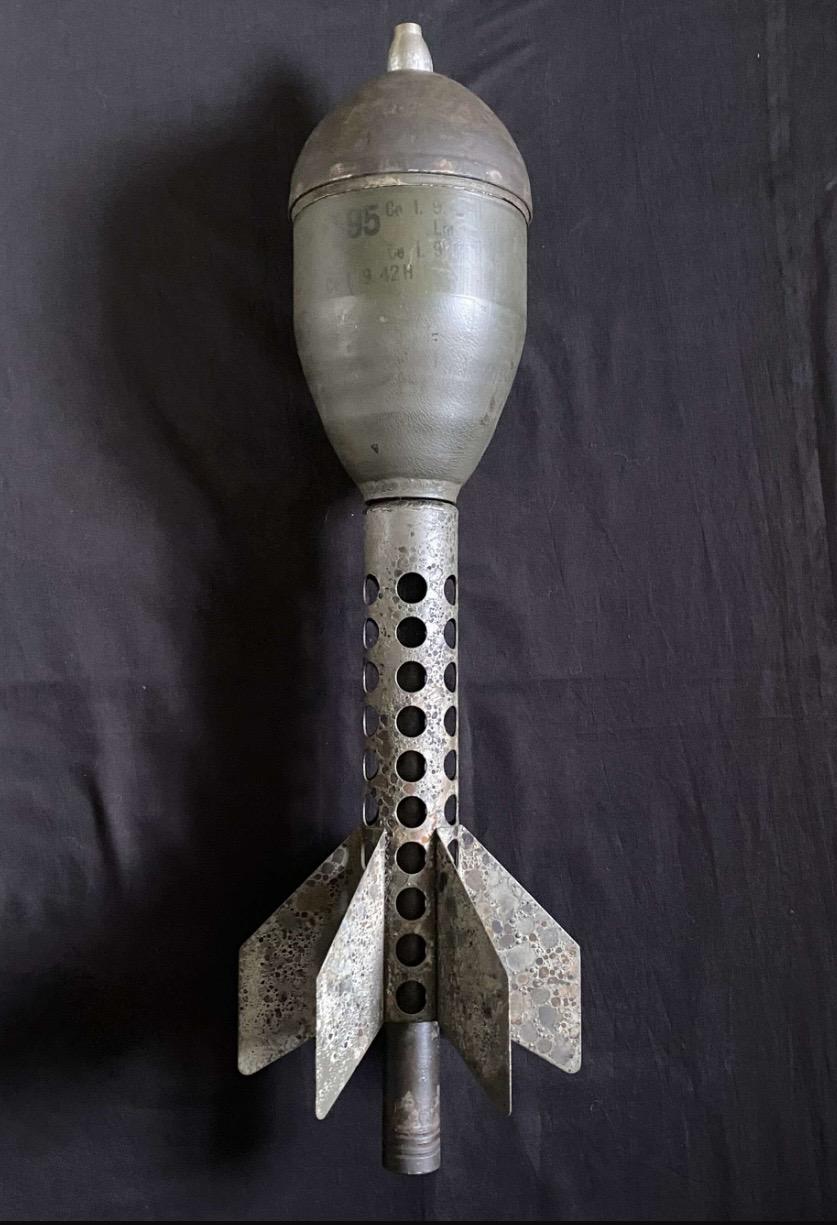
The Stielgranate 41 was a desperate attempt to keep this obsolete but still widespread gun relevant. Rather than increasing muzzle velocity, which the PaK 36 simply could not handle, German designers turned to a large hollow-charge warhead that relied on chemical energy rather than kinetic impact. The result was a massive, fin-stabilised shaped-charge grenade mounted on a long steel stem. This stem slid down over the outside of the gun barrel and seated at the muzzle, giving the weapon its distinctive and ungainly appearance.
Development was rushed, largely overseen by German Army ordnance authorities with industrial production carried out by firms such as Rheinmetall and other subcontractors already involved in PaK 36 manufacture. It entered service in 1942, at a time when Germany was scrambling for stopgap solutions while heavier anti-tank guns were still being fielded in insufficient numbers.
Using the Stielgranate 41 was an awkward and dangerous affair. The grenade had to be loaded from the front of the gun, meaning a crewman was required to stand in front of the PaK 36 to slide the stem over the barrel. In combat this exposed the crew to small-arms fire, shell fragments, and observation by enemy tank crews. Once fitted, the grenade was fired using a special blank cartridge that propelled it off the barrel. Because the warhead was far larger than the calibre of the gun, recoil was reduced, but accuracy was poor and the weapon was highly situational.
Its effective range was extremely short by anti-tank standards, generally around 100 to 300 metres, with best results at the lower end of that scale. Beyond this distance, the slow velocity and poor aerodynamics made hits unlikely. When it did strike a target squarely, however, the hollow-charge warhead could penetrate roughly 180 mm of armour under ideal conditions, theoretically enough to defeat even the frontal armour of the heaviest Allied tanks of the period. This penetration figure was impressive on paper, but real-world effectiveness was far more limited. Angled armour, spaced armour, and simple near-misses all reduced its lethality, and the small explosive filler meant that post-penetration damage inside the tank was not always catastrophic.
The grenade was attached solely to the PaK 36’s muzzle and could not be fired from other weapons, further limiting its usefulness. Once a Stielgranate was mounted, the gun could not fire normal ammunition until it was removed, slowing down the crew and making rapid target engagement impossible. Its slow flight also made it easier for alert tank crews to spot the firing position and respond with machine-gun fire or high-explosive shells.
Production figures are difficult to pin down precisely, but estimates generally place total manufacture in the tens of thousands rather than the hundreds of thousands. This relatively modest number reflects both its niche role and the fact that it was quickly overshadowed by more practical infantry anti-tank weapons such as the Panzerfaust and Panzerschreck, as well as by newer, more powerful anti-tank guns entering service with the Wehrmacht.
One of the more interesting aspects of the Stielgranate 41 was its psychological impact. For German crews stuck with an otherwise ineffective PaK 36, it restored at least some confidence that their gun could still threaten heavy tanks. Conversely, Allied crews encountering the weapon often noted its strange appearance and the surprisingly large explosion on impact, even if the actual damage was inconsistent. In some cases, the sheer blast and shock could disable external equipment, damage tracks, or concuss the crew without fully destroying the tank.
In the end, the Stielgranate 41 was a symbol of a transitional moment in the war, when rapidly evolving armour technology outpaced existing anti-tank weapons. It was clever, dangerous to use, and occasionally devastating, but it could not change the broader reality that the PaK 36 was obsolete. As better solutions became available, the “door knocker” grenade faded into obscurity, remembered today as an ingenious but ultimately inadequate answer to the problem of heavy tank armour.