Lockheed Martin
Lockheed Martin stands today as one of the world’s most influential aerospace and defense companies, but its origins reach back more than a century to two determined California brothers who were obsessed with flight. Allan and Malcolm Loughead, whose surname was later respelled as Lockheed to match its pronunciation, founded their first aviation venture in 1912 in the San Francisco Bay Area. They built early seaplanes and flying boats, offering sightseeing flights and experimenting with designs at a time when powered flight itself was barely a decade old. Their most ambitious aircraft of that era, the F-1 flying boat of 1918, was one of the largest passenger aircraft of its time. But the post-World War I collapse of the aircraft market forced their company to close in 1920.
Malcolm went on to start a successful hydraulic brake business, while Allan briefly left aviation before returning in 1926 with new partners, including the brilliant young designer Jack Northrop. Together they formed the Lockheed Aircraft Company in Hollywood, California. This was the direct ancestor of today’s Lockheed Martin. Its first major project was the Lockheed Vega, a revolutionary wooden monoplane with a molded monocoque fuselage that was far ahead of contemporary designs. The Vega became famous for its strength, speed and efficiency. Amelia Earhart flew one across the Atlantic, Wiley Post used another to circle the globe and later explore the jet stream, and the aircraft’s success launched Lockheed onto the world stage. Production moved from the small Hollywood shop to Burbank as demand grew.
Running parallel to the Lockheed story was the path of Glenn L. Martin, another aviation pioneer who founded his aircraft company in Los Angeles in 1912. Martin’s firm built early military aircraft, and over the decades evolved into a major supplier of bombers, missiles and rockets. After merging with American-Marietta in 1961, the combined Martin Marietta company became a leader in space hardware, intercontinental ballistic missiles and advanced materials. This background later proved crucial in shaping the space and missile expertise of the future Lockheed Martin.
The modern corporation emerged on 15 March 1995, when Lockheed Corporation and Martin Marietta agreed to merge in a deal valued at roughly ten billion dollars. The new company established its headquarters in Maryland, close to Washington, D.C., placing it at the heart of U.S. defense and space policy. With the merger, Lockheed Martin instantly became one of the largest and most technologically diverse defense contractors in the world.
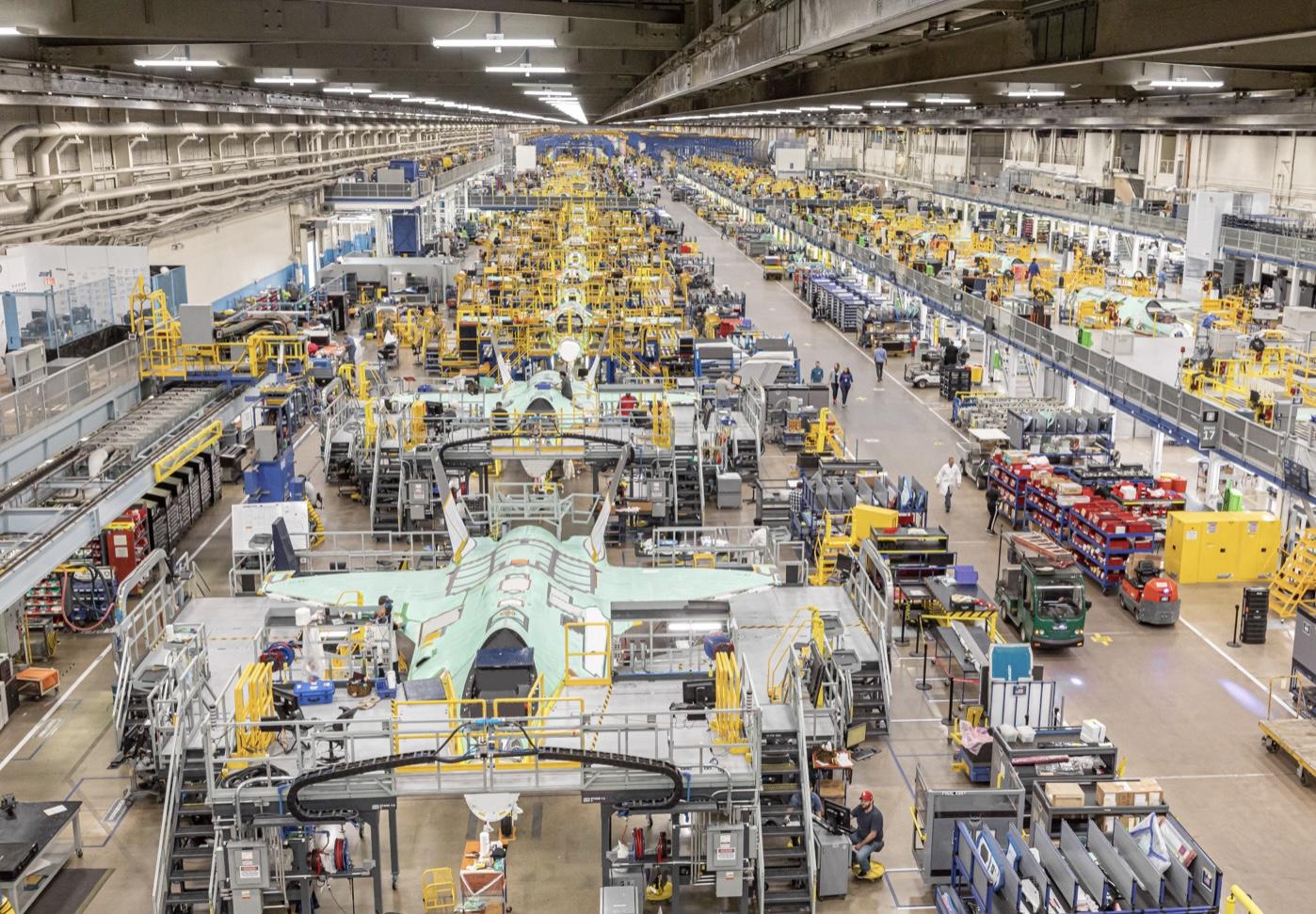
Over the following decades the company expanded into almost every major military domain: air, land, sea, space and cyber. In aviation, it produces some of the world’s most advanced fighters and transports, including the F-35 Lightning II, the F-22 Raptor, the F-16 Fighting Falcon and the C-130 Hercules. On land, it supplies key missile and rocket systems such as HIMARS, the MLRS, the Hellfire missile and the PAC-3 interceptor. At sea, its Aegis combat system equips many of the world’s most powerful naval fleets, while its Trident II ballistic missiles form the backbone of the U.S. Navy’s nuclear deterrent. In space, the company builds satellites for navigation, communications, surveillance and missile warning, as well as the Orion spacecraft for deep-space exploration. It also delivers cyber-defense, advanced networking and intelligence-processing systems, making it one of the U.S. government’s most important high-tech partners.
Lockheed Martin’s growth has come not only from engineering breakthroughs but also from strategic acquisitions. A major step came in 1996 with the purchase of most of Loral’s defense electronics and systems-integration business, which greatly expanded its capabilities in radar, electronic warfare and secure IT. Over the years it has absorbed numerous smaller firms in simulation, robotics, hypersonics, satellite technology and cybersecurity, allowing it to continually modernize its portfolio while shedding older, non-core businesses.
Much of the company’s research and development is concentrated in a few key locations. The most famous is the Skunk Works, based in Palmdale and Burbank, California. This legendary advanced-development division created the U-2 spy plane, the SR-71 Blackbird and the F-117 Nighthawk, and it continues to work on next-generation stealth, hypersonics, autonomous systems and classified aerospace programs. Additional research centers are spread across Colorado, Texas, Georgia, Florida and the Washington, D.C. region, supporting space systems, missile defense, advanced sensors and artificial-intelligence applications.
Among the company’s latest and most ambitious projects are hypersonic weapons such as the AGM-183A ARRW and other classified hypersonic programs, next-generation missile-warning satellites, new ship-combat systems, and the ongoing evolution of the F-35 to keep it at the forefront of global airpower for decades. Lockheed Martin is also heavily involved in autonomous drones, space-based defense architectures, directed-energy systems and advanced manufacturing techniques such as digital engineering and 3D-printed components.
An interesting detail in the company’s long history is that two of America’s most famous aircraft designers—Jack Northrop and Gerald Vultee—both got their start at Lockheed before going on to found major companies of their own. Another striking point is that Lockheed Martin, despite its global reputation for cutting-edge jets and missiles, continues to manufacture the C-130 Hercules, a transport aircraft first flown in 1954 and still in high demand around the world. The company today blends the legacy of early wooden airplanes built in garages with the most advanced aerospace and defense technology on Earth, a combination that reflects more than a century of relentless innovation, adaptation and ambition.