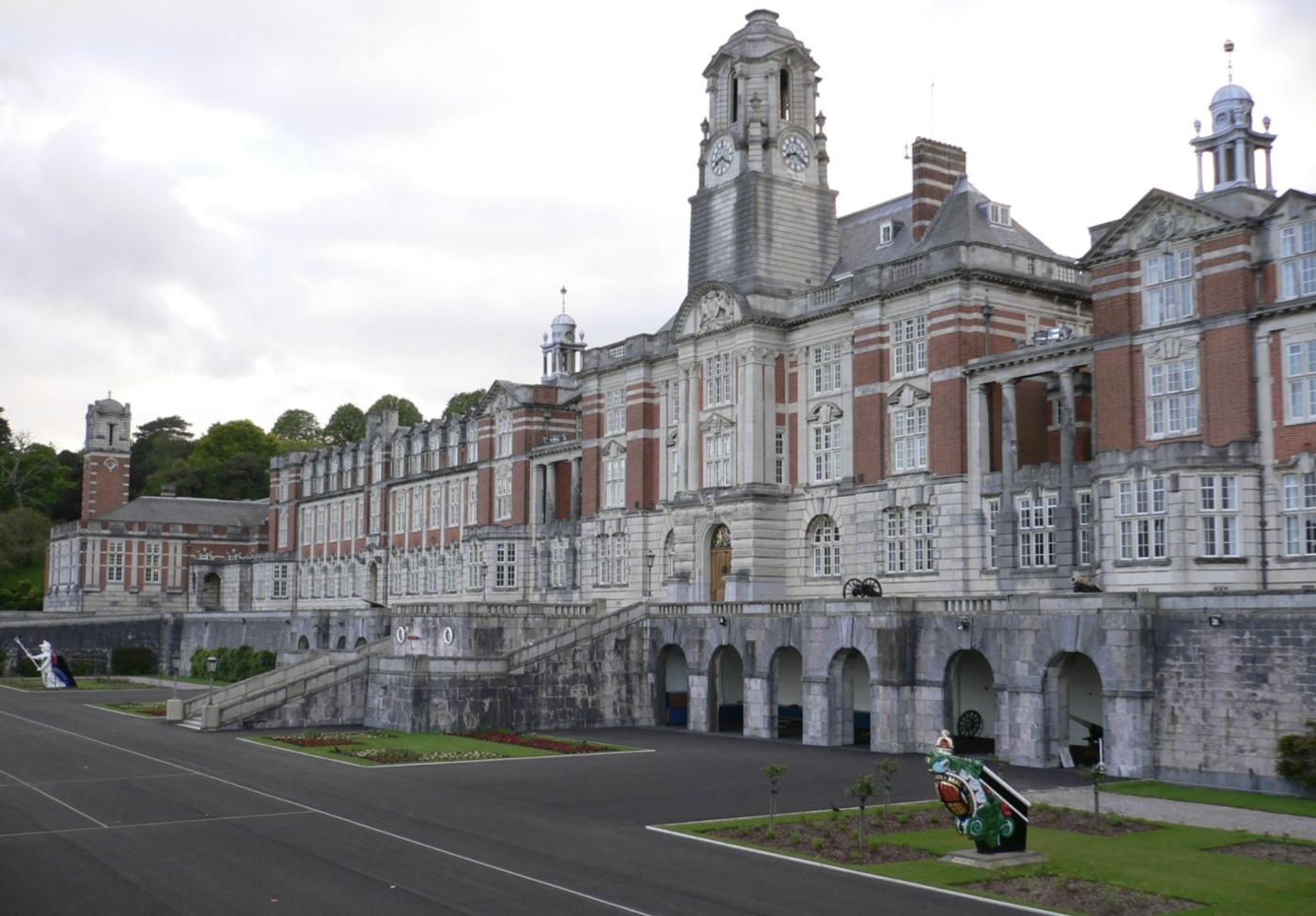
Royal Naval Academy
The Royal Naval Academy at Portsmouth emerged from a growing awareness in the early eighteenth century that the Royal Navy could no longer depend entirely on traditional, informal methods of producing officers. For generations, boys destined for command had gone to sea as “young gentlemen,” learning by observation, personal experience, and the favour of senior officers. As navigation became more scientific, gunnery more technical, and naval administration more complex, the Admiralty recognised that this system was uneven and wasteful of talent. The answer was a shore-based institution where selected boys could be systematically educated before being sent to sea.
The formal decision to create such an institution was taken by Order in Council in 1729. This order authorised the establishment of a naval academy within Portsmouth Dockyard, firmly tying education to the industrial and operational heart of the navy. Although the Academy is sometimes loosely associated with later eighteenth-century dockyard rebuilding, it was effectively established in the early 1730s and began operating soon after its purpose-built accommodation was completed. The building itself was a striking and deliberate statement of intent: a grey brick structure laid out on an H-plan, three storeys high, designed specifically for instruction rather than adapted from existing dockyard buildings. Its form reflected contemporary ideas about order, symmetry, and discipline, qualities the navy hoped to instil in its future officers.
The Academy was designed to admit no more than forty pupils at any one time. Boys typically entered between the ages of thirteen and sixteen, an age chosen to allow them to absorb mathematical and theoretical instruction while still being young enough to be shaped by naval discipline. This small intake was intentional. The Admiralty was experimenting with a new model of officer education and wanted close supervision and measurable results rather than mass training. Each pupil was required to remain for several years, combining classroom learning with practical exposure to ships, dockyard work, and seamanship.
The curriculum blended theory and practice in a way that was unusual for the period. Mathematics was central, particularly arithmetic, geometry, and trigonometry, all essential for navigation and surveying. Navigation itself was a core subject, along with astronomy as it related to finding latitude and longitude. Gunnery theory, fortification, and elements of ship construction were taught to ensure that future officers understood the capabilities and limitations of the vessels they would command. Alongside this, pupils were trained in practical seamanship, learning rigging, sail handling, and shipboard routines, often through direct observation and supervised work in the dockyard and aboard vessels lying in harbour.
Despite its reforming ambitions, the Academy was socially selective. Families were required to lodge a substantial financial bond, intended to guarantee that the pupil would enter naval service on completion of his studies. This requirement effectively restricted entry to families of means or those with strong connections. In practice, many of the earliest pupils came from naval families, particularly sons of commissioned officers who already had a tradition of service and access to patronage. This was partly by design, as a proportion of places were explicitly intended for officers’ sons, reinforcing the idea of the navy as a professional community passing skills and values from one generation to the next.
At the same time, the Academy represented a shift away from pure patronage. Admission increasingly took account of aptitude and progress rather than simply birth. Pupils were examined, their performance recorded, and their suitability for advancement assessed in a way that had little precedent in earlier naval practice. Not all students succeeded, and some failed to meet expectations, but the principle that an officer should demonstrate competence as well as social standing took root here.
The Academy’s history was not without controversy. There were repeated debates within the Admiralty about cost, effectiveness, and whether time spent ashore weakened a boy’s instincts for life at sea. Critics argued that nothing could replace experience gained aboard an active ship, while supporters countered that untrained boys could acquire bad habits as easily as good ones and that formal instruction produced more reliable and technically capable officers. These arguments shaped the Academy’s development and led to periodic adjustments in teaching methods and organisation.
Over time, the influence of the Portsmouth Academy extended far beyond its modest size. It established the principle that naval officers should be educated professionals, not merely gentlemen adventurers promoted through favour. Even after the original Academy was closed in the early nineteenth century and replaced by new systems of training, its ideas endured. Later naval colleges and officer training schemes drew on its emphasis on mathematics, navigation, disciplined study, and the integration of theoretical knowledge with practical seamanship.
In the present day, the direct institutional descendant of the Portsmouth Academy is found not in Portsmouth Dockyard but at Britannia Royal Naval College in Dartmouth. This establishment fulfils the same essential purpose as the eighteenth-century Academy, though on a much larger and more formalised scale. Modern officer training is open to candidates from a wide range of social and educational backgrounds and is based on clearly defined entry standards rather than financial guarantees or family connections.
Today, prospective officers must meet nationality and residency requirements and usually apply between the ages of eighteen and their late thirties, depending on specialisation and prior experience. Academic requirements vary by branch but generally include recognised qualifications in English and mathematics, with higher academic or professional qualifications expected for specialist roles such as engineering, logistics, aviation, or medicine. All candidates must pass medical and fitness assessments, aptitude testing, and a rigorous selection process designed to assess leadership potential, judgement, and resilience.
Initial officer training now lasts around thirty weeks. This period combines academic instruction, leadership development, physical training, and maritime skills, with time spent both ashore and at sea. Officer cadets study naval organisation, operations, navigation, and defence alongside practical exercises intended to test decision-making and command ability under pressure. After completing this initial phase, officers proceed to specialist training within their chosen branches, which can last from several months to several years and continues throughout their careers in the form of professional development and promotion courses.
Seen in this light, the small grey-brick Academy established inside Portsmouth Dockyard in the early eighteenth century stands as the starting point of a long tradition. Its founders could not have foreseen the scale or complexity of the modern Royal Navy, but they established a lasting idea: that effective naval officers are made through structured education, disciplined training, and the careful fusion of theory with experience.