Knights Cross with oak leaves swords &diamonds
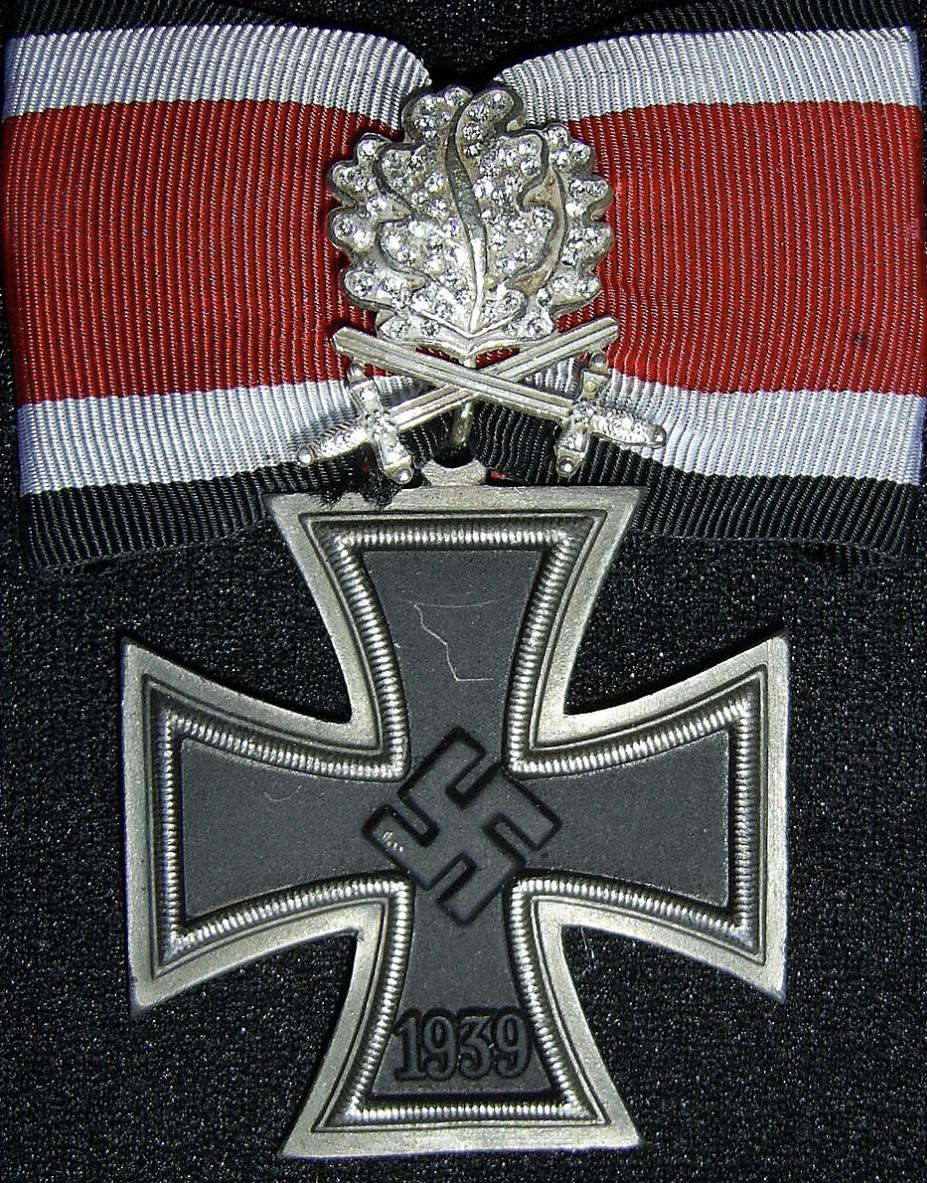
The decoration was formally known as the Knight’s Cross of the Iron Cross with Oak Leaves, Swords and Diamonds. It was not conceived as a single standalone award, but as the penultimate grade in a hierarchy that expanded steadily during the war. A recipient first had to hold the Knight’s Cross, then be advanced to Oak Leaves, then to Oak Leaves and Swords, and only then could be considered for the Diamonds. Its purpose was not simply to reward one act of bravery, but to mark individuals who had already been celebrated and who continued to serve as symbols of exceptional combat performance or command leadership.
The Diamonds grade was extraordinarily rare. Only twenty-seven wartime awards are recognised as legitimate and fully documented. Unlike some lower grades, which became entangled in administrative confusion during the final collapse of Germany in 1945, the Diamonds awards were tightly controlled and personally authorised at the highest level. As a result, the list of recipients is considered complete and unusually secure by historians.
Those twenty-seven recipients fall broadly into two categories. The first consists of highly visible “hero” figures, particularly fighter pilots and U-boat commanders, whose achievements could be reduced to figures and narratives easily understood by the public. The second consists of senior commanders whose awards reflected operational leadership, often during critical or increasingly desperate phases of the war, where holding ground, restoring a front, or conducting an orderly retreat was framed as exceptional achievement.
The Luftwaffe accounts for the largest number of Diamonds recipients. Werner Mölders was the first to receive the award, followed by Adolf Galland, both men already central to early-war fighter mythology. As the air war intensified, the Diamonds increasingly went to fighter aces whose cumulative victories and leadership made them symbolic figures: Gordon Gollob, Hans-Joachim Marseille, Hermann Graf and later Walter Nowotny all exemplify this pattern. Hans-Ulrich Rudel stands apart as the archetypal ground-attack pilot, rewarded for relentless front-line service and repeated survival under extreme conditions rather than air-to-air victories. Night-fighter leaders Helmut Lent and Heinz-Wolfgang Schnaufer were honoured for sustained success against Allied bomber forces, while Albert Kesselring illustrates how the award could also be applied to very senior Luftwaffe officers whose primary contribution lay in theatre-level command rather than personal combat. Hermann-Bernhard Ramcke, a paratroop general, reflects the late-war tendency to reward conspicuous defensive leadership in situations that were militarily hopeless but politically valuable.
The Kriegsmarine recipients were both U-boat commanders. Wolfgang Lüth and Albrecht Brandi were advanced to the Diamonds on the basis of patrol records, leadership and standing within the submarine arm. Their awards came at a time when individual U-boat commanders were still promoted as decisive figures, even as the wider strategic situation at sea had turned decisively against Germany.
Army recipients form the most varied group and are dominated by senior commanders. Erwin Rommel is the best-known example, his award inseparable from his public reputation and the legend built around earlier campaigns. Others such as Hyazinth Graf Strachwitz and Adelbert Schulz were armoured commanders celebrated for repeated tactical success and personal leadership at the front. As the war entered its final phase, the Diamonds increasingly went to generals credited with holding collapsing fronts together or conducting fighting withdrawals under overwhelming pressure. Hans Hube, Walter Model, Hermann Balck, Hasso von Manteuffel, Ferdinand Schörner, Karl Mauss, Theodor Tolsdorff and Dietrich von Saucken all received the award in this context, where honours served as instruments of authority and morale rather than recognition of strategic success.
Only two members of the Waffen-SS received the Diamonds: Herbert Otto Gille and Sepp Dietrich. Both were senior commanders whose formations were heavily engaged and politically significant, and their awards followed the same late-war pattern of recognising leadership under extreme and deteriorating circumstances rather than discrete acts of battlefield heroism.
Understanding what these awards were given for requires an appreciation of the system itself. The Diamonds were not adjudicated by an independent body applying fixed criteria. They were granted within a highly politicised environment, shaped by propaganda value, inter-service rivalry and the need to produce recognisable symbols of endurance and sacrifice. A fighter ace’s victory total, a U-boat commander’s claimed sinkings or a general’s ability to delay defeat could all be framed as extraordinary achievement when the regime required such examples.
The manufacture of the Diamonds grade adds further complexity. The original Knight’s Cross design was created before the war, and production of the various grades involved several firms operating under official regulation. The Diamonds required skilled precious-metal work and stone setting and were produced in extremely small numbers. Berlin jewellers, most notably Gebrüder Godet & Co., are most often associated with surviving Diamonds-grade components, while firms such as Steinhauer & Lück played an important role in the wider production history of the Knight’s Cross system as a whole.
The question of how many examples exist today has no precise answer. Although twenty-seven men were awarded the Diamonds, recipients could receive more than one piece, including presentation sets and replacements. Some awards were lost, destroyed or stripped of insignia after the war. In addition, the post-1945 period saw the production of denazified versions, officially sanctioned replacements and a vast number of replicas and forgeries, many of them highly convincing. What can be stated with confidence is that genuinely wartime-manufactured, stone-set Diamonds pieces with clear provenance are extremely few and represent some of the rarest and most controversial objects in the field of German Second World War decorations.