Knights Cross of the Iron Cross
The Knight’s Cross of the Iron Cross was one of the most prestigious and recognisable military decorations of Nazi Germany during the Second World War. Created in 1939 as part of the revived Iron Cross system, it was intended to reward acts of exceptional bravery, decisive leadership, and outstanding military achievement. Worn at the throat on a black, white and red ribbon, it quickly became more than a medal. It was a mark of battlefield distinction, a symbol of personal courage to those who received it, and a powerful propaganda image used by the German state throughout the war.
The Iron Cross itself was much older than the Third Reich. It began in Prussia in 1813, during the wars against Napoleon, when King Frederick William III introduced a stark, black iron cross edged in silver as a decoration for military merit. It was revived for later German wars, including the Franco-Prussian War of 1870 and the First World War in 1914. In 1939, Adolf Hitler revived the Iron Cross again on the day Germany invaded Poland, creating the Iron Cross Second Class, Iron Cross First Class, Knight’s Cross of the Iron Cross, and Grand Cross of the Iron Cross. The Knight’s Cross was new in 1939 and sat above the Iron Cross First Class. It effectively filled the place once occupied by older imperial German high bravery awards, especially the Pour le Mérite, but with one important difference: it could be awarded across rank and branch, from enlisted men to field marshals.
The Knight’s Cross, or Ritterkreuz des Eisernen Kreuzes, was awarded for exceptional bravery in the face of the enemy or for outstanding military leadership. It was not simply a long-service medal or a general campaign decoration. A soldier normally had to have already received the Iron Cross Second Class and First Class before being considered for the Knight’s Cross. In practice, the reasons varied widely. An infantryman might receive it for holding a position under extreme pressure, knocking out tanks at close range, rescuing comrades, or leading a decisive counterattack. A tank commander might receive it for repeated success in armoured combat. A U-boat commander might receive it after sinking large amounts of Allied shipping. A fighter pilot might receive it after reaching a high number of aerial victories. A general might receive it for leading a successful operation, breakthrough, defensive action, or withdrawal. The award therefore covered both personal gallantry and command achievement.
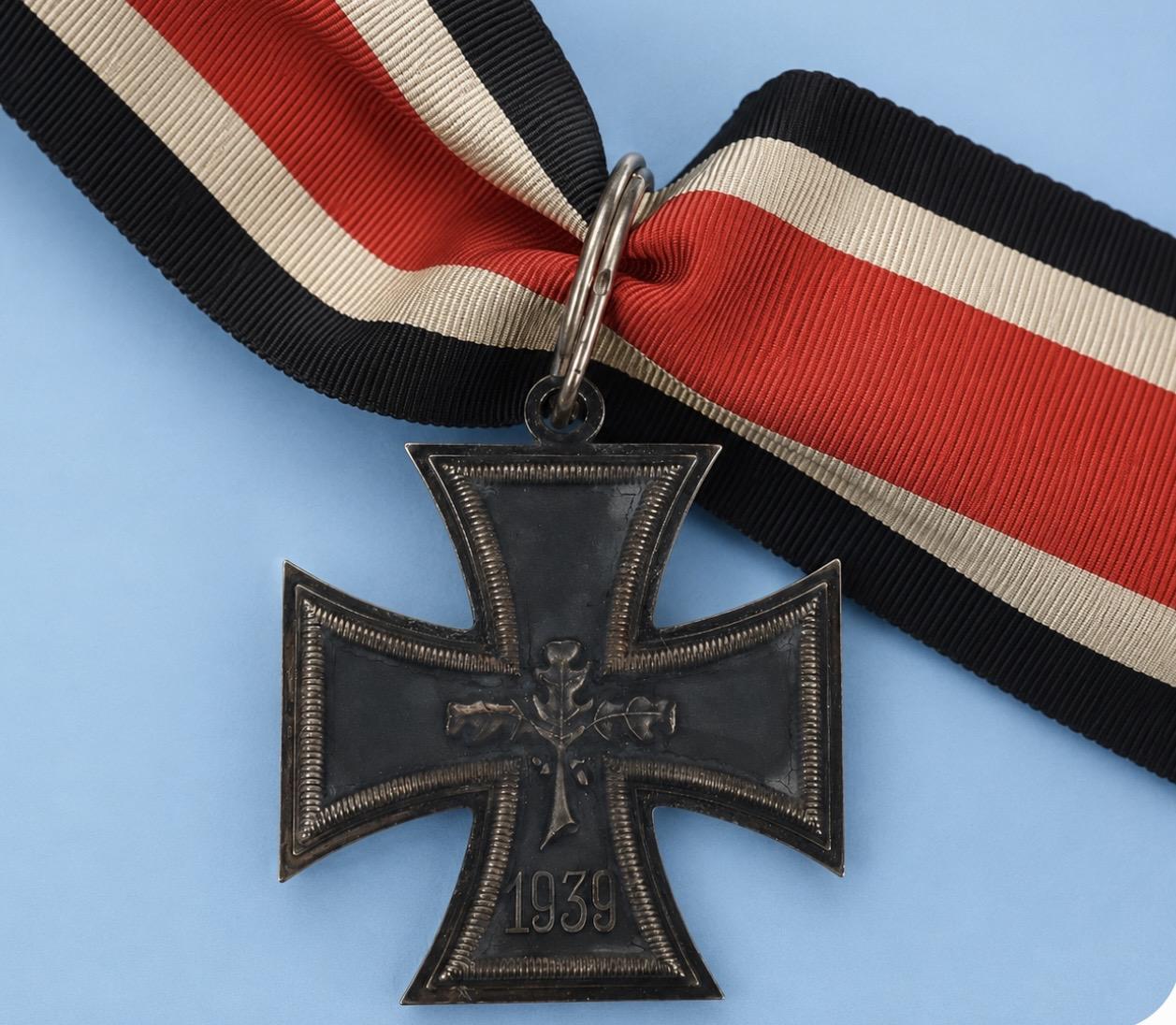
Its appearance was deliberately traditional. The cross followed the familiar cross pattée shape of earlier Iron Crosses, with blackened iron at the centre and a silver or silvered frame. The 1939 version carried a swastika in the centre and the date 1939 on the lower arm, while the reverse normally referred back to 1813, the year of the original Prussian institution. The Knight’s Cross was larger than the Iron Cross First and Second Class, usually around 48 to 49 millimetres across, and was worn around the neck on a black, white and red ribbon. That position made it instantly visible in photographs, newsreels, portraits, and battlefield reporting.
The manufacture of the Knight’s Cross was handled by specialist German firms that already had experience producing orders, medals, badges, and jewellery-quality metalwork. Known wartime makers included C. E. Juncker of Berlin, Steinhauer & Lück of Lüdenscheid, Klein & Quenzer of Idar-Oberstein, and firms associated with Zimmermann and Schickle production. Collector research also discusses makers and suppliers such as Godet, Deschler, and others, though the exact list depends on whether one is counting official award pieces, private-purchase replacements, component suppliers, or later veteran replacements. The typical construction was a three-piece design: a blackened iron core enclosed by a two-part frame, often in silver and sometimes marked with silver fineness such as 800.
The award did not remain a single grade for long. As the war expanded and the Nazi state sought ever more dramatic ways to reward repeated distinction, higher grades were added. The Knight’s Cross with Oak Leaves was introduced in 1940 for men who had already received the Knight’s Cross and then distinguished themselves again. In 1941 came the Oak Leaves with Swords, and then the Oak Leaves, Swords and Diamonds. At the end of 1944, the extremely rare Golden Oak Leaves, Swords and Diamonds was created. Only one man, Luftwaffe dive-bomber pilot Hans-Ulrich Rudel, received that final grade. The Diamonds grade was awarded only 27 times. The Swords grade is generally given as about 159 or 160 awards, while the Oak Leaves grade was awarded fewer than 900 times, depending on how disputed late-war cases are counted.
The total number of Knight’s Cross recipients is usually given as just over 7,000. Different published totals vary because of late-war paperwork losses, disputed awards in the final chaotic weeks of the Third Reich, post-war claims, and differences between recipient associations and archival research. One commonly cited tradition gives around 7,300 awards; research based on German Federal Archives evidence has produced a lower confirmed figure of 7,161 officially bestowed recipients, while some lists include foreign recipients serving with or alongside Germany and reach higher totals. For a general overview, it is safest to say that roughly 7,200 to 7,300 men received the Knight’s Cross, with the exact total depending on the criteria used.
The recipients came from every major arm of the German war machine: the Army, Navy, Luftwaffe, Waffen-SS, and some allied or foreign formations. Famous recipients included fighter aces, U-boat commanders, tank leaders, paratroopers, infantry officers, and senior commanders. The award was particularly visible among the Luftwaffe because aerial victory scores could be counted and publicised. U-boat commanders also became prominent recipients early in the war, when submarine successes against Allied shipping were heavily celebrated in Germany. Later in the war, as Germany shifted from conquest to desperate defence, many awards recognised local battlefield leadership, anti-tank actions, defensive stands, and attempts to delay Allied advances.
For the man who received it, the Knight’s Cross could be life-changing. It brought prestige, public recognition, and often rapid publicity. Recipients were photographed wearing it, named in newspapers, and sometimes invited to public ceremonies or meetings with senior leaders. In a military culture that valued bravery, obedience, sacrifice, and visible decorations, the Knight’s Cross marked someone as exceptional. It could help a career, increase status among comrades, and give even a junior soldier a national reputation. Some recipients became propaganda figures whose stories were used to encourage civilians and soldiers as the war worsened.
That propaganda value was central to its importance. The Nazi regime understood medals not only as rewards but as symbols. The Knight’s Cross created individual heroes who could be presented to the public as proof of German courage and fighting power. A young tank commander, pilot, or infantryman wearing the cross at his throat made a powerful image. The award helped turn battlefield actions into stories of sacrifice and determination. This was especially important after defeats began to mount. By 1943, 1944, and 1945, the regime increasingly needed examples of heroic resistance to sustain morale, even as the strategic situation became hopeless.
Militarily, the Knight’s Cross was significant because it sat at the meeting point of personal courage, command success, and morale. It recognised actions that German commanders believed had tactical or operational importance. An award could honour a single dramatic act, but it could also reward sustained performance over weeks or months. In many cases, the award reflected the German military’s emphasis on initiative at lower levels, especially among officers and non-commissioned officers who acted decisively under pressure. It was also part of a wider decorations system intended to motivate soldiers and publicly define what the state considered exemplary conduct.
There is also a more uncomfortable side to its history. The Knight’s Cross was a decoration of Nazi Germany, awarded during a war of aggression and in the context of a criminal regime. Some recipients served in formations implicated in war crimes, including parts of the Waffen-SS and units involved in brutal occupation warfare. The award itself recognised military performance rather than moral conduct. For that reason, modern discussion of the Knight’s Cross has to separate technical military history from admiration. It can be studied as an important decoration without romanticising the cause it served.
After 1945, Nazi symbols were banned or restricted in Germany. In 1957, West Germany allowed veterans to wear de-Nazified versions of certain wartime awards, including the Iron Cross family, with the swastika removed and replaced by oak leaves or other neutral devices. This explains why post-war replacement versions exist and why collectors must be careful: original wartime Knight’s Crosses, later official replacement pieces, private-purchase copies, and modern fakes all circulate. The Knight’s Cross is one of the most reproduced German military decorations, partly because genuine examples are rare, valuable, and historically famous.
Today, the Knight’s Cross remains one of the most studied and controversial decorations of the Second World War. To collectors, it is important because of its construction, makers, variants, markings, cases, ribbons, and provenance. To military historians, it is important because it shows how Germany rewarded battlefield achievement and built public heroes. To social historians, it reveals how the Nazi state used honour, sacrifice, and spectacle to bind soldiers and civilians to the war effort. To the recipients themselves, it was often the highest visible recognition they could receive, a sign that their courage or leadership had been singled out above thousands of others.
Its significance therefore lies not only in the metal cross and ribbon, but in what it represented: a continuation of an old Prussian and German military symbol, reshaped by the Third Reich; a reward for bravery and command achievement; a propaganda tool; and a personal badge of status for those who wore it. The Knight’s Cross of the Iron Cross was admired by many German soldiers, recognised by their enemies, and used relentlessly by the Nazi state. That mixture of craftsmanship, battlefield prestige, propaganda, and moral complexity is what makes it such a powerful and still heavily discussed object today.