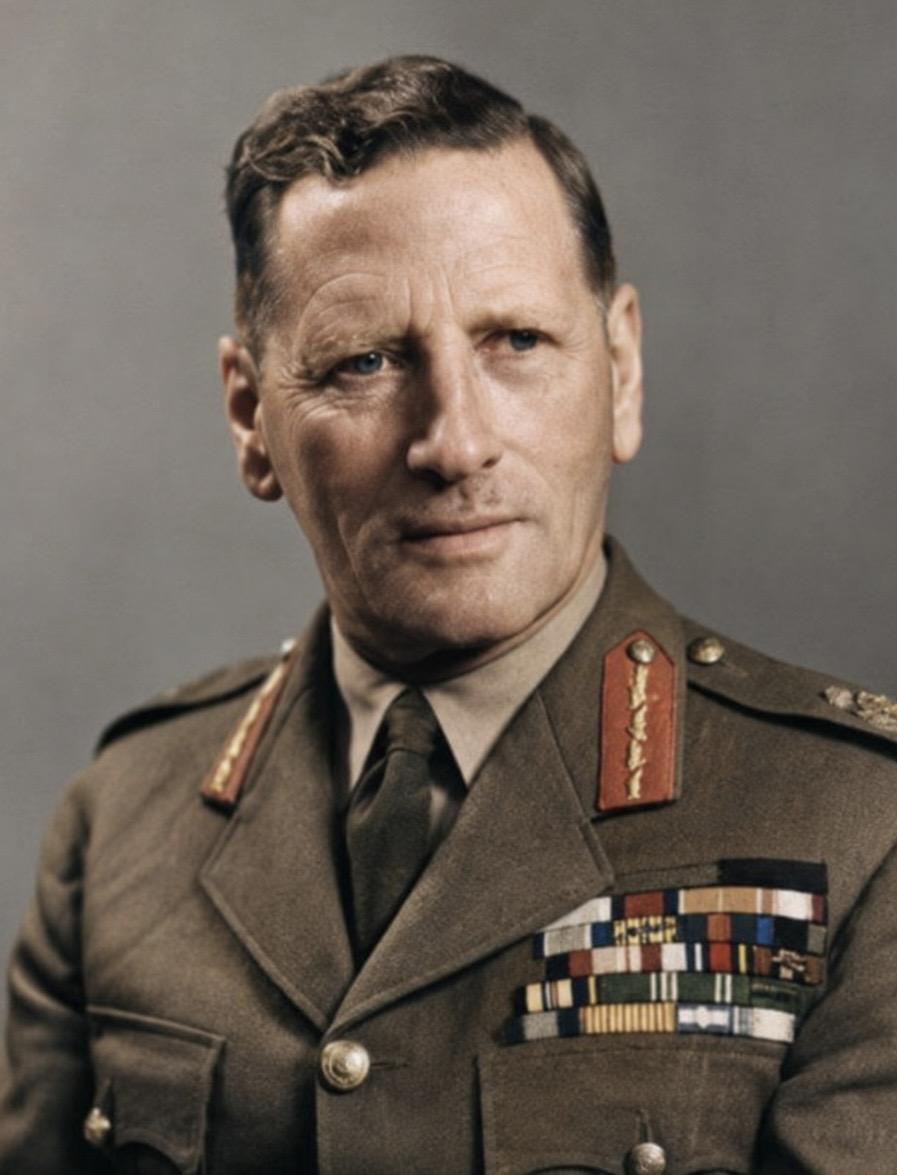
Claude Auchinleck
Claude John Eyre Auchinleck was one of the most important British commanders of the twentieth century, though his reputation has often been overshadowed by figures such as Bernard Montgomery, Harold Alexander and Archibald Wavell. He was a soldier of the old Indian Army tradition: disciplined, reserved, physically tough, deeply knowledgeable about imperial warfare, and unusually sympathetic toward Indian troops. His career stretched from the final years of the British Empire’s Victorian military system to the violent unravelling of empire after the Second World War. He served in frontier campaigns, the First World War, the interwar Indian Army, the Western Desert campaign, and finally the painful partition of the Indian Army in 1947. His life was marked by great responsibility, sharp reversals, and a strong personal code of duty.
He was born on 21 June 1884 at Aldershot, Hampshire, a town closely associated with the British Army. His family background was military and imperial. His father, Colonel John Claud Alexander Auchinleck, served in the army, and young Claude grew up in an environment where soldiering was treated as both a profession and a duty. His early life was not one of wealth or glamour, but he received the kind of education expected of a boy intended for service. He attended Wellington College, a school with strong military associations, and then entered the Royal Military College, Sandhurst.
In 1904, he was commissioned into the Indian Army, a decision that shaped almost every part of his character and career. He joined the 62nd Punjabis, one of the regiments of the British Indian Army. Service in India demanded different skills from those required in a purely British regiment. Officers were expected to understand local languages, customs, and the particular traditions of the soldiers under their command. He took this seriously, learning Punjabi and developing a lasting respect for Indian troops. This respect was not sentimental; it was practical and professional. He believed that Indian soldiers, properly led and properly treated, were among the finest in the world.
His early military experience came on the North-West Frontier, where the British Indian Army was often engaged in difficult operations against tribal fighters in harsh terrain. These campaigns taught him patience, endurance, and the value of careful logistics. Frontier warfare was rarely dramatic in the way large European battles were, but it forced officers to understand movement, supply, intelligence, and discipline under difficult conditions. His later ability to command large formations owed much to these early years.
During the First World War, he served in the Middle East, especially in the Mesopotamian campaign. This was a brutal and often badly managed theatre of war. British and Indian forces fought the Ottoman Empire in what is now Iraq, enduring heat, disease, poor supply arrangements, and difficult river operations. His service in Mesopotamia strengthened his reputation as a capable and dependable officer. He saw at close hand how poor planning and inadequate logistics could destroy armies. The disastrous British surrender at Kut in 1916, although not his personal responsibility, was part of the wider military environment in which he learned the importance of supply, medical care, and realistic operational planning.
After the First World War, he remained in the Indian Army and continued to rise steadily. He was not a flamboyant officer and did not seek publicity. His advancement came through professionalism, experience, and a reputation for sound judgment. In the interwar years, he held a series of increasingly senior appointments. He attended staff college, served in staff and command roles, and became known as an officer with a deep understanding of both field command and military administration.
His connection with Indian troops remained central. Unlike some British officers who regarded the Indian Army merely as an imperial instrument, he had a genuine professional loyalty to it. He admired its traditions and believed strongly that its soldiers deserved fair treatment. This attitude later became significant when he had to manage the vast expansion of the Indian Army during the Second World War and, later still, its division between India and Pakistan.
By the late 1930s, he had reached high command. The British Empire was entering a period of danger, with war approaching in Europe and Asia. The British Army was still recovering from years of underfunding, and the Indian Army was also being modernised and expanded. His experience made him valuable, particularly because he understood both imperial defence and the practical problems of training, equipping, and supplying large forces.
At the beginning of the Second World War, he held senior commands in Britain and India. In 1940, he was involved in the ill-fated Allied campaign in Norway. The Norway campaign was a confused and difficult operation, marked by poor coordination, inadequate air support, and German speed. His role there did not produce a decisive success, but the campaign itself exposed weaknesses in British planning and joint operations. Like many senior officers of the period, he had to learn quickly under wartime pressure.
In 1941, he was appointed Commander-in-Chief, India. This was one of the most important commands in the British Empire. India was not only a vast territory but also the main source of manpower for the British war effort in Asia and the Middle East. The Indian Army expanded enormously during the war, eventually becoming the largest volunteer army in history. He played a major role in this expansion, supporting better training, improved organisation, and the development of Indian officers. His belief in Indian soldiers was not new, but the scale of the war gave that belief enormous practical importance.
Later in 1941, he was sent to the Middle East as Commander-in-Chief, Middle East Command, replacing General Sir Archibald Wavell. This placed him at the centre of one of the most important theatres of the war. British and Commonwealth forces were fighting German and Italian forces in North Africa, where the desert war depended on mobility, supply lines, armour, air power, and the ability to recover from sudden reverses. The German commander, Erwin Rommel, had already become famous for his boldness and tactical skill.
His first major achievement in the desert was Operation Crusader, launched in November 1941. The aim was to relieve the siege of Tobruk and push Axis forces back. The fighting was extremely hard and confused. At times it looked as though the British Eighth Army might fail, and there were serious disagreements among commanders. He took the bold step of replacing General Alan Cunningham with General Neil Ritchie during the operation, believing Cunningham had lost confidence. Operation Crusader eventually succeeded in relieving Tobruk and forcing Rommel to retreat. It was one of the first major British land successes against German forces in the war.
However, success in the desert was rarely permanent. The Axis forces recovered, and Rommel struck back. In 1942, the British position deteriorated badly after the Battle of Gazala. Tobruk, which had resisted for months in 1941, fell suddenly in June 1942. Its loss was a severe blow to British morale and to his reputation. British forces retreated deep into Egypt, and the possibility of losing the Suez Canal became terrifyingly real. The Suez Canal was vital to British imperial communications, Middle Eastern oil supplies, and the whole Allied war effort.
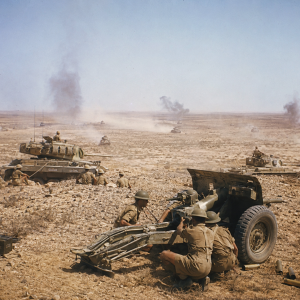
At this crisis, he personally took command of the Eighth Army from Neil Ritchie. His decision to intervene directly was one of the most important moments of his career. He halted the retreat at El Alamein, a narrow defensive position between the Mediterranean Sea and the Qattara Depression. This geography prevented Rommel from easily outflanking the British position. In the First Battle of El Alamein in July 1942, his forces stopped the Axis advance. This was a crucial accomplishment. Before Montgomery won the more famous Second Battle of El Alamein in October and November 1942, he had already prevented Rommel from breaking into Egypt.
His achievement at First El Alamein is sometimes underappreciated. He took over a battered army after a severe defeat, stabilised the front, and denied Rommel the decisive victory he needed. He also issued important tactical instructions aimed at improving the army’s handling of armour, artillery, and infantry cooperation. His leadership during this defensive phase helped preserve Egypt and the Suez Canal at a moment of extreme danger.
Despite this, Winston Churchill was dissatisfied. Churchill wanted more aggressive action and had lost confidence in the Middle East command structure. In August 1942, he was removed from his position. He was offered another command, but he did not accept the proposed arrangement. General Harold Alexander became Commander-in-Chief, Middle East, and General Bernard Montgomery took command of the Eighth Army. Montgomery later won the Second Battle of El Alamein and became one of Britain’s most celebrated commanders. This inevitably pushed him into the background, even though his earlier defensive success had made Montgomery’s victory possible.
His removal remains one of the most debated episodes of his career. Critics argued that he was not forceful enough, that he allowed subordinate commanders too much freedom, and that he lacked the public confidence and sharp offensive style Churchill desired. His defenders argue that he was a thoughtful and realistic commander who inherited serious problems, faced a brilliant opponent, and saved the British position in Egypt at a critical moment. Both views contain some truth. He was not a natural showman or political soldier. He could be reserved, stubborn, and sometimes too tolerant of weak subordinates. But he was also brave, experienced, and capable of calm judgment under pressure.
After his removal from the Middle East, he returned to India. In 1943, he again became Commander-in-Chief, India. This second period in India was extremely important. The war against Japan had become a major Allied priority after the fall of Singapore and the Japanese advance into Burma. India became the base for Allied operations in Burma, China, and Southeast Asia. He was responsible for training, organising, and supplying forces on a huge scale. He helped rebuild confidence after earlier disasters and supported the development of the forces that would eventually defeat the Japanese in Burma.
Although he did not personally command the Burma campaign in the field, his work in India was essential to its success. Armies do not fight only at the front. They require training establishments, supply depots, transport systems, hospitals, replacement drafts, staff organisation, and political management. His administrative and organisational abilities were well suited to these tasks. Under his leadership, the Indian Army continued its enormous wartime expansion and became a highly significant Allied force.
In 1946, he was promoted to field marshal, the highest rank in the British Army. This was a recognition of his long service and importance, even though his public reputation never reached the level of some other wartime commanders. By then, however, Britain’s position in India was changing rapidly. Indian independence was approaching, and political tensions between the Indian National Congress, the Muslim League, and the British government were intensifying. The question of partition became central.
His final great responsibility was overseeing the division of the Indian Army between the new states of India and Pakistan in 1947. This was an immensely difficult and painful task. The Indian Army had been one of the great institutions of the British Empire, and he had devoted most of his life to it. Partition meant dividing units, equipment, officers, records, bases, and loyalties. It also took place amid communal violence on a horrifying scale. Millions of people were displaced, and hundreds of thousands were killed.
He was deeply troubled by the human and military consequences of partition. He tried to act fairly between India and Pakistan, but the political situation was almost impossible. His sympathy for the old Indian Army and his concern for both new armies put him at odds with some political leaders. He believed that British officers and officials had a duty to manage the transition honourably, but events moved faster and more violently than orderly administration could handle.
After Indian independence in August 1947, his role rapidly diminished. The office of Supreme Commander, intended to supervise the division of military assets, was soon abolished. He left India in 1948. His departure marked the end of a military life tied closely to the British Indian Army. He had served the institution from the days of imperial frontier warfare to the birth of independent India and Pakistan.
After the war and after leaving India, he lived a relatively quiet life. He did not seek political power or public attention. He was offered honours, but he was known for his modesty and independence. Unlike some other senior commanders, he did not turn himself into a public celebrity. He spent much of his later life abroad, especially in Morocco, where he lived in Marrakesh. His marriage to Jessie Stewart had ended in divorce in the 1940s, and his later years were private.
He died on 23 March 1981 at the age of 96. By the time of his death, the world in which he had begun his career had vanished. The British Empire had largely disappeared, India and Pakistan were independent powers, and the style of soldiering he had known as a young officer belonged to history. Yet his career remained significant for several reasons.
His notable accomplishments were substantial. He rose from a young Indian Army officer to field marshal. He served with distinction in the First World War and became one of the most experienced British imperial soldiers of his generation. He helped expand and modernise the Indian Army during the Second World War. In North Africa, he relieved Tobruk during Operation Crusader and, most importantly, halted Rommel at the First Battle of El Alamein, preventing a potential Axis breakthrough into Egypt. Later, he supervised the difficult transition of the Indian Army during the end of British rule in India.
He was not a perfect commander, and his failures were real. He struggled at times to impose his will on subordinates, and he lacked the dramatic public style that wartime politics often rewarded. But he was also a serious, honourable and highly capable soldier. His greatest strength lay in his loyalty to the men he commanded, especially the soldiers of the Indian Army. He understood them, respected them, and devoted his life to their service. His career deserves to be remembered not only for the controversy of his removal before Montgomery’s victory, but for the larger story of a soldier who helped hold together armies in some of the most difficult moments of the twentieth century.