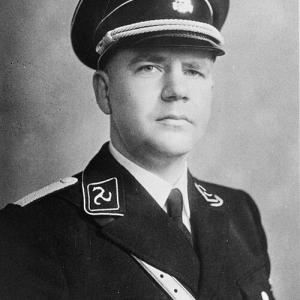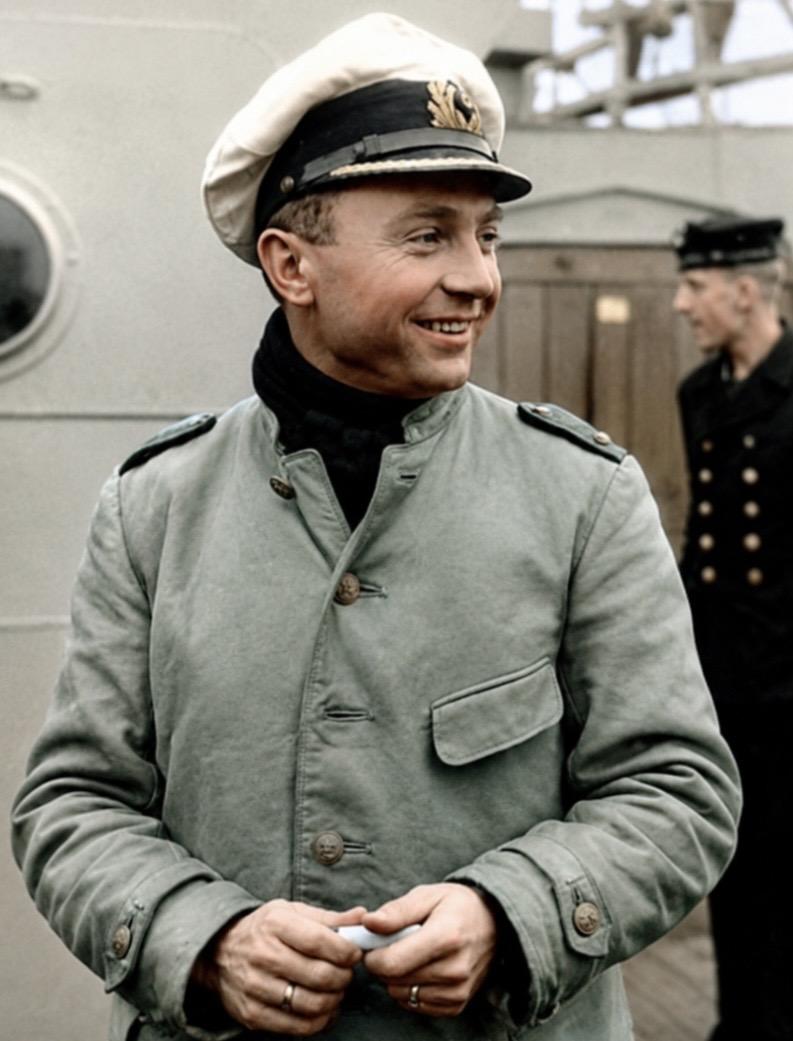
Gunther Prien
Günther Heinrich Prien was one of the most famous German U-boat captains of the Second World War, remembered above all for the daring raid on Scapa Flow in October 1939, when his submarine U-47 sank the British battleship HMS Royal Oak inside what was supposed to be one of the safest naval anchorages in the world. To Nazi Germany he became a national hero almost overnight, a symbol of courage, skill and the striking power of the Kriegsmarine. To Britain, his success was a shocking blow at the very heart of the Royal Navy. His career was short, but it made him one of the best-known submarine commanders of the war.
He was born on 16 January 1908 in Osterfeld, in what was then the German Empire. He did not come from the old aristocratic officer class that had traditionally supplied many German military leaders. His early life was more ordinary and hard-edged. As a young man, he went to sea in the merchant service. This experience was important because it gave him practical seamanship before he ever became a naval officer. He learned ships, weather, discipline, watchkeeping, navigation and the hard life of men who worked at sea for a living.
The future U-boat commander entered the German merchant marine at a young age and served on commercial vessels during the difficult years after the First World War. Germany in the 1920s was struggling with economic hardship, political violence, unemployment and the national humiliation felt after the Treaty of Versailles. For an ambitious young man, the sea offered both escape and opportunity. He trained as a merchant seaman and eventually gained enough experience to qualify as an officer in the merchant service. This background helped shape his later reputation. He was not simply a parade-ground officer; he was a professional seaman who had worked his way up.
In 1933, the same year Adolf Hitler came to power, he joined the Reichsmarine, the German navy of the Weimar period, which soon became the Kriegsmarine under the Nazi regime. Germany was still officially restricted by the Treaty of Versailles, but the new regime began rearming rapidly and secretly. Submarines had been forbidden to Germany after the First World War, but German naval planners had never entirely abandoned the idea of rebuilding an undersea fleet. By the mid-1930s, U-boats were again becoming a central part of German naval strategy.
His move from the merchant marine into the navy was a major step upward. His practical sea experience would have made him valuable, because submarine warfare demanded men who understood the sea in practical terms. U-boat command required much more than courage. A captain had to navigate in bad weather, conserve fuel, manage batteries, judge distances and speeds, attack at night, evade escorts and keep a crew functioning inside a cramped steel tube where fear, exhaustion and danger were constant companions.
He entered U-boat training and came under the influence of Karl Dönitz, the officer who would become the commander of Germany’s submarine arm. Dönitz believed that U-boats could strangle Britain by attacking merchant shipping across the Atlantic. Britain depended heavily on imports of food, oil, raw materials and war supplies. If German submarines could sink enough shipping, Dönitz believed Britain might be forced into crisis or even surrender. The young officer became part of this expanding force at the very moment when Nazi Germany was preparing for war.
By the late 1930s, he had risen through training and command appointments. He became known as a capable and determined officer. In December 1938 he took command of U-47, a Type VIIB submarine. This was the boat that would make his name famous. U-47 was not a huge vessel, but it was well suited to the early Atlantic war: long-ranged enough for serious operations, small enough to be manoeuvrable, and armed with torpedoes and a deck gun. Life aboard was harsh. The crew lived surrounded by fuel, machinery, torpedoes, stale air, damp clothing and little privacy. A successful commander had to be technically skilled, calm under pressure and able to inspire trust.
When the Second World War began on 1 September 1939, Germany’s U-boat force was still relatively small. Dönitz did not yet have the large number of submarines he wanted for a full Atlantic campaign. Even so, early victories could have great military and propaganda value. One of the boldest ideas was to send a U-boat into Scapa Flow, the great British naval base in Orkney, Scotland. Scapa Flow had been famous since the First World War as a major anchorage of the Royal Navy. It was protected by geography, anti-submarine obstacles, blockships and patrols. For Germany, striking there would be a symbolic revenge for the humiliation of the German High Seas Fleet, which had been interned and scuttled at Scapa Flow after the First World War.
The plan was dangerous. A U-boat entering Scapa Flow risked grounding, being trapped, attacked by patrol craft, caught in anti-submarine nets, or destroyed before it could escape. Dönitz selected the commander of U-47 for the mission because he judged him bold and competent enough to attempt it. The raid was scheduled for the night of 13–14 October 1939, when conditions were thought favourable. U-47 approached through Kirk Sound, one of the eastern entrances into Scapa Flow. The passage was narrow, shallow and partly blocked by sunken ships. Navigation had to be exact.
The mission nearly failed before it began. U-47 had to slip through obstacles in darkness and strong tidal conditions. At one point the submarine was dangerously close to obstruction and shallow water. The boat was on the surface for much of the approach, because underwater navigation through such a channel would have been extremely difficult. The story later gained dramatic details: the night sky illuminated by the northern lights, the submarine passing close to shore, and the crew moving silently as they entered the enemy’s harbour.
Once inside Scapa Flow, the captain expected to find major units of the British Home Fleet. But much of the fleet was absent. Eventually U-47 located HMS Royal Oak, an old but still important battleship anchored in the Flow. Royal Oak had fought at Jutland in the First World War and was being used in part for anti-aircraft protection. She was not the newest or fastest ship in the Royal Navy, but she was a battleship inside Britain’s main naval anchorage, and sinking her would be a sensational achievement.
He fired torpedoes. The first attack caused limited damage and confusion. On board Royal Oak, many men did not immediately realise that they were under submarine attack; some thought there had been an internal explosion. U-47 then manoeuvred for a second attack. This time the torpedoes struck with devastating effect. Royal Oak rolled and sank quickly. More than 800 men and boys died. The loss was a tragedy for the Royal Navy and a shock to the British public. It was not just the destruction of a battleship; it was the fact that a German submarine had penetrated Scapa Flow, attacked, and escaped.
U-47 returned safely to Germany. Its commander and crew were received as heroes. The propaganda value was enormous. Germany had achieved a spectacular naval success only weeks after the outbreak of war. He was decorated and celebrated. He became known as “Der Stier von Scapa Flow”, the Bull of Scapa Flow. A snorting bull emblem was painted on U-47’s conning tower, and the image later became associated with the 7th U-boat Flotilla. His face appeared in newspapers and newsreels. He was presented to the German people as the perfect U-boat commander: brave, disciplined, technically skilled and victorious.
The reason he became a national hero was not simply that he sank a ship. It was because of where he did it and what it seemed to prove. Scapa Flow had a legendary status as a fortress of British sea power. For a German submarine to enter that harbour and sink a battleship suggested that Britain was vulnerable. The raid had symbolic force far beyond its direct military value. It gave Nazi propaganda a story of daring and revenge, and it gave the Kriegsmarine a hero at a time when Germany wanted examples of military brilliance.
His fame was carefully shaped by the Nazi propaganda machine. He was useful because he looked like a new kind of German naval hero: young, hard, modern, aggressive and successful. He was not a First World War admiral or an aristocrat from an older age. He was a submarine commander from the new war, fighting with steel, diesel engines, torpedoes and nerve. His story could be told easily: the brave captain enters the enemy’s stronghold, strikes a mighty battleship, and returns home. It was ideal propaganda.
But behind the heroic image was the brutal reality of U-boat warfare. Submarine crews lived under extreme stress. They faced depth charges, mechanical failure, bad weather, aircraft, destroyers and the constant risk of dying unseen under the sea. Early in the war, German U-boats enjoyed a period of success, but even then survival was never guaranteed. The commander of U-47 continued to lead war patrols after Scapa Flow. He attacked Allied merchant shipping as part of Germany’s attempt to cut Britain’s sea routes. The submarine became one of the better-known U-boats of the early war.
His record was significant. Under his command, U-47 was credited with sinking more than thirty Allied vessels, including Royal Oak, and damaging others. These figures made him one of the notable U-boat aces of the early conflict. His success came before the Allies had fully developed the anti-submarine tactics, radar coverage, escort groups and codebreaking advantages that later made life increasingly deadly for German submariners. In 1939 and 1940, commanders such as Otto Kretschmer and Joachim Schepke also became celebrated stars of Dönitz’s U-boat force.
His personality has been described in different ways. Some accounts present him as bold and confident, others as serious and not entirely comfortable with public fame. He was a warrior used for propaganda, but he was also a professional officer carrying out a ruthless campaign against shipping. The romantic image of the U-boat ace should not obscure the human cost of the war at sea. Merchant seamen, naval crews and passengers died in large numbers in submarine attacks. The sinking of Royal Oak alone killed hundreds, including young sailors.
After Scapa Flow, he received high honours. He was the first U-boat commander to receive the Knight’s Cross of the Iron Cross, and later became the first member of the Kriegsmarine to receive the Knight’s Cross with Oak Leaves. These decorations reinforced his public status. In Nazi Germany, medals were not only military awards; they were political symbols. They turned soldiers into examples for the nation. His rise through the Kriegsmarine was therefore both professional and symbolic. He had gone from merchant seaman to submarine commander, from submarine commander to national celebrity.
He did not survive the war. In early March 1941, U-47 disappeared in the North Atlantic while operating against Allied convoy traffic. The usual date given for his presumed death is 7 or 8 March 1941. The exact circumstances remain uncertain. For many years it was believed that U-47 had been sunk by the British destroyer HMS Wolverine, but later research has cast doubt on that explanation. It is possible that the submarine was destroyed by depth charges, by accident, by a mine, or by some other cause. What is certain is that he and his crew never returned.
His death came at a significant moment. In March 1941, the German U-boat arm lost or saw removed from action several of its most famous commanders. The crew of U-47 disappeared, Joachim Schepke was killed when U-100 was sunk, and Otto Kretschmer was captured after U-99 was forced to the surface. These losses were a serious blow to German morale and to the experienced core of the U-boat service. The heroes of the early war were being lost just as the Battle of the Atlantic was growing larger and more deadly.
The Nazi regime did not immediately announce the loss. Famous commanders were valuable symbols, and their deaths could damage public morale. When the news became unavoidable, he was mourned as a fallen hero. His legend continued after his death because it served a purpose. He represented the daring early phase of the U-boat war, before the balance turned decisively against Germany’s submarines.
By the later years of the war, the U-boat campaign became increasingly desperate. Allied radar, sonar, long-range aircraft, escort carriers, codebreaking and improved convoy tactics made the Atlantic far more dangerous for German submarines. Losses became catastrophic. Many young U-boat crews went to sea with little chance of returning. The captain of U-47 did not live to see the worst of that destruction, but his career belonged to the same campaign that eventually consumed thousands of German submariners and killed many thousands of Allied sailors and civilians.
He remains a controversial historical figure because he was both an undoubtedly skilled submarine commander and a celebrated officer of Nazi Germany. The Scapa Flow raid was a remarkable military operation in terms of daring, navigation and nerve. Even British observers recognised its professional audacity. But it was also an act of war that caused immense loss of life and was used by a criminal regime for propaganda. To understand him properly, both facts must be held together.
He became a national hero because Germany in 1939 needed victories that could inspire the public, humiliate Britain and prove the strength of the new Kriegsmarine. The sinking of HMS Royal Oak gave the regime exactly that. His background, his youth, his success and his dramatic return made him ideal material for newspapers, radio and newsreels. His nickname, the Bull of Scapa Flow, gave the story a simple and memorable symbol.
Yet the legend was short-lived in reality. He was only thirty-three when he disappeared. His fame rested on a career of barely a few wartime years. He did not have an after-war life, trial, memoir or old age. His story ended in the Atlantic, with U-47 lost and its crew gone. What remained was the image: the bold U-boat captain who entered Scapa Flow, struck a battleship, became a hero of Nazi Germany, and vanished into the same sea that had made his name.