“Kate” Nakajima type 97
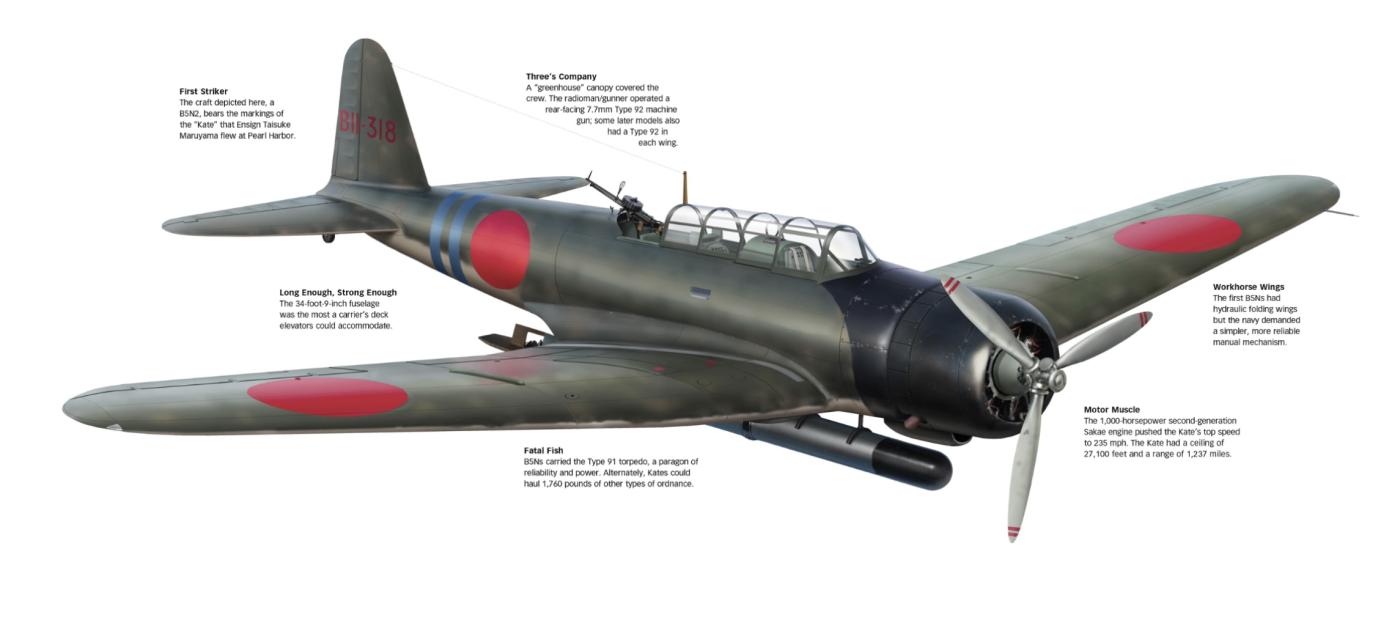
The Nakajima B5N2, known to the Allies as the “Kate” and to the Imperial Japanese Navy as the Navy Type 97 Carrier Attack Bomber, was the principal Japanese carrier-borne torpedo and level bomber during the attack on Pearl Harbor. Designed in the mid-1930s, it combined long range, a heavy strike load, and a well-trained three-man crew, making it one of the most formidable naval attack aircraft of its era.
The aircraft was created by a design team at the Nakajima Aircraft Company led by engineer Katsuji Nakamura. In 1935 the Imperial Japanese Navy issued a requirement for a modern, all-metal monoplane to replace its aging biplane torpedo bombers. Nakajima’s proposal outperformed its rivals and first flew in early 1937. After flight testing, it entered service as the Type 97 Carrier Attack Bomber and soon equipped Japan’s fleet carriers. By the time of Pearl Harbor, the improved B5N2 model had become the standard version.
Production of all variants of the B5N totaled just over 1,100 aircraft. Most were built by Nakajima, with additional airframes produced under license by Aichi to meet wartime demand. Early production consisted of the B5N1, but by 1939 the B5N2—with a more powerful engine and aerodynamic refinements—became the primary model used in frontline operations. It was this B5N2 that made up the torpedo and level-bombing elements of the carrier strike force on 7 December 1941.
Power came from a single Nakajima Sakae 11 fourteen-cylinder radial engine producing roughly 1,000 horsepower. With this engine the B5N2 reached a top speed of around 235 mph at altitude, with a cruising speed near 160 mph. Its range, one of its greatest strengths, averaged about 1,200 miles, allowing long-distance strikes from carriers operating far from enemy coasts. The airframe was an all-metal, low-wing monoplane with folding wings to maximize carrier hangar capacity. It carried a crew of three: pilot, navigator/bombardier, and radio-operator/gunner.
Offensive power was carried externally rather than through guns. The B5N2 could deliver a single Type 91 torpedo, one 800-kg armor-piercing bomb, two 250-kg bombs, or up to six smaller bombs for attacking airfields and lightly protected targets. For defense it carried only a single flexible 7.7 mm machine gun in the rear cockpit. The design emphasized speed and range rather than survivability, so it lacked armor protection and self-sealing fuel tanks, making it vulnerable once Allied fighter strength increased.
For the Pearl Harbor attack, the B5N2 was specially prepared for operations over the shallow harbor. Japanese engineers modified the Type 91 torpedo with wooden fins and stabilization systems so it would enter the water at a shallow angle instead of diving into the silted bottom. The first wave included torpedo-armed B5Ns aimed at the battleships along Battleship Row, alongside others carrying 800-kg armor-piercing bombs intended to rupture armored decks and ignite magazines. The second wave brought more B5Ns configured as level bombers to strike airfields, hangars, and grounded aircraft across Oahu.
One of the most consequential B5N2s that morning carried Commander Mitsuo Fuchida, the strike leader, who sent the famous “Tora! Tora! Tora!” message confirming that surprise had been achieved. The type played a central role in delivering the blows that sank or crippled the majority of the U.S. Pacific Fleet’s battleships.
Although the B5N2 began the war as one of the most effective carrier attack aircraft in the world, its lack of protection and increasingly outdated design soon became liabilities. As the war progressed and Allied air power strengthened, losses mounted. Even so, the B5N2 continued in service until later replacements like the Nakajima B6N became available. Its early-war record, especially at Pearl Harbor, secured its place among the most historically significant naval aircraft of the Second World War.