Junkers JU-52
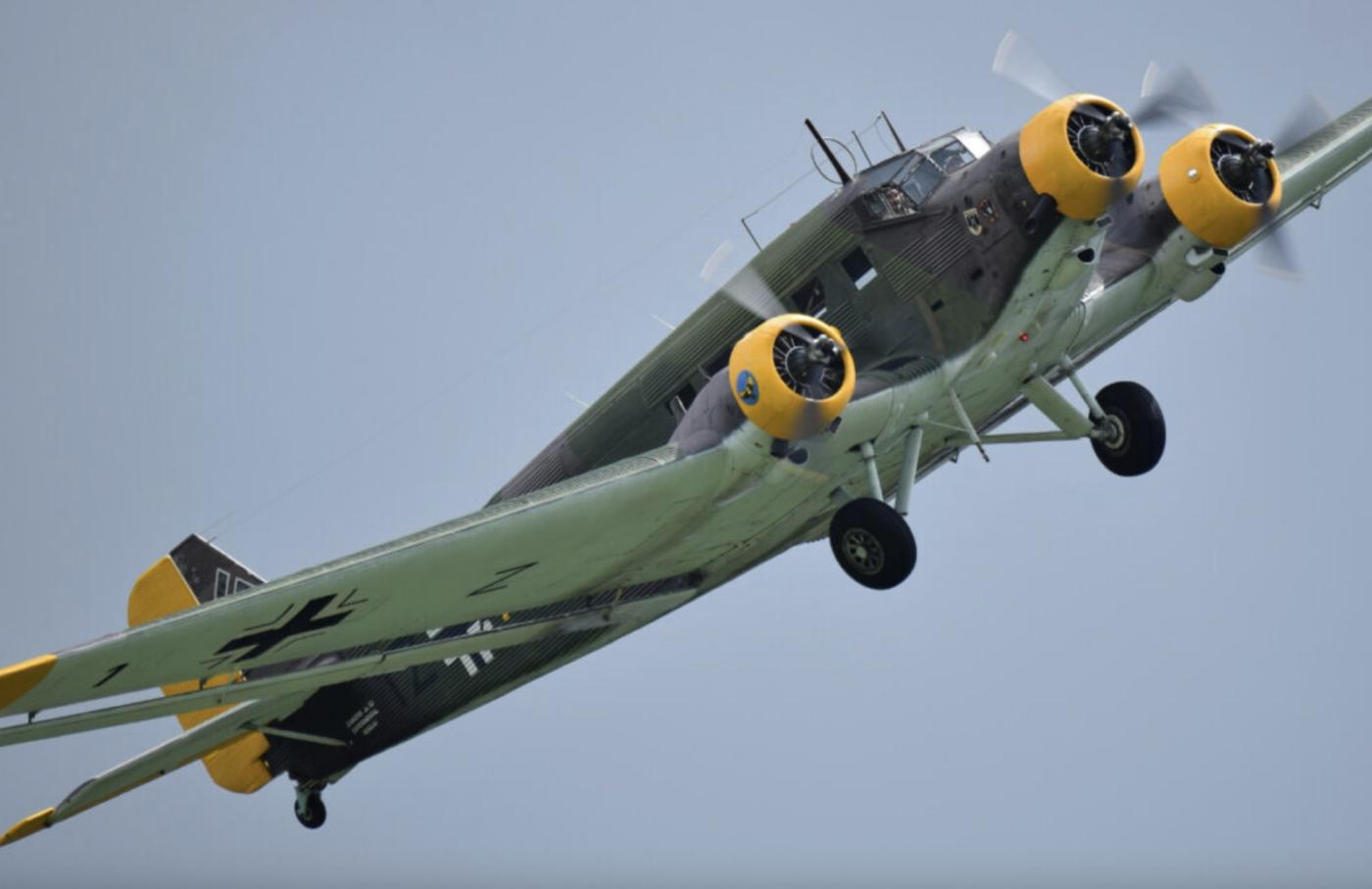
The Junkers Ju 52 was one of the most distinctive and hardworking aircraft ever built, instantly recognisable by its corrugated metal skin that gave it both strength and rigidity without adding excessive weight. This unconventional surface, inspired by earlier Junkers all-metal designs, acted like a structural truss, allowing the aircraft to endure rough conditions, heavy loads, and improvised airstrips. Its appearance may have been ungainly, but its reliability made it one of the most important German transport aircraft of the 1930s and the Second World War.
The Ju 52 was designed by Ernst Zindel of Junkers Flugzeug- und Motorenwerke AG, the pioneering company founded by Hugo Junkers. Although the “grandfather” of the design philosophy was Junkers himself, the Ju 52 as we know it was very much Zindel’s creation. The first version appeared in 1930 as a single-engined aircraft, but this configuration proved underpowered. Junkers engineers quickly reworked the airframe into the far more capable tri-motor layout, the Ju 52/3m, which became the definitive model and the aircraft remembered today.
Production was widespread and prolonged. Junkers built the bulk of aircraft in Germany, but licence production also took place in France by Amiot and in Spain by CASA. In total, more than 4,800 Ju 52s were built, with the Spanish continuing to produce variants into the 1950s. Its longevity in manufacturing mirrors its service life; the Ju 52 simply refused to become obsolete because it filled roles that no other aircraft handled quite as economically or reliably.
During the Second World War the Ju 52 became the Luftwaffe’s standard transport aircraft. It delivered paratroopers during the assaults on the Netherlands and Crete, carried vital supplies into the cauldron of Stalingrad, supported Afrika Korps operations in the desert, towed gliders for airborne assaults, evacuated wounded soldiers, and ferried personnel and equipment across every front where Germany fought. While slow and vulnerable to modern fighters, its short-field performance, load-carrying ability, and robustness kept it indispensable. Its corrugated skin, while aerodynamically inefficient, allowed it to shrug off minor battle damage and rough handling that would cripple more delicate designs.
The standard Ju 52/3m was powered most commonly by three BMW 132 radial engines, each delivering around 725 hp, although earlier and export models used Pratt & Whitney Hornet engines or Junkers L88 inline engines. With BMW radials the aircraft reached a speed of about 265 km/h (165 mph) and cruised comfortably at a lower speed that suited its transport role. Its range was typically around 870 km (540 miles), though auxiliary tanks and long-range modifications could extend this. The service ceiling was approximately 5,500 metres (18,000 feet), limited not so much by engines as by the aircraft’s role and weight. It could carry around 17 fully equipped soldiers or roughly two to three tons of cargo, depending on configuration.
Despite being a slow, wrinkled workhorse, the Ju 52 gained affection among its crews. Nicknames included Tante Ju (Auntie Ju) and Iron Annie, both reflecting the aircraft’s personality: tough, dependable, and almost human in its stubborn refusal to give up. Pilots frequently remarked on its benign handling; it could be flown with high precision despite its age and appearance. Its fixed landing gear and strong wing structure let it operate from snow, sand, mud, and primitive fields, often making the difference between a successful mission and disaster.
After the war, surviving Ju 52s continued to serve worldwide. Switzerland used them for decades as both military and civilian transports. Some flew with airlines such as Lufthansa and Iberia, others found their way into remote bush operations, and a few survive to this day in flying condition, offering passengers the chance to experience the rattling charm of 1930s aviation.
An interesting detail often overlooked is how the aircraft’s corrugated skin subtly altered airflow. While the ridges increased drag, they also stabilised airflow at low speeds, contributing to the Ju 52’s gentle stall characteristics and its suitability for short takeoffs and landings. In an era increasingly favouring smooth aluminium skins, Junkers’ approach was a fascinating counterpoint that showcased engineering priorities rooted in durability first and aerodynamics second.
In sum, the Ju 52 was not a glamorous aircraft, nor a fast one, nor even an advanced one by wartime standards, but it was a machine that mattered. Designed by Ernst Zindel, built in thousands across several countries, and powered by reliable radial engines, it became the backbone of German air transport during the war and a symbol of rugged practicality afterward. Its corrugated hide and three rumbling engines remain icons of early all-metal aviation, a reminder that sometimes the most unassuming designs are the ones that carry the heaviest weight of history.