Jerry Can
The humble World War II jerrycan began not as an Allied invention but as a German one, created years before the war and designed with a level of practicality that surprised every army that eventually used it. Its real name was the Wehrmacht-Einheitskanister, meaning “Armed Forces Standard Canister,” and it emerged from pre-war German planning for rapid mechanised warfare, where fuel and water would have to move quickly with advancing troops. The inventor generally credited with the design is the engineer Vinzenz Grünvogel of the Müller company (Müller Schwelm) in 1937. He designed a container that was simple to produce, exceptionally strong, stackable, easy to carry, and able to survive rough handling in any climate.
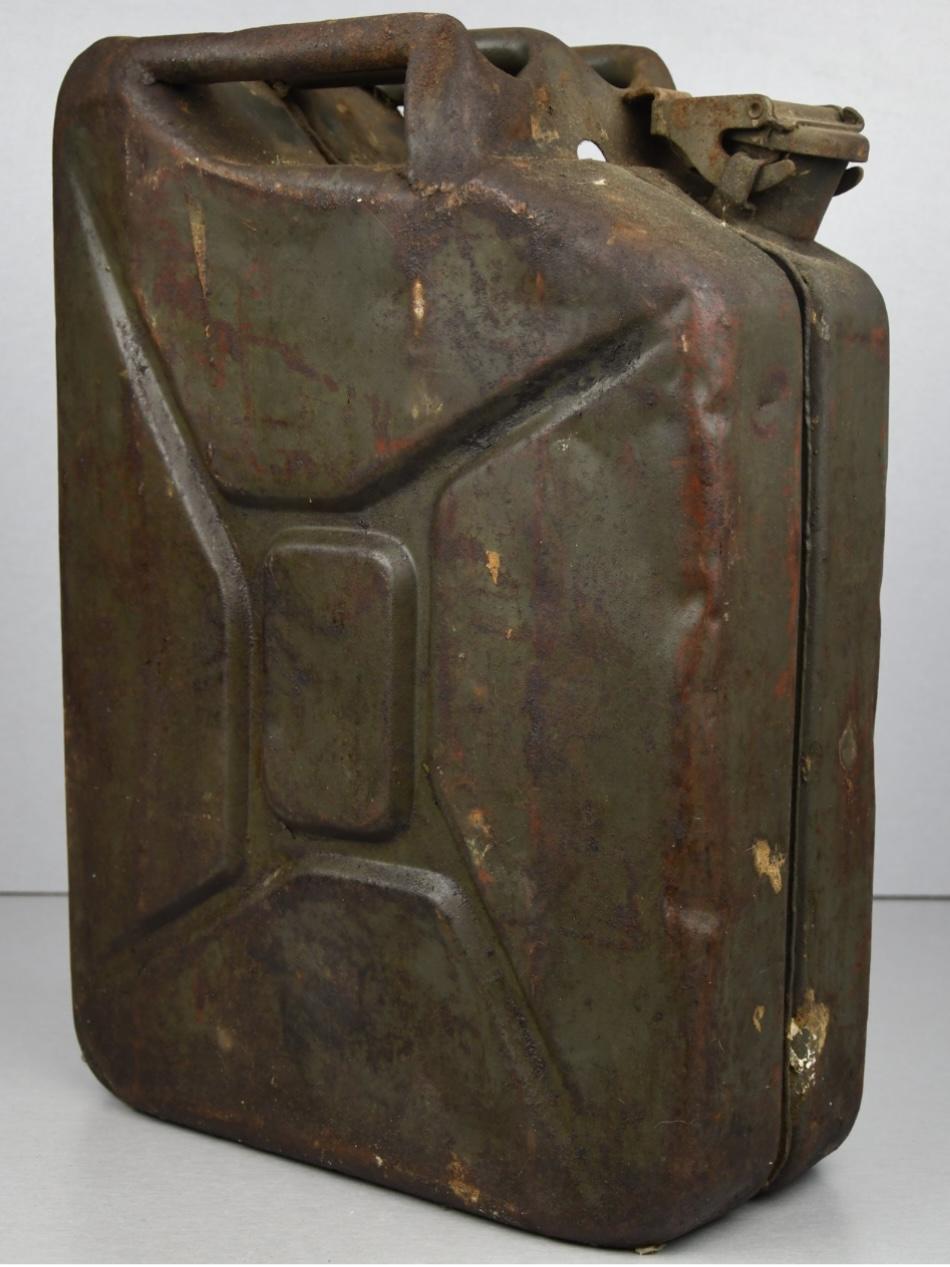
The German jerrycan measured twenty litres in capacity and had distinctive pressed-in X-shaped indentations on the sides. These were not decorative; they added strength and prevented the can from deforming when dropped or when contents expanded. The handles were one of its most ingenious features. Instead of a single central handle like most fuel cans of the era, the jerrycan had three: one in the middle, and two flanking it. This meant a single man could carry one can, two men could pass cans quickly down a line, and even when it was sloshing full of fuel it remained balanced. The cap was fast to open, sealing tightly without needing a separate tool, and air spaces in the design allowed the can to float.
Production began before the war at Müller in Schwelm and was soon taken up by other German manufacturers such as Schutzwerke GmbH in Apolda and various subcontractors across occupied Europe. The Germans produced enormous numbers of these cans, with estimates ranging from fourteen to twenty million during the course of the war. Factories in Germany, Austria, Czechoslovakia, and Poland all contributed, and as the war expanded, so did the need for more fuel containers to supply fast-moving armour divisions and support vehicles.
When Allied forces encountered the German cans in North Africa, they were astonished by how superior they were to their own fuel containers, which leaked, rusted, were slow to open, and often required special tools. British troops began capturing and reusing German cans immediately. American observers, equally impressed, sent samples back to the United States, where reverse-engineered versions were quickly produced. The Allied copies often lacked some of the original construction quality, especially early in production when factories tried to simplify the design, but the general form remained the same. Soon, millions more Allied-made cans were being produced by firms such as Norton, U.S. Steel, and various British manufacturers.
One interesting detail is that the earliest German cans were painted a distinctive red oxide primer that resisted corrosion. Fuel cans had a small interior air pipe running from the opening to the top corner of the can, allowing smooth, fast pouring without glugging. Water cans were marked with a white cross to avoid confusion with fuel. Another lesser-known fact is that the jerrycan was one of the first mass-produced containers designed specifically to be made from stamped sheet steel in two halves welded together—a technique that greatly increased speed of manufacture.
The name “jerrycan” itself came from Allied slang, as “Jerry” was a British nickname for the Germans. Even after the war, the name stuck, and millions of surplus cans flooded global markets. The design proved so practical that it became a worldwide standard for military and civilian use. Variants of the original German pattern are still produced today, nearly ninety years after Vinzenz Grünvogel sketched the first prototype.