Japanese type 91 Frag Grenade ww2
The Type 91 fragmentation grenade was introduced into service with the Imperial Japanese Army in 1931, corresponding to the year 2591 in the Japanese imperial calendar from which its designation was derived. It represented an early attempt by Japan to standardise infantry hand grenades after earlier models proved unreliable and inconsistent during the 1920s. The weapon became one of the standard explosive devices issued to Japanese infantry during the early years of the Second World War and continued to see service even after more specialised grenades were introduced.
Responsibility for its development lay with the Imperial Japanese Army’s ordnance research and engineering departments, operating under the Army Technical Bureau. Japanese weapons development in this period was usually handled internally by military arsenals rather than private designers, and the grenade emerged from a programme aimed at creating a more versatile explosive device for infantry use. Engineers sought to produce a munition that could serve not only as a hand grenade but also as a charge compatible with the small grenade dischargers carried by Japanese squads.
Production was carried out across several government-controlled arsenals and contracted factories. Major manufacturing centres included the Tokyo Army Arsenal and the Osaka Army Arsenal, both of which handled large quantities of small arms and ammunition. As wartime pressures increased and Allied bombing disrupted industry, manufacture spread to smaller workshops and facilities in occupied territories such as Korea and Manchuria. Declining material quality and labour shortages during the later years of the conflict led to less consistent production standards, and some late examples suffered from defects.
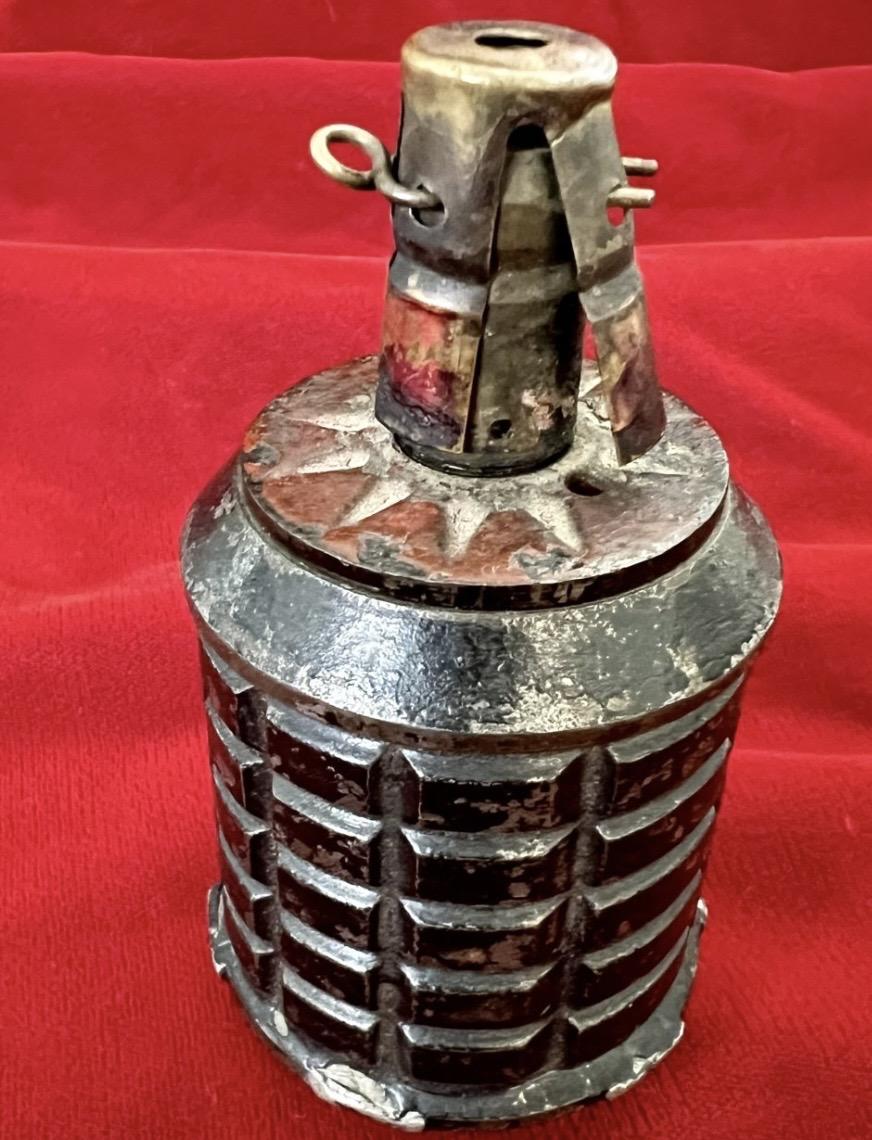
The grenade featured a cylindrical cast-iron body designed to fragment upon detonation. Its exterior was segmented to encourage predictable shattering into lethal fragments. A threaded top section housed the fuse mechanism, which projected slightly above the body and incorporated a striking head. The explosive filler was typically TNT or a similar high explosive available within Japanese supply chains. The overall design prioritised ease of manufacture and adaptability over precision engineering, reflecting Japan’s limited industrial resources compared with Western powers.
One of the most distinctive aspects of the design was its multipurpose nature. Japanese infantry doctrine emphasised flexibility, and this grenade could be thrown by hand, launched from a grenade discharger, or adapted for demolition and booby-trap use. To prepare it for throwing, the user removed the safety pin and struck the protruding firing head against a hard object such as a helmet or rifle butt. This action ignited the delay fuse, giving several seconds before detonation. The relatively long delay was intentional, allowing the same device to be used safely in dischargers where a longer flight time required more fuse length.
The compatibility with the Type 89 grenade discharger was central to its role within Japanese infantry squads. These small, mortar-like weapons provided portable indirect fire capability. By fitting a propellant charge, the grenade could be launched over greater distances than a soldier could throw by hand. However, when used as a hand grenade the long delay sometimes allowed opposing troops time to react, leading to the later adoption of grenades with shorter fuse times designed specifically for throwing.
In addition to its standard battlefield role, soldiers frequently employed it for improvised demolition tasks. The relatively simple construction made it easy to combine with other charges or adapt for destroying equipment, light fortifications, or supplies. Training manuals encouraged creative use of available explosives, and this device suited that philosophy. At the same time, the requirement to strike the fuse before use and the variability in manufacturing quality could create risks for the user, particularly with late-war production.
Allied forces in the Pacific encountered large numbers of these grenades and examined captured examples for intelligence purposes. Some were reused in emergencies, though many troops considered them less safe than Allied designs due to the activation method and occasional reliability issues. Despite these concerns, the grenade remained in widespread service and became a common element of Japanese infantry equipment throughout campaigns in China, Southeast Asia, and the Pacific islands.