On this day in military history…
On 20 February 1942, Lieutenant Edward Henry “Butch” O’Hare of the United States Navy carried out one of the most extraordinary single-pilot air actions in naval aviation history. Flying from the aircraft carrier USS Lexington in the South Pacific during the early months of the Second World War, O’Hare intercepted an incoming formation of Japanese bombers and, in a matter of minutes, shot down five enemy aircraft almost single-handedly. His actions made him the first naval aviator of the war to become an ace and earned him the Medal of Honor.
At the time, American naval forces were still reeling from the shock of the attack on Pearl Harbor in December 1941. The Pacific Fleet was on the defensive, and aircraft carriers had become the primary striking arm of the U.S. Navy. USS Lexington was operating northeast of New Guinea as part of a task force attempting to strike Japanese bases in the region. Japanese reconnaissance detected the American carrier group and dispatched a formation of twin-engine bombers to locate and attack the carrier.
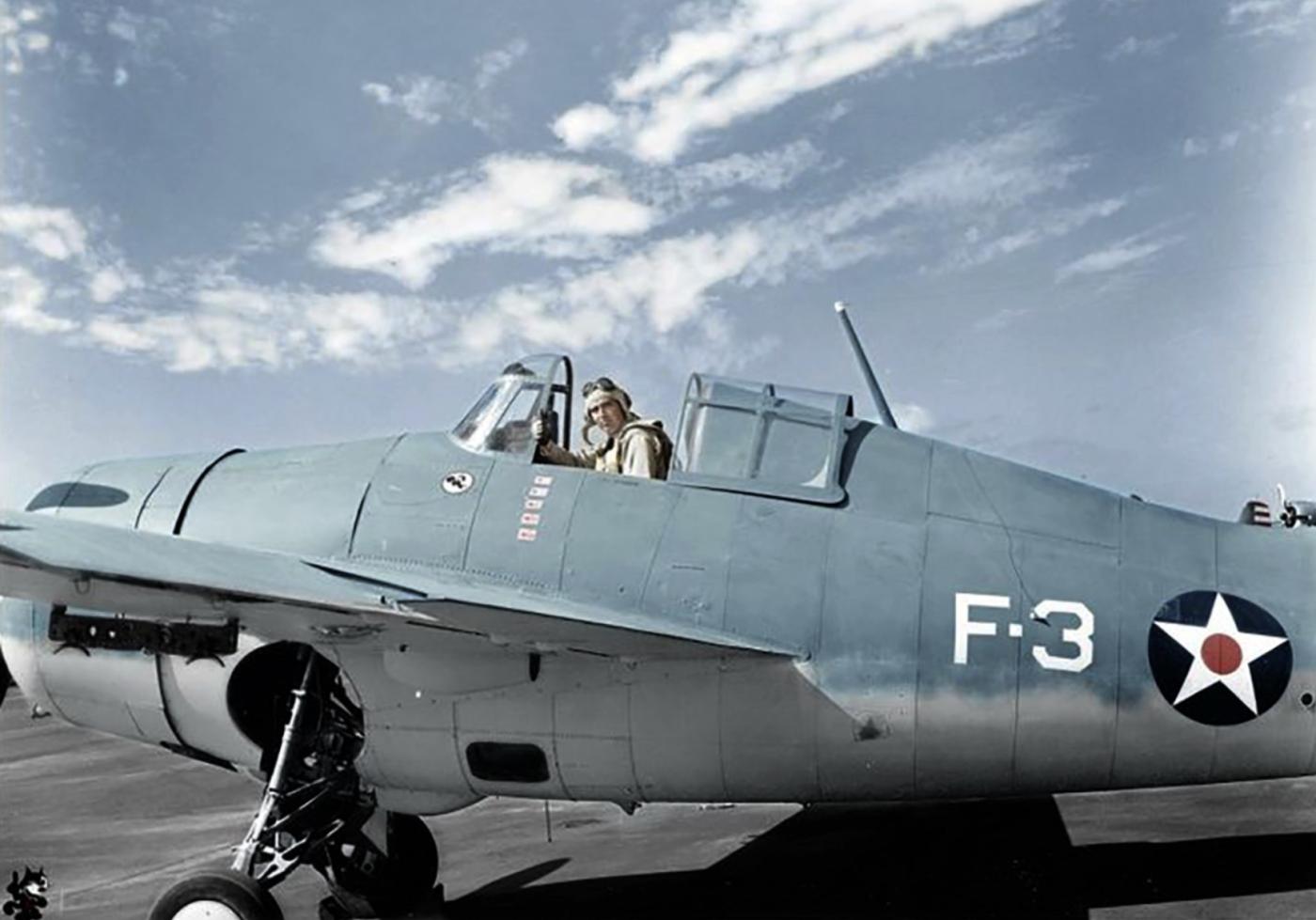
Lieutenant O’Hare, a 27-year-old pilot from St. Louis, Missouri, was flying a Grumman F4F-3 Wildcat, the standard U.S. Navy carrier fighter of the time. The Wildcat was a rugged, heavily built aircraft armed with four .50-calibre Browning machine guns and designed to withstand punishment while operating from aircraft carriers. Although not as agile as some Japanese fighters, it was sturdy and capable of absorbing damage that might destroy lighter aircraft. O’Hare was serving with Fighting Squadron 3 (VF-3), one of Lexington’s fighter squadrons, and had already demonstrated exceptional skill as a pilot.
On the afternoon of 20 February, radar detected a formation of Japanese aircraft approaching Lexington. These were Mitsubishi G4M Type 1 land-based bombers, known to the Allies by the reporting name “Betty.” The G4M was fast and long-ranged but lightly armored, carrying a heavy bomb load intended to cripple ships. They posed a serious threat to any carrier task force if allowed to reach bombing range.
A group of Wildcats was vectored to intercept the incoming bombers. Due to communication difficulties and navigation confusion, only a small number of American fighters managed to position themselves between the Japanese formation and Lexington. O’Hare and his wingman, Lieutenant Marion Dufilho, found themselves in the best position to attack the bombers as they approached the carrier. However, Dufilho’s guns jammed early in the engagement, leaving O’Hare to face the incoming formation alone.
The Japanese formation consisted of nine G4M bombers flying in a tight V-shaped pattern at an altitude of around 10,000 feet. Their target was Lexington, and they were closing in fast. O’Hare immediately maneuvered his Wildcat into an attacking position above and behind the bombers. He dove into the formation, opening fire at close range with his .50-calibre machine guns.
O’Hare made repeated high-speed firing passes through the Japanese formation. On each pass he aimed carefully at engines and cockpits, knowing that the Betty bombers were particularly vulnerable to such strikes. His marksmanship was exceptional. Within moments, he set the first bomber ablaze. Flames and smoke poured from its engine, and it fell out of formation, doomed.
Without hesitation, O’Hare climbed back above the formation and attacked again. He pressed home his attacks with calm precision, despite being alone and facing defensive gunfire from multiple bombers. One after another, he closed to point-blank range and fired short, accurate bursts. Within minutes he destroyed a second bomber, then a third. The remaining Japanese aircraft continued toward Lexington, determined to complete their mission.
O’Hare continued his assault, making pass after pass. He maneuvered aggressively but with careful control, conserving his limited ammunition and ensuring each burst counted. He shot down a fourth bomber, sending it plunging toward the sea. Still undeterred, he closed on another and delivered a final devastating burst that destroyed the fifth aircraft.
In approximately six minutes of intense combat, O’Hare had shot down five Japanese bombers and severely damaged a sixth. The remaining aircraft in the formation, shaken and disorganized by his relentless attacks, either jettisoned their bombs prematurely or failed to press home an effective strike. Lexington escaped serious damage. O’Hare’s intervention had almost certainly saved the carrier from being hit by multiple bombs.
After expending nearly all his ammunition, O’Hare returned to Lexington. His Wildcat had been struck by enemy fire, but the sturdy aircraft had brought him safely back to the carrier deck. Gun camera footage from his fighter confirmed the destruction of five enemy bombers, an extraordinary achievement for a single pilot in one engagement. The feat made him the first U.S. Navy aviator of the Second World War to achieve ace status—five victories in aerial combat.
News of the action quickly spread through the fleet and back to the United States. At a time when morale was fragile following early Japanese successes across the Pacific, O’Hare’s heroism provided a powerful symbol of courage and determination. He was hailed as a national hero and brought back to the United States for a period of public appearances and war bond drives.
For his actions on 20 February 1942, Lieutenant Edward “Butch” O’Hare was awarded the Medal of Honor, the United States’ highest military decoration. The citation praised his “extreme gallantry and intrepidity in aerial combat” and noted that his actions had saved his carrier from serious damage. He received the medal from President Franklin D. Roosevelt at a ceremony in Washington, D.C.
O’Hare later returned to combat duty in the Pacific. He continued to serve with distinction but was killed in action on the night of 26 November 1943 during a night fighter mission from the aircraft carrier USS Enterprise. His aircraft was lost during an interception of Japanese bombers, and the exact circumstances of his death remain uncertain.
Edward “Butch” O’Hare’s remarkable combat on 20 February 1942 remains one of the most celebrated episodes in U.S. naval aviation history. Flying a single Grumman F4F-3 Wildcat against a formation of heavily armed Japanese Mitsubishi G4M bombers, he demonstrated exceptional courage, marksmanship, and determination. His destruction of five enemy aircraft in a matter of minutes not only made him the Navy’s first ace of the war but also helped preserve an American carrier at a critical moment in the Pacific conflict.