Japanese Propaganda
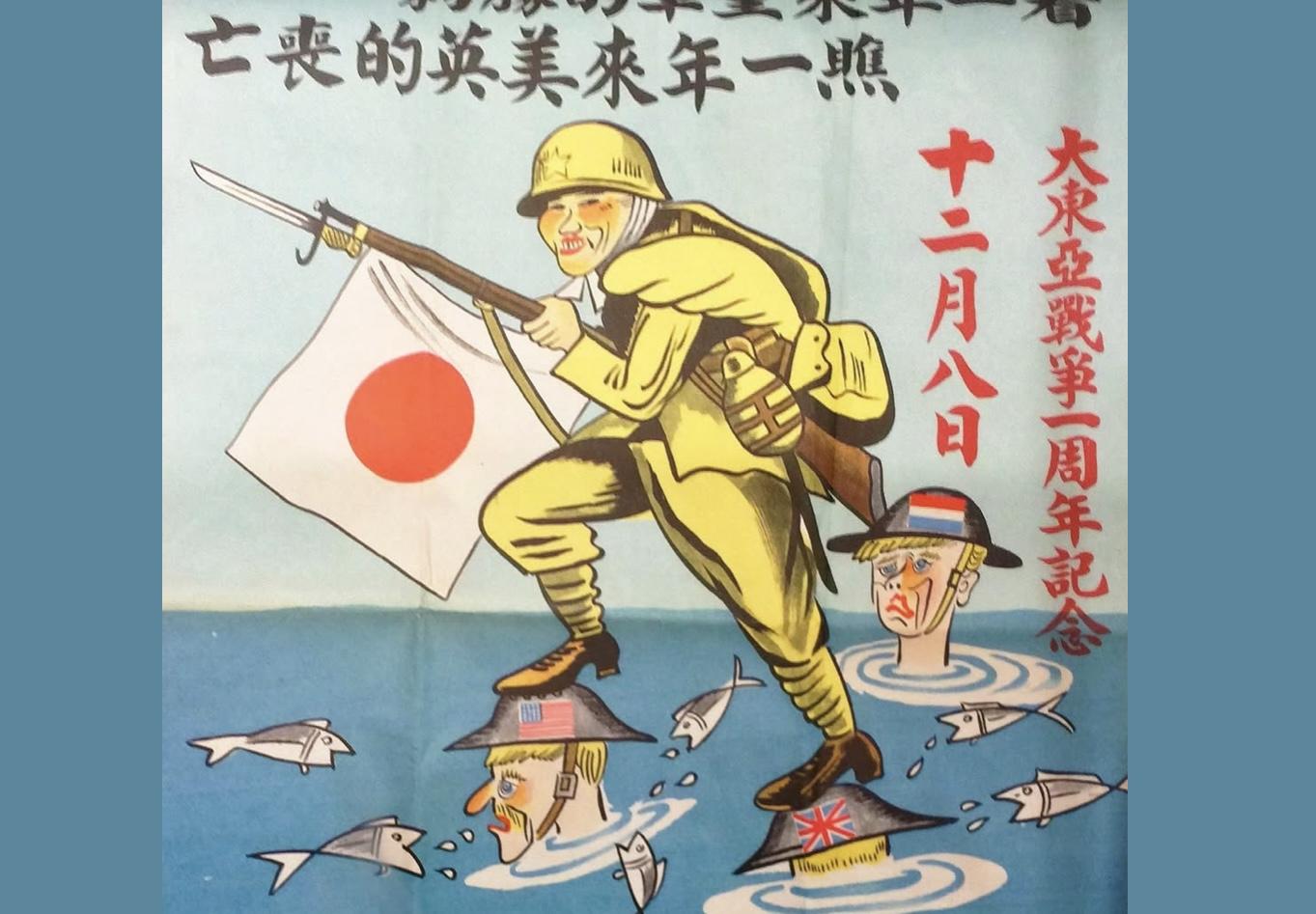
Japanese wartime posters that depicted victories over Allied forces were a central tool in sustaining public morale and reinforcing the legitimacy of Japan’s military campaigns from the 1930s through the end of the Second World War. These posters blended state ideology, visual propaganda, and the illusion of continuous triumph, aiming to keep the civilian population committed to a long and increasingly desperate conflict.


The conceptual origins of these posters came largely from Japan’s wartime propaganda apparatus, most prominently the Cabinet Information Bureau. This bureau grew out of earlier government information offices of the 1930s and was expanded dramatically in 1940 to centralize messaging across the empire. Senior bureaucrats—many with backgrounds in education, media, or military public relations—met regularly with army and navy representatives to determine the themes considered essential for mobilizing public spirit. The push for “victory posters” increased after the early successes in the Pacific, which leaders felt should be communicated visually to maintain a sense of inevitability and national destiny.
While the ideas were strongly guided by government officials, the artwork itself was typically produced by professional illustrators, printmakers, and graphic artists who had already built reputations in commercial advertising or news illustration. Artists such as Kondō Shōichirō, Sugiura Hisui, and others who worked anonymously under contract contributed to many of the most recognizable designs. Some were motivated by nationalism, others by obligation or fear of reprisal, and some simply by the opportunity for stable income in a controlled economy. Most posters relied on sharp contrasts, heroic poses, and simplified, dramatic imagery rather than detailed realism, making them instantly readable to the public.
Printing was carried out by major publishing houses and lithographic firms concentrated in Tokyo, Osaka, and other industrial centers. Companies that had previously produced commercial advertisements or mass-market prints were either requisitioned or incentivized to convert their presses to propaganda output. Paper shortages grew severe after 1943, so print runs became smaller and production methods more economical; some posters were printed on recycled paper or low-grade stock, and others were distributed as small broadsheets rather than large-format wall posters. The government managed allocations of ink, paper, and press time, ensuring propaganda material was prioritized above private printing needs.
Distribution followed a highly coordinated network. Local government offices and neighborhood associations received bundles of posters from central agencies and were responsible for placing them in train stations, schools, street kiosks, post offices, and factories. Rural areas saw traveling information teams—sometimes including soldiers or local police—who delivered posters and supervised their display in villages. Newspapers also inserted miniature poster-style images as special supplements, while department stores and cinemas mounted them prominently as part of broader patriotic exhibitions. Many schools used them in classrooms to reinforce lessons on national unity and sacrifice.
Posters depicting victories often exaggerated or simplified events, such as naval triumphs, air battles, captures of key territories, and scenes of Allied forces in retreat. They served several psychological purposes: to convince citizens that Japan remained strong even as the war turned against it; to reduce fear of Allied retaliation; and to cultivate the belief that endurance at home directly contributed to battlefield success. Some posters referenced actual battles, but many conveyed symbolic victories or depicted idealized soldiers embodying collective heroism rather than specific individuals.
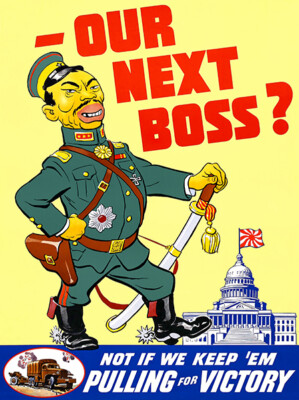
An interesting aspect of these posters is their integration of traditional aesthetics with modern propaganda techniques. Many incorporated design elements inspired by ukiyo-e prints, especially dramatic diagonals or stylized waves reminiscent of Hokusai, giving the images a familiar cultural resonance. Others borrowed techniques from avant-garde commercial art or even Soviet and German propaganda graphics, demonstrating Japan’s awareness of global visual trends despite its political isolation. Another notable point is that some posters used English phrases or Romanized Japanese deliberately, reflecting an attempt to frame the conflict on an international stage or to demonstrate cultural sophistication.
After major defeats began to accumulate, especially from 1943 onward, the tone of the posters shifted from triumph to perseverance. Overt victory imagery became rarer, but earlier posters depicting success continued to circulate because they required fewer resources to reproduce and were useful in maintaining a fading optimism. Today, surviving examples provide valuable insight not just into wartime propaganda but also into the everyday psychological environment in which Japanese civilians lived. Collectors and historians consider them important artifacts of both visual culture and state messaging, illustrating how art, ideology, and national crisis intertwined during one of the darkest periods in Japan’s modern history.