Japanese ARISAKA bayonet
The Japanese Arisaka bayonet adopted in 1897 is one of the most recognisable and long-lived bayonets of the modern military era. It remained in frontline service from the late Meiji period through to the end of the Second World War, an exceptionally long lifespan for any edged weapon. Measuring just over half a metre in overall length with a blade of roughly 40 centimetres, it ranks among the longest standard-issue bayonets used during the war and reflects a time when close-quarters fighting with cold steel was still considered a normal part of infantry combat.
Its development was closely tied to Japan’s adoption of modern small-bore rifles in the late nineteenth century. The bayonet emerged alongside the new service rifle programme at the Tokyo Army Arsenal, overseen by Colonel Arisaka Nariakira. Rather than being the work of a single named bayonet designer, it should be seen as a product of the Japanese ordnance system of the period, created to be strong, simple, and adaptable enough to remain useful as firearms evolved.
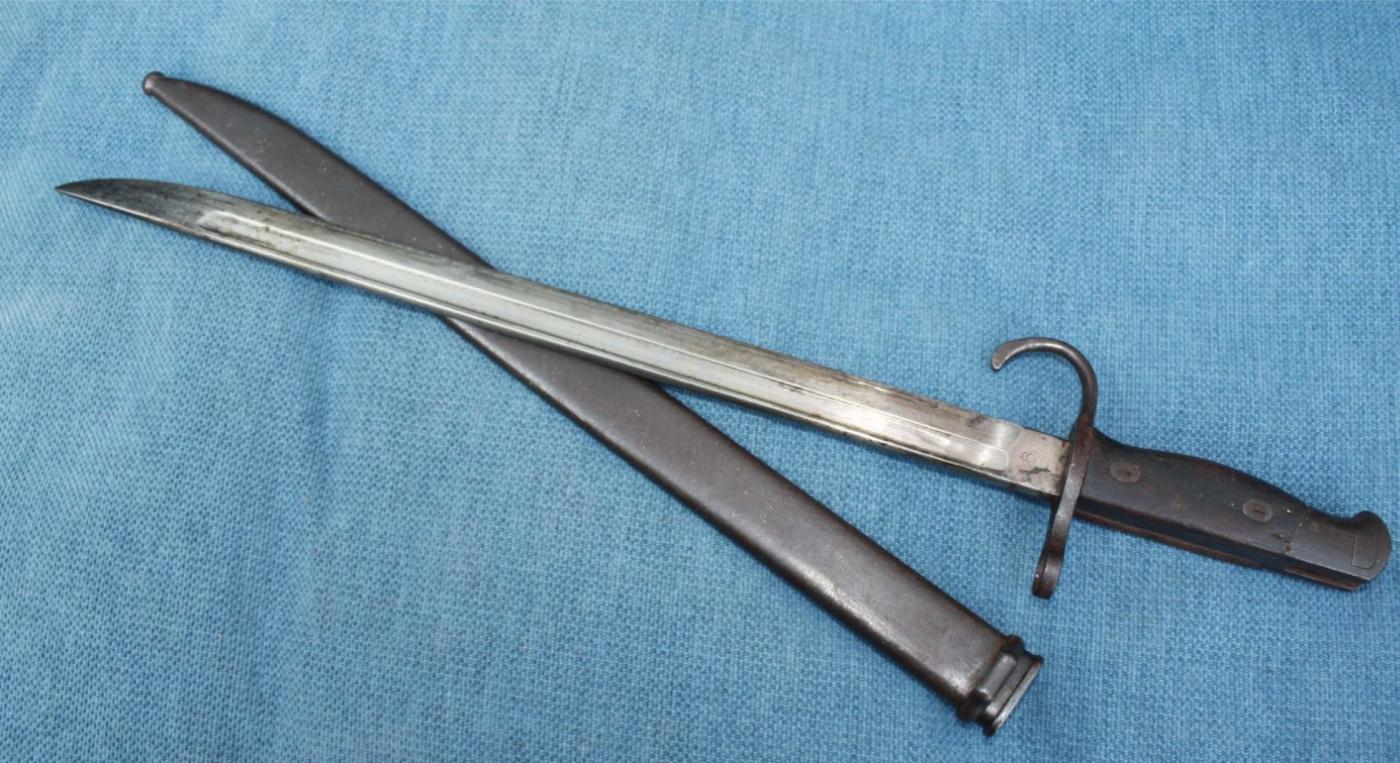
In form it is a classic sword bayonet, with a single-edged blade featuring a long fuller, wooden grip scales secured by screws, and a distinctive bird’s-head pommel. Early examples are especially notable for their hooked quillon, a forward-curving projection on the guard intended to catch or control an opponent’s blade. This feature was later dropped as manufacturing was simplified, first in peacetime updates and then more aggressively during the war, resulting in the straight-guard pattern more commonly encountered today. Scabbards followed a similar evolution, beginning as steel, then moving to vulcanised fibre, and finally to very crude wooden or bamboo substitutes as Japan’s material shortages worsened.
One of the reasons this bayonet became so widespread is the number of weapons it fitted. Although originally intended for the first Arisaka service rifle, it was retained when the later and far more common Type 38 and Type 99 rifles entered service. The same mounting system also allowed it to be used on carbines and even on some light machine guns and submachine guns. This broad compatibility reflects Japanese infantry doctrine, which placed great emphasis on bayonet training and aggressive close-combat tactics.
Manufacture began in 1897 and continued until 1945. Early production came from major government arsenals such as Tokyo, Kokura, and Nagoya, but wartime demand led to extensive use of private contractors and arsenals in occupied territories, including Korea and Manchuria. Total production is generally estimated at around 8.4 million examples, explaining why these bayonets remain relatively common on the collectors’ market today.
The blades were made from carbon steel, with finish varying by period. Early pieces were usually left bright and polished, while many later examples were blued to reduce glare and speed production. Late-war manufacture often shows simplified machining, rougher finishing, and in some cases the absence of a fuller, all of which are now recognised as genuine wartime expedients rather than post-war damage. Earlier arsenal-made examples tend to show more consistent heat treatment and overall quality.
An interesting historical detail is that this Japanese design influenced foreign bayonets. British ordnance trials in the early twentieth century examined several long bayonet patterns, including the Japanese example, and the resulting Pattern 1907 bayonet adopted the same general long, sword-like form. This places the Japanese bayonet within a broader international trend rather than as an isolated national design.
In terms of original cost, surviving military pricing suggests that on the eve of the Second World War a bayonet of this pattern cost a little over nine yen, making it an economical mass-issue item. Today its value is determined mainly by condition, scabbard type, and manufacturing marks. Typical serviceable examples usually sell in the low to mid hundreds, while early hooked-quillon versions, scarce arsenal marks, or particularly well-preserved pieces can command significantly higher prices. Very rough late-war examples often sell for less, though they are increasingly appreciated for what they reveal about Japan’s declining industrial capacity in the final years of the conflict.
For collectors, the real appeal lies in the long and clearly visible evolution of this bayonet. Small details such as guard shape, scabbard material, and arsenal markings tell a story that stretches from Japan’s rise as a modern military power at the end of the nineteenth century to the desperate conditions of 1945.