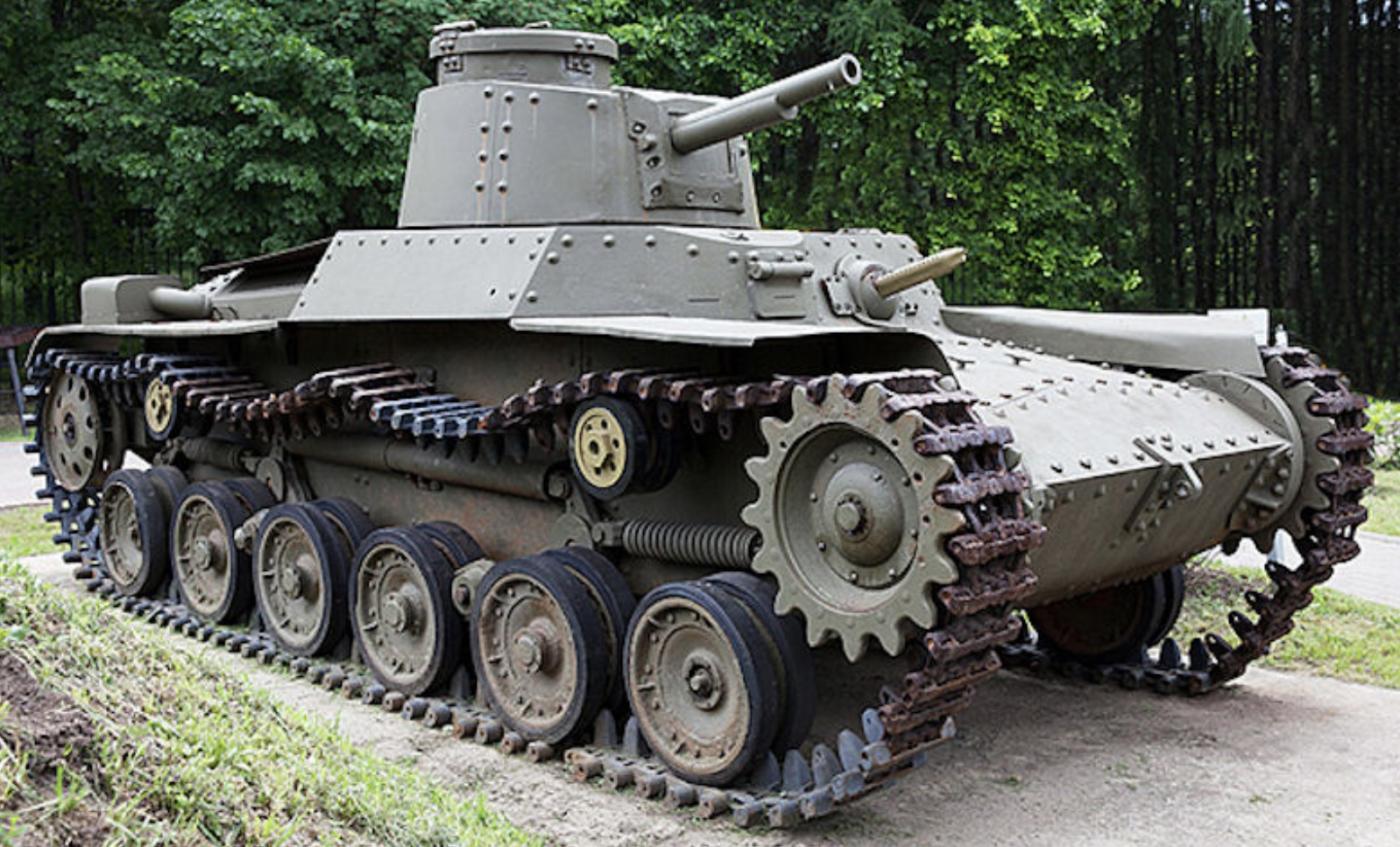
Japanese 97 chi-Ha Tank
The Type 97 Chi-Ha was the Imperial Japanese Army’s standard medium tank during the late 1930s and the early years of the Second World War, and it ultimately became the most produced Japanese medium tank of the conflict. The designation “Type 97” comes from the Japanese imperial year 2597, corresponding to 1937, when the tank was officially accepted for service. “Chi” indicated a medium tank in Japanese Army classification, while “Ha” meant it was the third design in that category under the old iroha ordering system.
The Chi-Ha was developed as a replacement for the older Type 89 I-Go, which had proven too slow and outdated for modern mobile warfare. Design work began in the mid-1930s as the Army debated what kind of tank it needed for future wars. Two competing concepts emerged: a lighter, cheaper design known as the Chi-Ni, and a heavier, better-protected and more capable design produced by Mitsubishi Heavy Industries, which became the Chi-Ha. When the Second Sino-Japanese War broke out in 1937 and combat demands became more urgent, the Army chose the Mitsubishi design despite its higher cost, prioritising performance over economy.
Mitsubishi Heavy Industries was the main designer and manufacturer, with Hitachi Industries and Army arsenals contributing to production. Rather than being the vision of a single individual, the Chi-Ha reflected the collective thinking of Japanese Army planners and engineers, shaped by combat experience in China and expectations of how tanks would be used. Production ran from 1938 to 1943, and in total just over two thousand vehicles were built. Of these, roughly 1,160 were the original version, and around 930 were the later improved model.
The tank’s layout was conventional for its time, with the driver and bow machine gunner in the front hull, the fighting compartment in the middle, and the engine at the rear. One of its most distinctive features was its suspension system, which used a bell-crank arrangement associated with Japanese tank designer Tomio Hara. This system gave the Chi-Ha reasonably good cross-country mobility despite its relatively narrow tracks and light weight compared with contemporary European designs.
Power came from a Mitsubishi air-cooled V-12 diesel engine producing about 170 horsepower. This gave the Chi-Ha a top road speed of roughly 38 kilometres per hour and a range of around 200 kilometres. The use of a diesel engine was a practical choice, reducing fire risk and fitting Japan’s fuel situation better than petrol engines.
Armour protection was limited, reflecting Japanese priorities of mobility and ease of production. Thickness generally ranged from about 8 mm on thinner sections to around 25 mm on the front and turret areas. This was sufficient against small arms and light anti-tank weapons of the mid-1930s, but it quickly became inadequate as anti-tank guns improved during the war.
Firepower changed significantly over the Chi-Ha’s service life. The original model was armed with a short-barrelled 57 mm gun designed primarily for infantry support. It fired an effective high-explosive shell and was useful against field fortifications and soft targets, which suited early fighting in China. However, its low muzzle velocity meant poor performance against enemy armour. This weakness became clear during clashes with Soviet forces at Khalkhin Gol and later when facing better-equipped Allied tanks.
As a result, the Chi-Ha was upgraded into the Type 97-Kai Shinhōtō Chi-Ha, meaning “new turret.” This version mounted a longer-barrelled, high-velocity 47 mm gun that greatly improved anti-tank capability and allowed Japanese crews to engage enemy armour more effectively at typical combat ranges. The redesigned turret was larger and better arranged, improving crew efficiency and battlefield awareness.
Secondary armament consisted of two 7.7 mm machine guns, one mounted in the hull and another in the turret, giving the tank basic close-defence capability against infantry. Crew size varied by version. The original Chi-Ha typically operated with four men, while the Shinhōtō version usually carried five, reflecting the improved turret layout and a better division of responsibilities. In early models, the commander was often overworked, having to command, observe, and assist with gunnery, whereas the later turret eased this burden.
In service, the Chi-Ha was best suited to the roles it had originally been designed for: infantry support, mobile operations against lightly equipped enemies, and fighting in difficult terrain where reliability and range mattered more than heavy armour. It was compact, mechanically dependable, and relatively easy to maintain in harsh conditions. Against modern Allied medium tanks later in the war, it was clearly outclassed, but with the 47 mm gun it remained dangerous to lighter vehicles and could still be effective when used with skill and tactical awareness.
An interesting aspect of the Chi-Ha is how long it remained in frontline use despite its limitations. Japanese industry struggled to field a true successor in large numbers, so the Chi-Ha continued to serve across China, Southeast Asia, and the Pacific islands well into the later stages of the war. Its long service life and large production run make it one of the most important Japanese armoured vehicles of the Second World War, representing both the strengths and the limitations of Japan’s wartime tank development.