
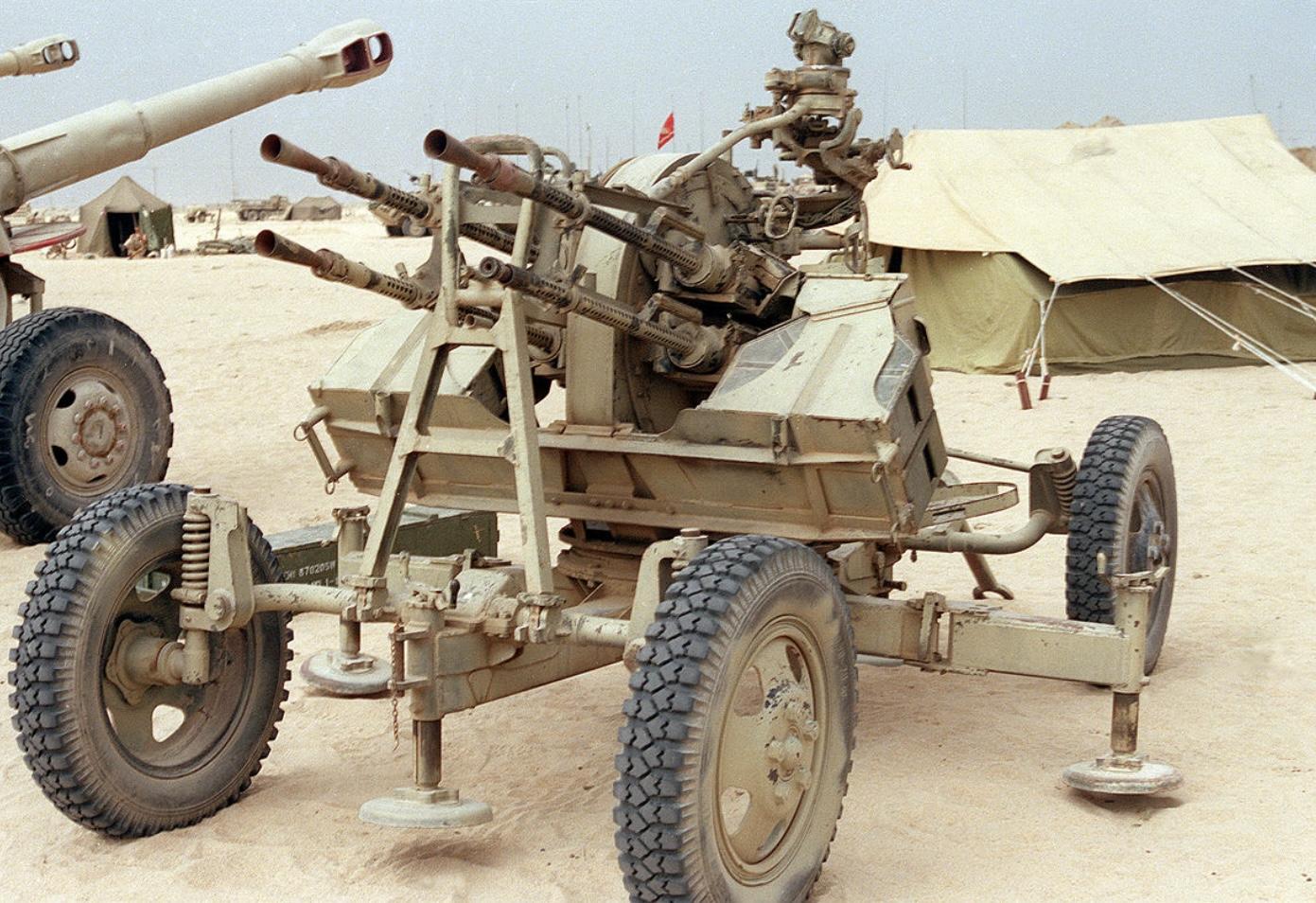
Iraq ZPU-4 anti aircraft gun
During the First Gulf War of 1990–1991, Iraq possessed one of the largest and most heavily layered air-defence systems in the Middle East. While much attention after the war focused on surface-to-air missile sites and radar installations destroyed in the opening hours of the air campaign, a far greater number of simpler weapons formed the backbone of Iraq’s low-level defences. Chief among these was the quadruple 14.5 mm anti-aircraft gun, a rugged and intimidating system that posed a real threat to aircraft flying close to the ground.
The weapon was originally designed and manufactured in the Soviet Union in the early Cold War period, with large numbers also produced under licence in China and other Warsaw Pact countries. Iraq acquired its examples primarily from Soviet and Chinese sources over several decades, particularly during the 1970s and 1980s. By the time of the Gulf War, Iraq was believed to have hundreds of 14.5 mm anti-aircraft mounts of various types in service, including both twin and quadruple versions, making them one of the most widespread air-defence weapons in the country.
The quadruple mount consisted of four 14.5 mm KPV heavy machine guns installed on a single towed carriage. Although not modern by 1991 standards, the design was brutally effective within its intended role. Each gun fired extremely powerful ammunition, far larger than rifle-calibre weapons, capable of punching through aircraft skin, damaging engines, severing control lines, or shattering helicopter rotor blades. When all four guns were fired together, the volume of fire was immense, filling the air with tracer and explosive rounds.
Several types of ammunition were used. These included armour-piercing incendiary rounds designed to penetrate aircraft structures and ignite fuel or components, armour-piercing incendiary tracer rounds that allowed gunners to see and correct their fire, and high-explosive incendiary ammunition intended to cause damage through blast and fragmentation. The tracer component was especially important, as it allowed crews to “walk” their fire onto a target visually.
The weapon was most accurate and dangerous at low altitude and relatively short range. While its maximum ballistic range was much greater, effective engagement against aircraft was generally within about one to one and a half kilometres. Accuracy depended heavily on crew skill, target speed, and firing discipline. Against fast jets it relied more on volume of fire than precision, but against helicopters or aircraft committed to an attack run, it could be extremely dangerous.
Operation of the gun required a crew, typically between five and eight men. One gunner aimed and fired the weapon, seated behind the guns, while another assisted with elevation and traverse. Additional crew members fed ammunition belts, changed barrels when overheated, spotted aircraft, and provided local security. Well-trained crews could keep up a surprisingly high rate of effective fire, though sustained firing quickly led to barrel wear and overheating.
A key feature of the system was its simplicity. It used a purely optical sighting system, usually a mechanical anti-aircraft ring or reflector sight calibrated for speed and lead rather than range. There was no radar, no fire-control computer, and no external guidance. This made the weapon immune to electronic jamming and allowed it to operate independently of Iraq’s wider air-defence network. As long as the crew could see the target, they could engage it.
Before the war, Iraq organised its air defences in layers. Long-range missiles were intended to engage aircraft at high altitude, medium systems filled the gaps, and anti-aircraft guns defended specific points on the ground. The quad 14.5 mm gun sat at the bottom of this structure. Because it was cheap, robust, and easy to maintain, it was deployed in large numbers around airfields, bridges, power stations, government buildings, military camps, and Republican Guard positions. In urban areas it was often placed to cover likely low-level approach routes. Many positions were dug in or protected by earth berms to give the crew some cover while maintaining a clear field of fire.
During the air campaign, Iraqi crews generally used these guns as point-defence weapons. Rather than firing continuously, they often waited until an aircraft was clearly committed to an attack before opening fire. Short, violent bursts were preferred, conserving ammunition and increasing the chance of catching the pilot at the most dangerous moment of the attack run. At night, the system could still be effective against aircraft silhouetted by fires, flares, or city lighting, although firing in darkness also made the gun’s position visible and often resulted in rapid retaliation.
As coalition air power tightened its grip on the battlefield, some of these weapons were also turned against ground targets. The heavy 14.5 mm guns were devastating against infantry, light vehicles, and buildings, and they were sometimes used for local defence or to strengthen positions during the later stages of the war. This secondary role highlighted the flexibility of the system, even though it had never been designed for that purpose.
Against modern coalition aircraft, the quadruple gun could not alter the outcome of the war. Coalition forces quickly achieved air superiority and adopted tactics that reduced exposure to light anti-aircraft fire, including higher attack altitudes, night operations, and stand-off weapons. Even so, the gun remained a real threat within its limited envelope. Helicopters and aircraft conducting low-level attacks or repeated passes were particularly vulnerable, and even when no hits were achieved, the presence of heavy tracer fire often forced pilots to change direction, climb higher, or abandon attack runs.
During the ground offensive, coalition troops overran many Iraqi positions and captured large quantities of equipment. Quadruple 14.5 mm guns were frequently found abandoned, destroyed, or intact after Iraqi units withdrew. Their widespread presence across the battlefield underlined how heavily Iraq had relied on light anti-aircraft artillery as a last line of defence once more advanced systems had been suppressed or destroyed.