Aerial mine Bombs
During the Second World War the standard British moored contact sea mine was the Mark XVII, often casually referred to as a “Mk.1” by people who assume it was the first type, but in official Royal Navy terminology the mine that became the backbone of Britain’s defensive and offensive mining effort was the Mark XVII. Alongside it, Britain also developed magnetic influence mines such as the M Mark I, which represented a major technological leap forward. Together these weapons formed a central part of Britain’s naval strategy.
British naval mine development before and during the war was overseen by the Admiralty, with much of the research and experimental work carried out at HMS Vernon, the Royal Navy’s torpedo and mining school at Portsmouth. HMS Vernon functioned as the intellectual center of British underwater weapons development, bringing together naval officers, engineers, and civilian scientists. The mines themselves were manufactured by major British industrial firms under Admiralty contracts, including companies such as Vickers-Armstrongs and Royal Ordnance factories. As with many wartime munitions programs, production was dispersed among multiple facilities for security and output efficiency.
The Mark XVII was a moored contact mine. Physically, it was a spherical steel casing filled with several hundred pounds of high explosive, typically amatol. Protruding from its surface were multiple “Hertz horns,” soft metal spikes containing a glass vial of electrolyte. When a ship’s hull struck one of these horns, the vial broke, completing an electrical circuit and firing the detonator. The mine was attached to a mooring cable and anchor. After being laid, the anchor sank to the seabed while the buoyant mine floated at a preset depth, positioned to strike the hull of passing ships.
Magnetic influence mines such as the M Mark I worked differently. Instead of requiring physical contact, they detected disturbances in the Earth’s magnetic field caused by a large steel vessel passing nearby. When the magnetic signature exceeded a calibrated threshold, the mine detonated. This allowed the explosion to occur beneath the keel of a ship rather than against its side. An under-keel detonation was often far more destructive because it could break the ship’s back through the powerful upward shock wave and hull flexing effect. This innovation made influence mines particularly feared weapons and forced enemy navies to develop degaussing techniques to reduce their ships’ magnetic signatures.
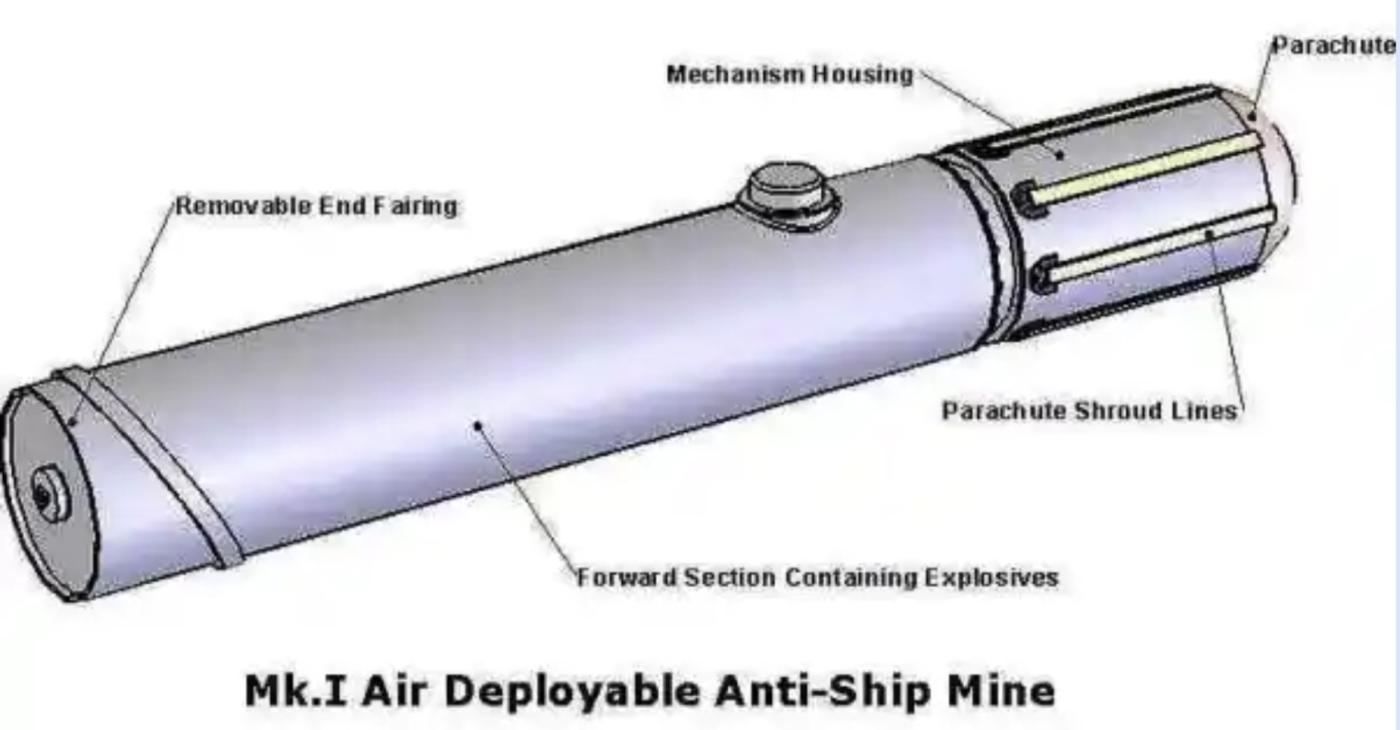
British mines were deployed in several ways. Surface minelayers laid defensive minefields around the British Isles to guard against invasion and protect key harbors. Submarines were also used offensively to lay mines covertly in enemy waters. Perhaps most dramatically, the Royal Air Force conducted extensive aerial mining operations known as “Gardening.” Bomber aircraft such as the Avro Lancaster carried large sea mines fitted with parachutes and dropped them into shipping lanes, harbor entrances, and estuaries under cover of darkness. Once in the water, the mines armed themselves and settled into position.
Production figures for individual mine marks are not always clearly separated in surviving records, but overall British wartime mine production ran into the hundreds of thousands. Over the course of the war, the Royal Navy and Royal Air Force laid well over 250,000 mines in both defensive and offensive operations. This massive mining effort had a significant strategic impact. Axis shipping was forced into predictable swept channels, slowed by constant minesweeping requirements, and subjected to continual risk in coastal waters.
In terms of results, British and Allied naval mines sank or damaged well over a thousand Axis vessels during the war. These included merchant ships, auxiliary vessels, destroyers, and submarines. It is difficult to assign exact sinking totals to a specific mine mark like the Mark XVII or the M Mark I because ships were often lost in established minefields without precise identification of the individual device responsible. Nonetheless, mines were among the most cost-effective naval weapons of the conflict. A relatively inexpensive device, once laid, could sit silently for months and destroy a ship worth millions.
An interesting aspect of British mine warfare was the constant technological duel between mine designers and minesweepers. As Britain introduced magnetic mines, countermeasures such as degaussing cables were developed to reduce ships’ magnetic fields. In response, more sophisticated mines were designed with delayed arming mechanisms, ship-counting features, and combined magnetic-acoustic triggers to defeat sweeping attempts. This underwater arms race continued throughout the war.
Another notable point is that mining was often strategically decisive without a single explosion occurring. The mere threat of mines could close ports, disrupt supply lines, and force extensive diversion of enemy resources to minesweeping operations. In this sense, the psychological and economic effects of British mines were as important as the ships they physically destroyed.
By the end of the war, Britain had established itself as one of the world leaders in naval mine technology. The experience gained at establishments like HMS Vernon and in the vast wartime production programs shaped postwar mine development for decades. Though overshadowed in popular memory by battleships and aircraft carriers, the British sea mine—whether contact types like the Mark XVII or influence types like the M Mark I—was one of the quiet but decisive weapons of the Second World War.