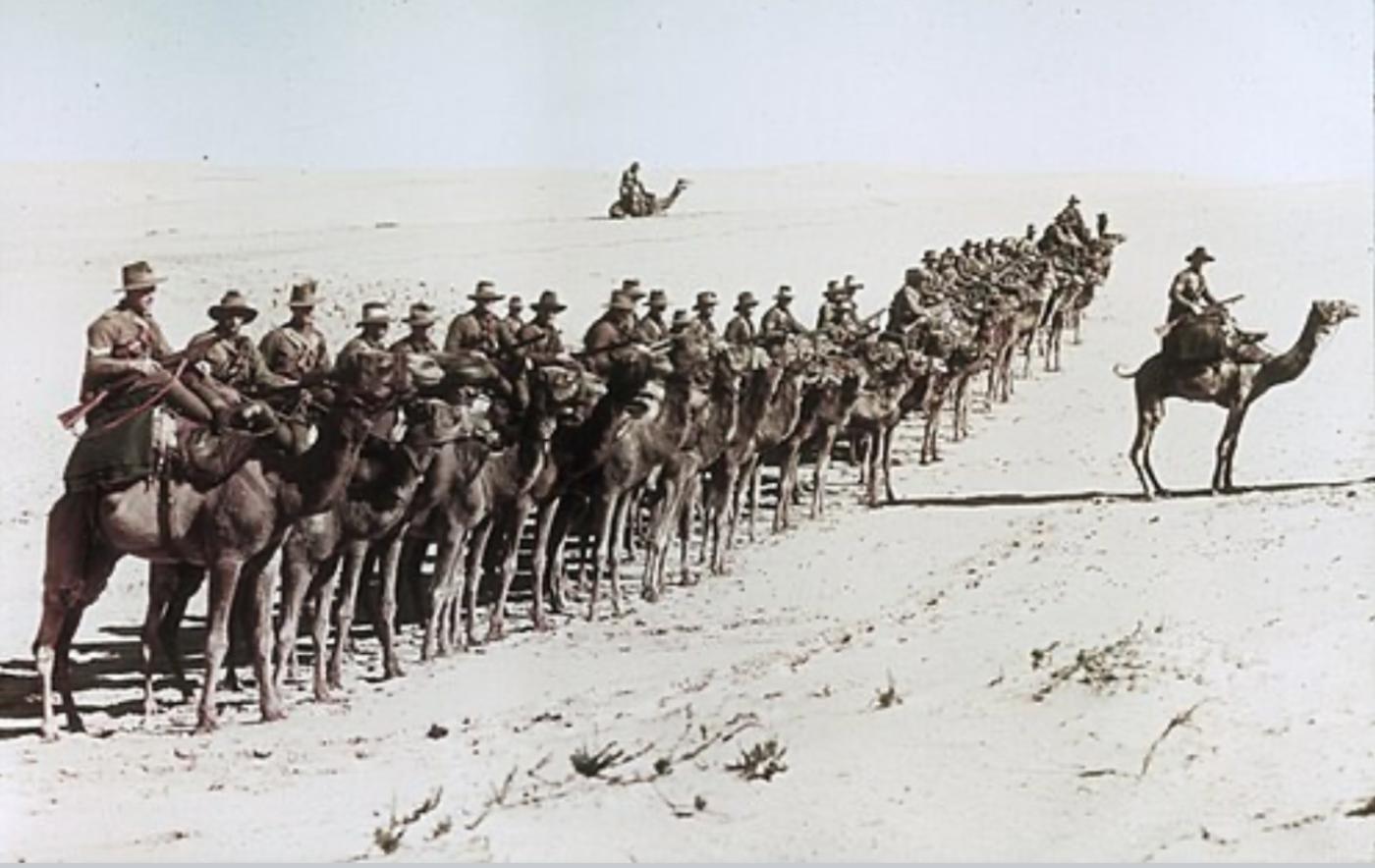
Imperial Camel Corps
The Imperial Camel Corps was formed in 1916, during one of the most demanding phases of the First World War, when the British Empire needed a highly mobile force capable of operating deep in the deserts of Egypt, Sinai, and later Palestine. It emerged from the early fighting against the Senussi and the Ottoman Empire, where small mounted camel patrols had already proven that camels could carry men, equipment, and supplies farther and faster through harsh terrain than horses or motor vehicles. What began as scattered local units quickly evolved into an organised multinational corps intended to give the British Empire an advantage in mobility, scouting, and desert warfare.
The men who made up the Imperial Camel Corps came from across the empire, though the majority were from Australia and Britain, with significant contributions from New Zealand and India. Australian soldiers formed the largest contingent, initially drawn from the Australian Light Horse and infantry battalions already serving in Egypt. Many of these men had been wounded at Gallipoli and were reassigned to desert duties after recovering. British recruits were often yeomanry or men experienced in mounted service, while the New Zealand Mounted Rifles supplied skilled riders and scouts. Indian troops, especially from the Bikaner Camel Corps, added vital experience in camel handling and long-distance desert operations. By 1917 the corps had grown to roughly 4,000 men organised into four main battalions, each with its own camel companies trained to fight either mounted or on foot.
Training these units required a blend of military discipline and specialist desert knowledge. Much of the instruction was conducted in Egypt, particularly around Abbassia and later the Suez Canal region, where the terrain allowed realistic preparation for long patrols and harsh conditions. British officers were responsible for military drill and battlefield tactics, but the actual teaching of camel management fell to experienced Egyptian, Sudanese, and Indian cameleers who could instruct new recruits in loading, riding, saddling, and caring for the notoriously stubborn but resilient animals. Soldiers had to learn to travel for hours in extreme heat, survive with minimal water, and fight after long desert marches. Camels enabled the men to carry heavier weapons, such as the Lewis gun, into areas that horses could not reach, giving the corps a unique battlefield role.
Command of the Imperial Camel Corps was held by Brigadier General Clement Leslie Smith, a former Royal Artillery officer and recipient of the Victoria Cross. Smith was known for leading from the front and for understanding the special nature of his men’s work. Under his direction the corps took part in many of the key campaigns of the Sinai and Palestine theatre, including the battles of Magdhaba and Rafa in late 1916 and early 1917. Their mobility made them effective in cutting off enemy retreats and raiding Ottoman outposts. They were also heavily involved in the advance toward Gaza and later the push into Palestine, where their endurance proved vital in outflanking entrenched positions.
The Imperial Camel Corps was used for reconnaissance, raiding operations, long-range patrols, and direct fighting on foot once engagements began. Camels gave the troops the ability to move silently at night and to carry enough food and ammunition for extended operations far beyond normal supply lines. Despite this advantage, the corps endured extreme hardship. Sandstorms, heat, dysentery, and the sheer exhaustion of desert marches made service gruelling. Yet many soldiers later recalled that camels, though temperamental, were far more dependable than other forms of transport in the desert. One interesting detail often mentioned in diaries is that camels could smell water many miles away, occasionally leading entire columns toward hidden wells long before scouts had identified them.
By mid-1918 the strategic needs of the campaign changed. Motorised vehicles and horses became more practical as the fighting moved north into more temperate terrain. The Imperial Camel Corps was gradually broken up, and many of its men transferred into the newly formed 5th Australian Light Horse Brigade and other mounted units for the final offensive against the Ottoman Empire.
Though it existed for only a short period, the Imperial Camel Corps left a lasting impression. Its multinational composition, its extraordinary endurance, and the unusual partnership between soldiers and camels created one of the most distinctive fighting formations of the First World War. The men who served in it carried memories of a style of warfare that has almost no modern equivalent, a blend of ancient desert travel and modern industrial combat fought across some of the harshest landscapes of the war.