Humber Pig
The Humber Pig was one of the most recognisable armoured vehicles used by British security forces during the Northern Ireland conflict known as the Troubles. Officially designated the Humber Armoured Personnel Carrier, it became universally known as the Pig, a nickname that reflected both its ungainly appearance and the mixed feelings many soldiers and police officers had about serving in it. Despite its shortcomings, it played a central role in internal security operations for more than three decades.
The vehicle was designed in the late 1950s by the British company Humber at a time when the British Army was looking for a simple, rugged armoured vehicle for use in colonial and internal security roles. It was not originally intended for Northern Ireland, but rather for operations in places such as Cyprus and Aden, where troops needed protection from small arms fire and thrown explosives while patrolling hostile urban areas. When violence escalated in Northern Ireland from 1969 onwards, it was already in service and was quickly pressed into widespread use.
Manufacture took place in the United Kingdom, with production spread across several years. Exact numbers vary, but it is generally accepted that around 1,000 vehicles were built in total, including several variants and rebuilds. Many early examples were later refurbished or rebuilt on new chassis, extending their service life well beyond what had originally been planned. Both the British Army and the Royal Ulster Constabulary operated the vehicle extensively.
Mechanically, it was based on a commercial truck design, which kept costs down but also imposed limitations. Early versions used a Rolls-Royce B-series petrol engine, later replaced in many vehicles by diesel engines to reduce fire risk and improve reliability. Power output was modest, and when combined with the vehicle’s considerable weight this resulted in slow acceleration and a low top speed. Crews frequently complained that it was underpowered, particularly on hills or when fully loaded, a common situation during riot control operations.
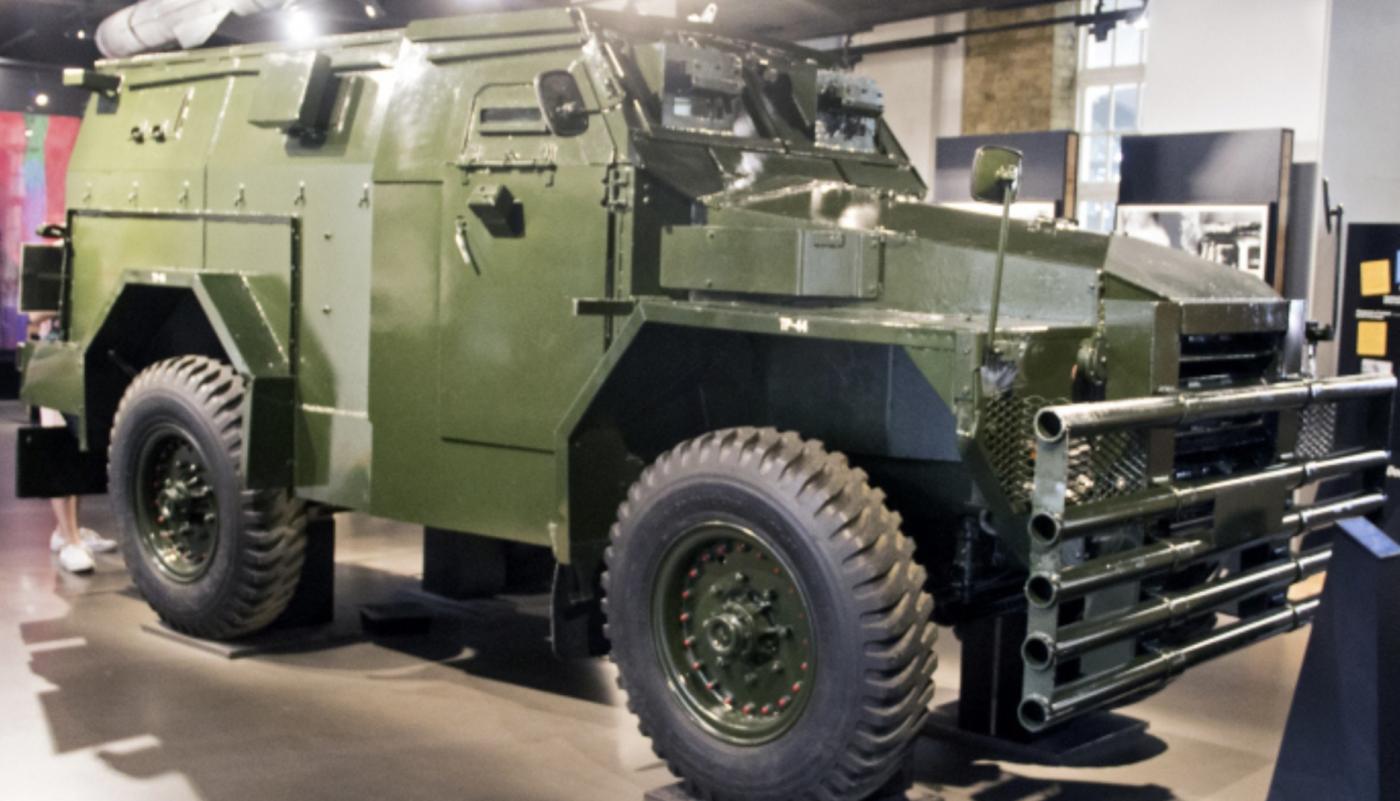
Armour protection was basic by military standards but adequate for its intended role. The hull was constructed from steel plate, typically around 8 to 12 millimetres thick, enough to stop small arms fire, shrapnel, and most petrol bombs. The flat-sided design made it relatively easy to manufacture but also meant it offered little ballistic shaping, so impacts were absorbed directly rather than deflected. Windows were small and fitted with thick armoured glass, often further protected by steel grilles.
One of its primary roles in Northern Ireland was crowd control and riot suppression, and it was fitted accordingly. Many vehicles were equipped with firing ports along the sides, allowing troops inside to deploy baton rounds if required. Some versions carried a roof-mounted cupola or turret position, though this was usually unarmed and used mainly for observation. Wire mesh screens were often added to protect vulnerable areas from stones, bricks, and incendiary devices. Its sheer bulk and noise also had a psychological effect, making it an effective tool for pushing through barricades and dispersing crowds.
The standard crew consisted of two men, a driver and a commander, with space in the rear compartment for around eight to ten fully equipped soldiers or police officers. Access was usually through a rear door, which allowed troops to disembark directly into cover provided by the vehicle. Inside, conditions were cramped, noisy, and uncomfortable, especially during long patrols. Ventilation was poor, and in the event of a fire or serious attack escape could be difficult, a factor that contributed to its unpopularity with those who had to use it regularly.
Over time, it acquired a formidable reputation, both among the security forces and within the communities where it operated. It became a symbol of the British Army’s presence in Northern Ireland and was frequently targeted with petrol bombs, nail bombs, and later improvised explosive devices. Although vulnerable by modern standards, it proved remarkably resilient, and many survived repeated attacks with little more than cosmetic damage.
By the late 1990s it was clearly obsolete. Advances in weaponry, changes in policing philosophy, and the introduction of more modern armoured vehicles finally led to its withdrawal from service. Even so, its long operational life and distinctive appearance ensured its place in the history of the Troubles, remembered as much for what it represented as for its practical role on the streets of Northern Ireland.