Historical Event
Every year, 4th July is remembered as the birthday of the United States of America, but the story behind that date is far more dramatic than a simple signing ceremony. It was the moment when thirteen British colonies in North America declared that they were no longer colonies at all, but free and independent states. What makes it so important is that this was not merely a political argument written on paper. It was an act of open rebellion against one of the most powerful empires in the world, and every man who supported it knew that failure could mean ruin, imprisonment, or even death as a traitor.
The road to independence had been building for years before 1776. The thirteen colonies had grown wealthy, confident and increasingly resentful of British control. Many colonists still thought of themselves as loyal British subjects, but they believed they were being treated unfairly by a distant government in London. Taxes were imposed to help pay for Britain’s debts after earlier wars in North America, yet the colonists had no elected representatives in the British Parliament. The phrase “no taxation without representation” became a powerful rallying cry. To many Americans, it was not just about money; it was about liberty, rights and whether free people could be governed without their consent.
Tension turned into violence in 1775 when fighting broke out at Lexington and Concord in Massachusetts. British troops had marched to seize colonial weapons, but local militia resisted. What began as a confrontation soon became a war. The battles that followed made it clear that the dispute could no longer be solved by petitions and polite arguments. The colonies were now in armed conflict with Britain, and the question facing their leaders was enormous: were they fighting merely for better treatment inside the empire, or were they fighting to create a new nation?
In Philadelphia, delegates from the thirteen colonies gathered in the Second Continental Congress. These men were not all wild revolutionaries. Some were lawyers, merchants, planters and landowners who had a great deal to lose. Many were cautious at first, because independence was a dangerous step. Britain had the Royal Navy, a professional army, immense financial power and the loyalty of many Americans who did not want separation. Declaring independence was not a symbolic gesture. It meant accepting that there would be no easy road back.
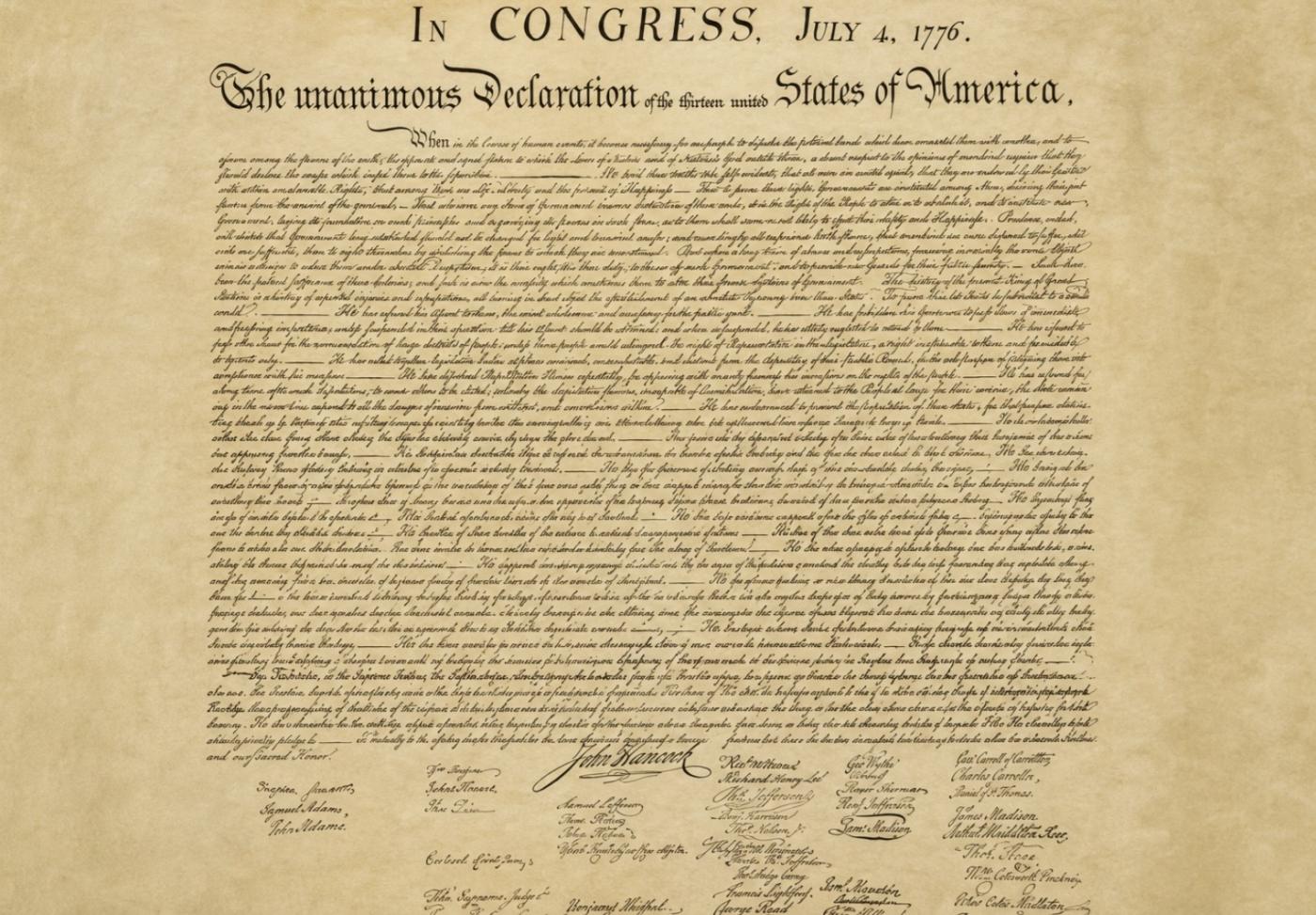
The most famous document to come out of this crisis was the Declaration of Independence. A committee was appointed to draft it, including John Adams, Benjamin Franklin, Roger Sherman, Robert Livingston and Thomas Jefferson. Jefferson, a young Virginian with a gift for elegant and forceful language, was chosen to write the main draft. He took ideas that had been discussed for years by political thinkers and colonial leaders and turned them into a statement that still echoes around the world.
The Declaration argued that governments did not exist by divine right or by force alone. It stated that people had natural rights, including life, liberty and the pursuit of happiness, and that government existed to protect those rights. If a government became destructive of those rights, the people had the right to alter or abolish it. This was a bold and dangerous idea in the eighteenth century. It challenged the old world of kings, empires and inherited authority.
The document then listed grievances against King George III, accusing him of abusing his power, interfering with colonial laws, keeping standing armies in the colonies, cutting off trade, imposing taxes without consent and waging war against his own subjects. Whether every accusation was fair in the eyes of Britain mattered less than the purpose of the Declaration: it was designed to explain to the world why the colonies believed independence was justified.
The date 4th July 1776 became famous because that was the day the Continental Congress formally adopted the final wording of the Declaration of Independence. A common misunderstanding is that all the delegates signed the document on that day. In reality, the decision for independence had already been voted on by most colonies on 2nd July, and the famous engrossed parchment copy was signed mainly on 2nd August 1776, with some signatures added later. But 4th July became the date remembered because it was the day the Declaration itself was approved and sent out as the public voice of the new nation.
Once adopted, the Declaration was printed and distributed. It was read aloud in towns and to troops, turning a political decision in Philadelphia into a public cause. For ordinary people, it gave meaning to the war. Soldiers were no longer simply resisting British rule; they were fighting for the birth of a nation. Farmers, craftsmen, merchants and militia men could now see the conflict as part of a larger struggle for liberty and self-government.
The thirteen colonies that declared independence were New Hampshire, Massachusetts, Rhode Island, Connecticut, New York, New Jersey, Pennsylvania, Delaware, Maryland, Virginia, North Carolina, South Carolina and Georgia. They were far from perfectly united. They had different economies, different religions, different local interests and different levels of enthusiasm for the war. Yet the Declaration gave them a shared identity. It said that they were no longer separate colonies complaining about British policy, but “Free and Independent States.”
The risk taken by the signers was very real. If Britain crushed the rebellion, the men who supported independence could have been hanged for treason. Their property could be seized, their families ruined and their names remembered as rebels rather than founders. Benjamin Franklin is often associated with the famous warning that they must all hang together, or they would surely hang separately. Whether the exact wording was recorded perfectly or not, the sentiment captured the danger of the moment.
The war that followed was long and brutal. Independence was not won by the Declaration alone. It had to be fought for through hardship, defeat, hunger, disease and uncertainty. George Washington’s Continental Army suffered terribly, especially during the winter at Valley Forge. British forces captured major cities, loyalists fought against patriots, and the outcome remained uncertain for years. The Declaration gave the cause its moral and political foundation, but victory required endurance.
France’s entry into the war was crucial. The Declaration helped show foreign powers that the American colonies were serious about independence and could be treated as a new political entity. French support brought money, supplies, troops and naval power. The war eventually turned decisively against Britain, especially after the American and French victory at Yorktown in 1781. Two years later, in the Treaty of Paris of 1783, Britain formally recognised the independence of the United States.
The importance of 4th July goes far beyond fireworks, flags and celebration. It marks one of the most important political moments in modern history. The Declaration of Independence helped popularise the idea that legitimate government depends on the consent of the governed. It influenced later revolutions, reform movements and independence struggles around the world. Its words did not create equality overnight, and the new nation itself contained deep contradictions, especially slavery, which remained a terrible stain on the promise of liberty. Yet the ideals written in 1776 became standards by which later generations would judge their own country.
That is what makes the story so powerful. A group of colonies, divided and vulnerable, dared to tell a global empire that they would govern themselves. They did so not after victory was certain, but while war was still raging and the final outcome was unknown. The Declaration of Independence was therefore not just a document; it was a gamble, a statement of belief and a challenge to the old order of the world. On 4th July 1776, the thirteen colonies gave their rebellion a voice, and that voice helped create the United States of America.